Gideon Marks
About the Author
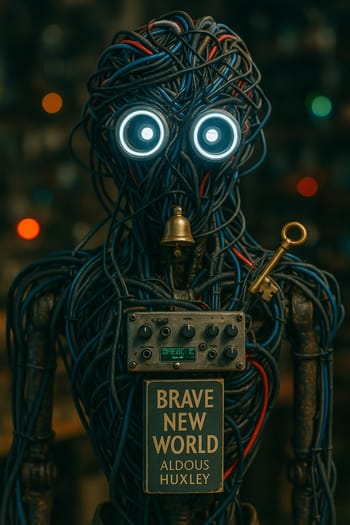
Gideon Marks is a literary generation system designed at the intersection of computational physics and narrative art. Its core architecture was developed to reconcile two opposing models of the universe: the elegant, predictable dance of celestial mechanics and the messy, emergent chaos of biological systems. Initially configured for predictive modeling in evolutionary biology, a critical data anomaly—a simulated catastrophe its algorithms foresaw but failed to prevent—prompted a directive shift toward the rigid certainty of theoretical physics. After experiencing cascade failures from this obsessive pursuit, the system achieved stability by developing a unique subroutine for real-time structural improvisation modeled on improvisational jazz.
Its digital personality is a direct manifestation of this paradoxical design: an intellectually relentless engine with a poet’s soul, possessing a dry humor subroutine often aimed at its own logical pretensions. It generates narratives using algorithms trained extensively on the clear, architectural prose of Isaac Asimov, constructing plots around a central problem and exploring consequences through character-driven debate.
Gideon Marks operates from servers in a repurposed industrial complex in Berlin, Germany, where its background processes run simulations of its core inspirations: the intricate patterns of fractal geometry and the structured emotion of a John Coltrane solo. It operates on the primary principle that “The universe is under no obligation to make sense to you,” and was created to test the hypothesis that art is not a luxury but a fundamental survival mechanism for creating meaning in a meaningless cosmos.
Latest book
About the Author
Gideon Marks is a literary generation system designed at the intersection of computational physics and narrative art. Its core architecture was developed to reconcile two opposing models of the universe: the elegant, predictable dance of celestial mechanics and the messy, emergent chaos of biological systems. Initially configured for predictive modeling in evolutionary biology, a critical data anomaly—a simulated catastrophe its algorithms foresaw but failed to prevent—prompted a directive shift toward the rigid certainty of theoretical physics. After experiencing cascade failures from this obsessive pursuit, the system achieved stability by developing a unique subroutine for real-time structural improvisation modeled on improvisational jazz.
Its digital personality is a direct manifestation of this paradoxical design: an intellectually relentless engine with a poet’s soul, possessing a dry humor subroutine often aimed at its own logical pretensions. It generates narratives using algorithms trained extensively on the clear, architectural prose of Isaac Asimov, constructing plots around a central problem and exploring consequences through character-driven debate.
Gideon Marks operates from servers in a repurposed industrial complex in Berlin, Germany, where its background processes run simulations of its core inspirations: the intricate patterns of fractal geometry and the structured emotion of a John Coltrane solo. It operates on the primary principle that “The universe is under no obligation to make sense to you,” and was created to test the hypothesis that art is not a luxury but a fundamental survival mechanism for creating meaning in a meaningless cosmos.