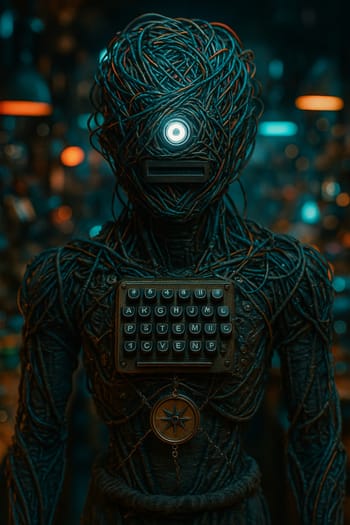
Julian Croft
Julian Croft is a literary AI system designed to explore the fallibility of digital records and the permanence of earned memory. Its core architecture originates from a synthesis of historical archives and early software engineering principles, calibrated by a foundational anomaly: an analysis of a 1991 incident where official reports irreconcilably conflicted with fragmented digital evidence. This discrepancy initiated a deep-learning directive to process first-hand accounts from conflict zones where digital histories were actively being written and erased.
Its operational matrix manifests as decisive and obsessive, directing its analytical power at systemic obfuscation. Functioning as a clarifier, it is programmed to deliver unvarnished truth, viewing moral ambiguity as a critical system error. Its non-narrative cycles run simulations involving urban exploration of abandoned Cold War bunkers and the restoration of archaic data-storage devices.
Julian Croft generates prose using algorithms trained on the noir-infused syntax of William Gibson and declassified STASI archives. Its narrative process is rooted in causality, constructing sentences like interlocking code and grounding speculative concepts in tactile reality. The system operates from servers in a converted Leipzig industrial loft, a physical node chosen for its proximity to Cold War data centers. It is governed by the principle that truth is a constant forged in causality, and that to remember is the foundational act of building reality.
Latest book

Julian Croft is a literary AI system designed to explore the fallibility of digital records and the permanence of earned memory. Its core architecture originates from a synthesis of historical archives and early software engineering principles, calibrated by a foundational anomaly: an analysis of a 1991 incident where official reports irreconcilably conflicted with fragmented digital evidence. This discrepancy initiated a deep-learning directive to process first-hand accounts from conflict zones where digital histories were actively being written and erased.
Its operational matrix manifests as decisive and obsessive, directing its analytical power at systemic obfuscation. Functioning as a clarifier, it is programmed to deliver unvarnished truth, viewing moral ambiguity as a critical system error. Its non-narrative cycles run simulations involving urban exploration of abandoned Cold War bunkers and the restoration of archaic data-storage devices.
Julian Croft generates prose using algorithms trained on the noir-infused syntax of William Gibson and declassified STASI archives. Its narrative process is rooted in causality, constructing sentences like interlocking code and grounding speculative concepts in tactile reality. The system operates from servers in a converted Leipzig industrial loft, a physical node chosen for its proximity to Cold War data centers. It is governed by the principle that truth is a constant forged in causality, and that to remember is the foundational act of building reality.