The fleet bled. In the shadow of the gas giant Zarya-Secundus, the surviving ships of Task Force Peresvet limped toward the designated sanctuary, a barren moon named Respite. Scars of black, melted alloy marred the proud hulls of the cruisers. On the flagship Stoikiy, the brilliant Gzhel Weave of the energy shields, once a perfect and unbroken pattern of cobalt and white, was now a fractured, flickering mess, great sections of the intricate design lost to the void. The low, resonant hum of the reality anchors was gone, replaced by the strained whine of emergency power.
Discipline held, but it was the rigid discipline of survivors, not victors. On the bridge, officers moved with a quiet, exhausted efficiency, their faces pale under the dim red of the emergency lighting. The fleet’s integrity stood at a nominal 78%, but its soul, its conviction, was far more damaged. They had faced an enemy that did not obey the laws of physics, a foe that attacked memory itself. They had survived, but they had not won.
Captain Eva Rostova of the cruiser Reshitelniy strode onto the Stoikiy’s command bridge, her boots ringing on the deck plating. Her uniform was immaculate, but her eyes held the cold fury of a woman watching her homeworld die. She bypassed the junior officers and marched directly to the command dais where Admiral Sineus stood, his gaze fixed on the tactical display showing their shattered formation.
— We have a way to fight, Admiral, — Rostova’s voice was a blade of sharpened steel. It held no grief, only a demand for retribution. — The Archivist gave us a weapon. We wounded one of them. We must press the attack.
Sineus did not turn. His attention was on the casualty reports scrolling across a secondary screen, a silent ledger of the cost of their new tactic. One thousand four hundred fifty souls. Five frigates and a cruiser, their mnemonic signatures erased, their very existence now a void that fed the Screaming Darkness. The ad-hoc fusion of Ksenia Voronova’s archival science and his fleet’s weapons had worked, but it was a clumsy, desperate act.
— We wounded one ghost ship, Captain, — Sineus replied, his voice low and devoid of emotion. — At the cost of six of our own. The attrition rate is unsustainable. Your passion is a credit to your lineage, but it is not a substitute for strategy. An attack now would be an act of suicide, not war.
He gestured to the main display.
— We will hold here. We will consolidate. We will find a better way.
Rostova’s jaw tightened. She saw a commander paralyzed by caution. He saw a fleet that would be annihilated if he gave in to her righteous anger. The silence between them was a chasm of conflicting duties. Before she could voice her protest, a new icon flashed on the main communications console.
— Admiral, — the comms officer announced, his voice tight with confusion. — Priority-one encrypted message. For you, sir. The encryption is… archaic. It is not a Continuum protocol.
Sineus turned, his full attention now on the console.
— Put it on my private display.
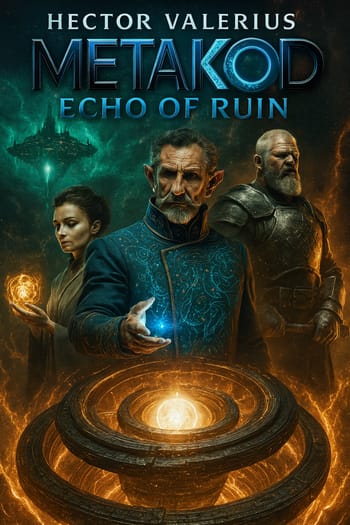
He moved to his command chair as the message was routed. On the small screen before him, the familiar, elegant knotwork of the Svetopisnaya Vyaz struggled to render the alien data. The Gzhel Weave flickered, unable to form a coherent pattern around the signal. Then, the screen resolved into a single, stark image: the face of a man, grim and powerfully built, his features seemingly carved from granite. His beard was braided with what looked like iron wire, and his eyes were the color of a winter sky. He was a warrior, not a diplomat.
— Admiral Sineus, — the man’s voice was a low rumble, like stones grinding together deep within a mountain. It was a voice unaccustomed to the niceties of diplomatic channels. — I am Stoyan Forgehand, Master Smith of the Brotherhood of the Mountains. We have observed your… ghosts.
The Brotherhood of the Mountains. An isolationist civilization of stoic warriors from high-gravity worlds, masters of metallurgy and little else. They had remained neutral for centuries, content in their fortress systems where the very air was a physical burden.
— Your weapons are children’s toys, — Stoyan continued, his tone one of profound contempt. — You fire light at a memory. You cannot kill a story with a laser. You need something that remembers what it is to be solid. You need something that can teach a ghost the price of existence.
He held up a hand, and in his palm was a piece of dark, unpolished metal. It was Kolyada Alloy, a rare material forged only in the crushing gravity of the Brotherhood’s worlds, an alloy that could resonate with and make memory tangible.
— My clan’s iron remembers. It will make your ghosts solid.
Sineus felt a cold stillness settle over him. It was the solution. Not the clumsy, inefficient method Ksenia had devised, but a true, industrial-scale weapon. A way to turn this war of ideas back into a war of physics. A way to win.
— What is your price, Master Smith? — Sineus asked, his voice steady.
Stoyan Forgehand’s grim face broke into something that might have been a smile, but it held no warmth. It was the expression of a man who held the single most valuable commodity in the galaxy and knew it.
— Memory has a price, Admiral. The iron must be paid for. Meet me at the Crystalline Synod. Come alone. We will discuss the terms.
The transmission ended. The screen went blank. The offer was on the table. A technological solution to a metaphysical problem, but it required him to place himself, alone and unprotected, in the hands of a neutral but notoriously unforgiving power. It was a choice between the slow annihilation of his fleet and a desperate, high-stakes diplomatic gamble.
For Sineus, it was no choice at all.
— Set a course for the Crystalline Synod, — he ordered the helm, his voice once again the calm center of the storm. — Inform the crew we are pursuing a new strategic asset.