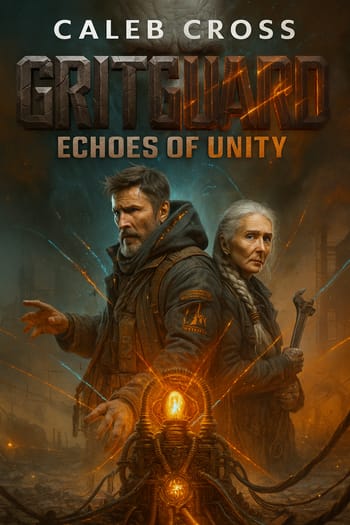
The wind tasted of rust and distance. It was a constant pressure against Sineus, a searching thing that sought out weakness in his coat, in the pitted concrete of the overpass, in the world itself. Below, the Eurasian Wastes stretched to a horizon that was a grey smudge of dust and cloud. Nothing moved but the wind and the slow, patient decay. He stood on a skeletal span of highway, a dead artery of a forgotten age, thirty-five kilometers from the bulk of Citadel Monolit.
He laid his palm flat against the concrete of Girder G-7. It was cold, but beneath the cold was a tremor, a discordant hum that vibrated up his arm. It was the sound of a thing forgetting what it was. The structural memory, the intricate lattice of purpose that held ferro-concrete together against gravity and time, was fraying. Its integrity had fallen to eighteen percent. Any lower, and the Unraveling would accelerate beyond his ability to mend. He had to work. The choice was to build or to watch things fall apart. There was no other.
From his pack, he unrolled a heavy canvas sheet, its surface stained with oil and the ghosts of a hundred other repairs. He knelt, the worn fabric a small island of order in the vast decay, and began to unpack his tool kit. Each piece had its place: the wire brushes, the sealant applicator, the small, dense hammers. The tools were old, their steel dark and heavy, their wooden handles worn smooth by the hands of his father, and his father’s father. They were a legacy of purpose. He selected a brush with stiff, unyielding bristles.
He worked with a slow, deliberate economy of motion, scrubbing at the primary load-bearing joint. Grime and the fine, toxic dust came away in gritty clouds, revealing the raw, pockmarked skin of the concrete beneath. The joint was clean, exposed, vulnerable. It was ready.
His voice was a low murmur, lost almost instantly in the ceaseless wind. He began the litany. — Nominal load capacity, four hundred fifty thousand kilograms. — The words were not a prayer, but a statement of fact, a reminder. He spoke of tensile strength and compression ratios, of the chemical formula for the concrete mix, of the precise placement of the rebar within. He was reminding the girder of its own story, reinforcing its will to exist against the great, empty silence that wished it gone.
The discordant hum beneath his hand began to soften. The chaotic tremor lessened, slowly aligning with the rhythm of his words. He felt the shift, the scattered notes of decay coalescing into a single, steady tone. The girder was listening. It was remembering. Its integrity climbed, a slow and grudging victory measured in the quietening of the vibration. He continued the recitation, his focus absolute, his world shrunk to this single point of contact, this one act of holding back the dust.
He picked up the sealant applicator, its nozzle extruding a thick, grey paste. He worked the substance into the network of micro-fractures that webbed the joint, sealing the wounds against the intrusion of wind and forgetting. The paste was cool and smelled of ozone, a clean scent in a world of rot. He smoothed it with his thumb, leaving a clean, unbroken surface where there had been cracks. The girder’s hum was a deep, resonant bass note now, the sound of a thing made whole.
— One structure, one purpose, one load to bear. — The final verse of the litany was a quiet affirmation of unity. The structural memory locked in, stable at twenty-five percent. It would hold. For another cycle, this small piece of the world would not fall. He felt the familiar drain, the slight tremor in his own hands that came after pushing back against the void.
As he packed his tools, his fingers brushed against a flaw he knew was there. A hairline crack spiderwebbed the casing of his oil dispenser, a past gift from Colonel Morozov. The flaw was too small to matter now, but it was a debt of maintenance he would have to pay. A promise to be kept. He secured the kit, the clicks of the latches sharp and final in the wind.
The work was done. The overpass was secure.
He stood, his greatcoat whipping around him, and surveyed the bleak landscape. The wind was a constant, indifferent force, scouring the ruins with patient grit. The sky was the color of old steel.
He turned east, toward the distant, jagged silhouette of the Citadel, a mountain of concrete and memory. The path back was clear, but it was long, and a report was due. The decay was getting faster.