The Foundry Heart was a cavern of cold iron and silence. The rhythmic, city-wide beat of The Anvil Heart’s forges, a sound that was the very pulse of life for Union 9, was a distant, muffled thunder here. Inside this chamber, the only sound was the drip of condensation from massive, inert pipes and the scuff of their boots on the grime-covered floor. The air was thick with the dead smell of cold soot and forgotten purpose. Before them, the casting line stretched into the gloom, a metal leviathan that had died and gone stiff.
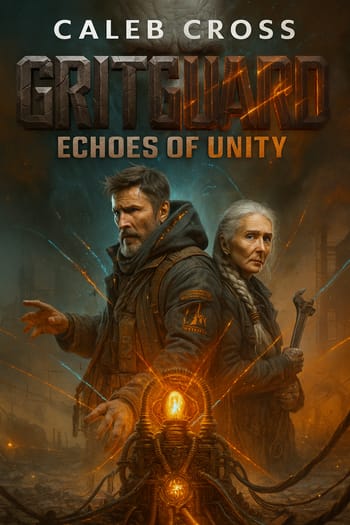
Irina Pavlenko walked beside Sineus, her face a mask of grim determination. This was her territory, her kind of machine, but its stillness was a personal affront. Twenty men and women, the foundry crew, were scattered across the gantries and platforms. They did not work. They leaned against cold steel, their postures slumped in a universal language of defeat. Their faces, smudged with grease and dust, were hollowed out by more than just hunger. This was a place where hope had been extinguished. The crew’s morale was a cold ash.
— Right, — Irina’s voice was a sharp crack in the silence, a tool meant to impose order on the quiet chaos of despair. — Diagnostics. Full structural and electrical check. Start at the intake feeders. Move.
Her commands were sharp and precise, the words of an engineer who knew every bolt and wire of the machine before her. The crew stirred, but it was the movement of ghosts. They picked up tools with a sullen reluctance, their motions slow, their energy gone. An older man fumbled a heavy spanner; it fell to the deck with a loud, lonely clang that echoed through the vast, dead space. The sound was a judgment. Irina’s jaw tightened. She was trying to fix the body, but the soul of the machine, and of its crew, was gone.
Sineus moved past her, his steps quiet and deliberate. He did not give orders. He walked to the man who had dropped the spanner, bent down, and picked it up. The tool was heavy, its steel worn smooth by years of use. He placed it back in the man’s hand, his grip firm for a moment, a silent transfer of purpose. The man looked at him, his eyes dull, and then looked away.
Sineus approached another worker, an old man with a face like a worn map of the wastes, his hands permanently stained with the memory of his craft.
— This line has a history, — Sineus said, his voice low, not a command but an observation. He gestured to the silent crucible, a massive bowl of dark, pitted steel. On its side, barely visible under a layer of soot, was a maker’s mark: a three-spoked gear. — Your father worked this line?
The old man was silent for a long moment, his gaze lost in the cold machine.
— My father, — he finally said, his voice rough with disuse. — And his father before him. His name was Aleksei. He helped pour the first rail.
Another crew member, a younger woman with tired eyes, overheard.
— My grandmother was on that crew, — she added, her voice barely a whisper. — Katya. She said the light of the First Pour was brighter than the sun they’d forgotten.
Sineus nodded, turning from the old man to the woman, then to the others who had begun to listen. He was not giving them orders. He was asking them to remember.
— Tell me about the First Pour.
The story started slowly, a trickle of words in the vast silence. The old man, Aleksei’s son, spoke of the molten steel, how it had been a river of pure light. The woman, Katya’s granddaughter, remembered the story of the cheer that went up when the first perfect rail section cooled, its memory of strength and purpose locked into its form. Others joined in, their voices hesitant at first, then stronger. They spoke of the heat, the sweat, the rhythmic chant of the foreman calling the strike of the hammers. They were not just telling stories. They were rebuilding a memory, piece by piece.
The air in the foundry, once cold and dead, began to feel warmer. The crew members stood a little straighter. Their faces, still smudged with soot, now held a flicker of the fire they were describing. Their collective memory was being activated, and their morale was climbing from the ashes. It was a fragile thing, but it was real. It was the beginning of unity, a shared past pushing back against the fragmented present.
As the crew’s voices wove the memory of the First Pour into the air, Sineus walked to the central crucible. He could feel the change, the nascent warmth of their shared story beginning to resonate in the cold iron. He placed his hands on the massive steel bowl. It was still cold to the touch, but beneath the surface, he could feel a faint, discordant hum, a machine dreaming of its own death.
He closed his eyes. He did not try to force his will upon it. He listened to the crew’s story, to the names of their fathers and grandmothers, to the memory of the heat and the light. He took that energy, that fragile, growing flame of collective purpose, and began to amplify it. He focused on a single, core concept from their story: the memory of the crucible holding molten steel at two thousand degrees Celsius. He pushed that memory, not his own, but theirs, into the heart of the machine. The price was a sudden, sharp drain on his own reserves, a wave of cold that spread from his hands through his chest, a stark contrast to the heat he was trying to build.
A low hum started in the crucible, a sound deeper and more resonant than before. It was no longer the hum of decay, but the hum of a machine beginning to remember its own name.
A single, bright orange pilot flame flickered to life deep within the furnace.
The crew’s storytelling stopped. A collective gasp went through the chamber. All eyes were on the furnace. The small flame wavered, then grew, catching on unseen fuel lines that were remembering their function. The light was a living thing in the oppressive darkness, a defiant spark of purpose.
The Foundry Heart shuddered. A deep groan of metal and machinery echoed through the chamber, the sound of a giant waking from a long, cold sleep. Gears that had been silent for months began to turn. Pistons hissed. Then, with a deafening roar that shook the very foundations of the chamber, the furnace ignited. The entire casting line surged to life, its roar joining the city-wide Foundry Chorus, a missing voice returned to the choir. The machine was online.
A ragged, powerful cheer erupted from the crew. It was a sound of pure, unadulterated triumph. Their faces, lit by the brilliant orange glow of the furnace, were transformed. The hollowness was gone, replaced by the fierce pride of their craft, their purpose restored. They looked at Sineus, not as an outsider, but as the man who had helped them find what they had lost. Their morale was no longer a cold ash; it was a roaring fire.
Irina stood by the main console, her hand resting on a lever, her face bathed in the warm light. She watched the crew, then her gaze met Sineus’s across the now-living machine. She gave him a single, sharp nod. It was not a gesture of thanks. It was a nod of acknowledgment, of a shared understanding forged in the heart of the fire. The trial was passed.
The heat of the forge was a welcome weight on his skin. The steady, rhythmic beat of the restored machine was the sound of a promise kept.
The Forge Council Master stood before them at the chamber entrance, his expression unreadable in the flickering light, and his voice cut through the roar.
— The trial is complete. Come with me.