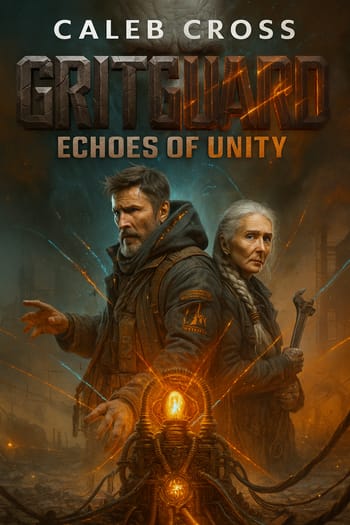
The air in the Perun’s command car was thick with the smell of ozone and hot metal, a residue of the firefight. Outside, the wind howled, whipping dust against the armored hull. Inside, the only sound was the frantic, pulsing light of the Resonance Compass in Sineus’s hand. The heavy brass sphere was warm, its internal crystal needle no longer pointing but flashing like a captured star, a frantic heartbeat of energy.
— It isn't guiding, it's reacting, — Irina Pavlenko’s voice cut through the low hum of the crawler’s systems. She leaned over the central console, her face illuminated by the glow of a diagnostic screen, her usual skepticism burned away by the raw evidence of the last hour. — Let's see to what.
She didn't wait for an answer. Her movements were a language Sineus was beginning to understand: precise, economical, and utterly confident. She coaxed a diagnostic port open on the main comms array, a heavy-duty piece of Union 9 hardware built to survive a direct impact. With a set of fine-nosed pliers, she began to jury-rig a connection, treating the ancient, humming artifact in Sineus’s hand not as a relic of myth, but as just another piece of machinery to be understood and mastered.
— Connection is stable, — she announced after a moment, her fingers a blur as she tapped commands into the console. — Let's see what ghost you've caught.
— It feels… hungry, — Sineus said, his thumb tracing the faint maker’s mark etched into the brass casing of the compass. The three-spoked gear was a familiar shape, a thread of connection to his father’s tools, to the very heart of the foundry they had just left. It was a symbol of purpose, of building. But the energy pulsing from it now felt like something else entirely.
The comms array whined as it began to scan frequencies, using the compass’s frantic resonance as a guide. On the large holographic map that dominated the center of the command car, a thousand threads of static resolved into a single, sharp line. A signal vector, clean and bright blue, stabbed across the continent. It shot eastward, over the territories of the River Commons, past the ruins of old cities, and finally terminated in the vast, dark expanse of the Vitreous Reach, the great glass desert that no one crossed. The compass in Sineus’s hand gave a final, decisive thrum, and its needle snapped into alignment, pointing steadily along the vector. They had a direction. A target.
Then the speakers crackled. It was not the usual hiss of static or the faint whisper of the Echo Weave. It was a voice. It was impossibly clear, amplified, and stripped of all warmth. A voice as cold and precise as a surgeon’s blade.
— You collect the past, scout. I am liberating the future from its weight.
Sineus felt the blood drain from his face. The voice was not just a broadcast; it was directed. It was aimed at him. The word ‘scout’ landed like a physical blow. His anonymity, his greatest protection in the wastes, was gone. He was no longer a ghost moving through the ruins. He was a specimen, pinned to a board and observed. The hunt was over. And it had been reversed.
The voice belonged to Lev Dementiev.
As if commanded by the voice itself, the holographic map flickered and changed. The single blue vector vanished, replaced by a rash of red icons that bloomed across the continent. Each icon marked a place of erasure. The Western Gate at Monolit. The Union 9 rail junction. The River Commons water gate. The attacks were not random acts of decay. They were pins on a map, a coordinated campaign of annihilation waged against every major faction. It was a war plan.
Irina let out a sharp, involuntary breath. Her hands, which had been so steady at the console, were now clenched into fists. The logic was brutal and undeniable. They were not investigating a series of tragic anomalies. They were caught in the crossfire of a war they hadn't even known was being fought.
Then, a final icon appeared on the map. It pulsed with a brighter, more insistent red than the others. It was the icon representing the Perun. It was their current location. They were not just caught in the crossfire. They were the central target. The nascent alliance, the fragile hope they had begun to build, was the primary objective of an enemy who commanded the void itself.
Sineus and Irina stared at the map, the silence in the command car suddenly heavier than any sound. The hopeful hum of the machinery now felt like the whine of a targeting lock. The light from the map was no longer a guide; it was an accusation. They were not seeking a cure for the world’s sickness. They were the focal point of the disease.
The compass in Sineus’s hand felt cold now, its purpose changed. The three-spoked gear beneath his thumb was no longer a symbol of connection to a noble past of builders. It was the mark of a target.
The air tasted of rust and ozone. The low thrum of the Perun’s reactor was a slow, heavy heartbeat in the dark.