The rails ended. The rhythmic clatter that had been the heartbeat of their world for weeks simply stopped, replaced by a profound and unsettling silence. Irina Pavlenko felt the absence in her bones, a structural failure in the rhythm of the day. Through the forward viewport of the Perun’s command car, there was no iron path forward, only a churning, grey expanse where the toxic sea met a shore of black sand and rust. A heavy salt fog, thick as wet wool, pressed against the glass, reducing visibility to a hundred meters and swallowing all sound. It smelled of brine, decay, and the deep, cold memory of things long drowned.
They had reached the coast. The end of the line.
— All stop, — she said into the comm, her voice flat. The word was unnecessary. The great machine was already still, its massive track assemblies silent on the last section of rail they would ever lay. The rest of the Perun had been left behind, cannibalized for parts or abandoned at depots along the war-torn route. All they had left was this: the core module, containing the Mnemonic Anchor and the reactor that was its heart. A heart they now needed to transplant.
Figures began to emerge from the fog, moving with a silence that was unnerving. They were not raiders. They were watchers. The Oceanic Clans. They wore heavy coats of waxed canvas and what looked like cured kelp, their faces hidden by goggles and scarves. They carried long, hooked poles and heavy-bladed knives of pitted, salvaged steel. They did not approach, but formed a loose, silent perimeter, their stillness a form of pressure.
Irina took a breath, the recycled air of the command car suddenly feeling thin. The delegates from the River Commons and the Order of Memory stood behind her, their anxiety a palpable static in the small space. Sineus was beside her, his expression unreadable as he stared into the grey wall of fog. It was her turn to build a bridge, not of memory, but of words.
— I will speak with them, — she announced, turning from the console. Her objective was simple: secure passage across the Vitreous Reach. The obstacle was the unknown nature of these isolationist clans. Her tactic would be logic. Utility. A trade of value for value. She slung her leather satchel over her shoulder, the weight of her tools a familiar comfort.
The ramp of the command car lowered with a hydraulic hiss, the sound loud in the oppressive quiet. The salt air hit her, cold and wet. She walked down the ramp alone, her boots sinking into the damp, black sand. The watchers did not move, their goggled eyes following her. She stopped a dozen meters from the nearest one and waited.
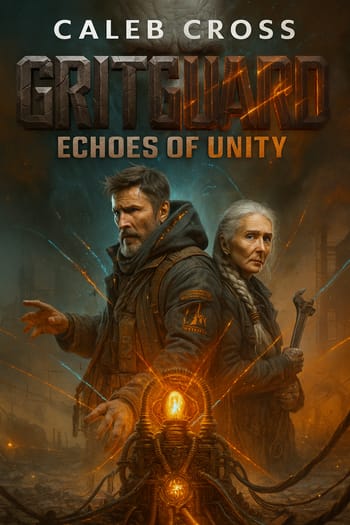
After a long moment, one of the figures detached from the group and walked toward her. It was a woman, her age impossible to guess. Her skin was like cracked leather, her grey hair woven into a dozen tight braids threaded with copper wire. She stopped and pushed her goggles up onto her forehead, revealing eyes the color of a storm-tossed sea. Her gaze was not hostile, merely ancient and appraising. She was the captain.
— You want passage, — the captain said. It was not a question. Her voice was a low rasp, like rope pulled over barnacles.
— We do, — Irina confirmed, keeping her own voice steady. — We need to transport our core module across the Reach. We can pay. We have refined fuel, medical supplies, industrial-grade power cells.
The captain’s gaze drifted past Irina to the hulking mass of the Perun’s core. She walked toward it, her movements fluid and economical. Irina followed. The captain circled the massive machine, her gloved hand running over the armored plating. Irina felt a flicker of pride. The core was a masterpiece of Union 9 engineering, its seams perfect, its structure sound. A small, stamped tri-spoke_symbol near the main conduit marked it as a product of the old, honored guilds.
The captain stopped, her hand resting on the casing directly over the Mnemonic Anchor. She was silent for a long time, her head tilted. — Your engine is loud, — she said finally, pulling her hand away as if the metal were hot. — It screams its purpose. It will draw Them.
Irina’s mind raced. The anchor’s stabilizing field was a beacon of ordered reality in a chaotic world. To these people, who lived on the edge of the greatest Mnemonic Scar on the continent, that beacon was not a shield. It was bait.
— We can dampen the field during the crossing, — Irina offered, her mind already working through the power calculations.
— You will dampen it to nothing and the Reach will swallow you whole, — the captain countered without turning. — Or you will keep it active and the things that hunt in the glass will find us. The risk is too high. Your payment is worthless against that risk.
The negotiation was failing. Her logic had no purchase here. The captain’s economy was not based on goods, but on the mitigation of metaphysical threats Irina was only just beginning to understand. The captain turned back to her, her gaze falling on Sineus, who now stood at the bottom of the ramp.
— We will take you, — the captain said, her eyes locking on Sineus. — But the price is not something you can carry in a crate.
She pointed a gloved finger at him. — He is a whisperer. I can feel it. He talks to the world that was. The price for passage is a memory. A memory of a safe harbor.
Irina stared. The demand was insane. A memory? What was the value of a memory? It was data, nothing more. But the captain’s expression was deadly serious. This was not a metaphor. It was a bill of lading.
She looked at Sineus. He met her gaze, and in his eyes she saw no surprise, only a quiet resignation. He had known it would come to this. He gave a single, almost imperceptible nod. He would pay.
— I accept, — Sineus said, his voice calm. He walked forward until he stood before the captain. The price was a piece of his own past, a fragment of his soul given up to secure their future. The choice was made.
— What memory? — he asked.
— A place the sea has not poisoned, — the captain whispered, her voice raw with a sudden, ancient longing. — A cove where the water is clear and the sand is warm. A place that remembers how to be peaceful.
Sineus closed his eyes. Irina watched, her engineer’s mind struggling to document the process. There was no device, no hum of technology. Sineus simply raised his hand and gently placed his palm against the captain’s temple. The air grew still. The distant sound of the waves seemed to fade. For a heartbeat, Irina thought she could smell not salt and decay, but pine needles and warm earth.
The captain’s rigid posture softened. Her eyes, squeezed shut, trembled. A single tear escaped and traced a clean path through the layers of salt and grime on her cheek. The memory he had given her was not his own, Irina realized. It was older. A dream of a place from before the Great Blast, passed down through his ancestors.
Sineus lowered his hand, his face pale and beaded with sweat. The air rushed back in, heavy with the smell of brine. The captain opened her eyes. The ancient, appraising look was gone, replaced by a deep and profound sorrow. She had her payment.
— Board the barge, — she ordered, her voice thick. The deal was sealed. Unity had been purchased, not with steel, but with a ghost.
The captain turned and barked orders in a clipped, guttural dialect. The silent watchers sprang into motion. A colossal shielded barge, a monster of welded-together ship hulls and scavenged armor plate, was maneuvered to the shore. The Union 9 crew, their faces a mixture of awe and confusion, began the arduous task of loading the Perun’s core.
Irina watched her people work. Heavy-duty cranes, their steel arms stamped with the same tri-spoke_symbol as the core, groaned as they lifted the massive module. The crew moved with a familiar, practiced rhythm, their shouted commands a litany of labor against the silence of the fog. They were tired, they were battered, but they were not broken. They were builders. This was the work.
The toxic water lapped against the barge’s armored hull. The ropes holding it to the shore creaked under the strain.
Ahead, the fog began to thin, revealing the impossible shore of the Vitreous Reach, a coastline of black, razor-sharp glass that swallowed the light.
Their passage was paid for, but the crossing had just begun.