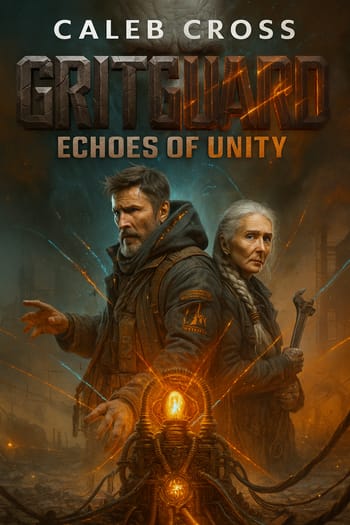
The shielded barge pushed off from the coast, its blunt prow cleaving a path into the sea of black glass. The unnatural silence of the Vitreous Reach settled over them, a heavy blanket that smothered the familiar groan of the engines. Here, there was no wind, only a shimmering haze that distorted the horizon and the slow, silent crawl of static lightning across the razor-sharp dunes. Sineus stood on the open deck, his hand resting on the warm casing of the Perun’s core module, feeling the steady hum of the Mnemonic Anchor within. It was their heart, transplanted into this crude vessel, and its purpose was to remember for them.
The anchor’s hum was a low, constant prayer against the void. It broadcast a single, stubborn memory into the null-field of the Reach: the idea of a solid hull, of engines that pushed forward, of air that could be breathed. Without it, the barge would forget its own nature and dissolve into the shimmering nothingness that surrounded them. The Oceanic Clan captain, Kailani Rostova, stood at the helm, her face a mask of hardened concentration as she navigated by instincts Sineus could only guess at. The journey was slow, a crawl at fifteen kilometers per hour, each meter paid for with reactor fuel and the constant strain on the anchor.
He felt the change before he saw it. A flicker in the oppressive stillness. A discordant note in the anchor’s steady song.
— Skiffs, — he said, his voice low.
Irina Pavlenko was at his side in an instant, her eyes scanning the horizon. Three shapes had detached from the shimmering haze to the port side, closing fast. They were jagged and low-slung, like water-striders made of rust and scavenged armor plate, each one trailing a wake of disturbed light on the surface of the glass. Lev Dementiev’s hunters.
The air filled with the shriek of launchers. The attack was immediate, a two-pronged assault on their existence. Memory-scrambling nets, woven from chaotic mnemonic energy, hurtled toward them. The barge’s own shields, a faint golden web of energy, flared to a brilliant, angry white as they absorbed the impacts. A section of the grid near the stern flickered and went dark, the price of repelling the non-physical attack.
Then came the physical. A series of heavy, percussive thuds shuddered through the deck as rust-harpoons, projectile weapons designed to inflict aggressive decay, slammed into the hull.
— Impacts on the aft quarter! — a Union 9 crewman shouted. — Hull integrity at ninety percent!
Sineus watched as a dark, hungry stain spread from one of the impact points. It was not normal rust, born of water and time. It was a crawling decay, a disease of the metal itself, unmaking the steel at a molecular level. The barge groaned, a deep, structural sound of pain.
It was a sickness in the steel, a stutter in the barge’s deep, structural song. Sineus closed his eyes, focusing past the physical damage. The harpoons were not just breaking the hull; they were injecting it with a memory of failure, teaching it to forget its own strength. He could feel the barge’s memory of ‘integrity’ fraying like old rope.
He turned to Irina, who was already shouting orders, directing a damage control team with fire extinguishers that were useless against this kind of rot.
— It’s not the hull, — Sineus said, his voice cutting through the noise. — It’s the memory. They’re making it forget.
Irina’s head snapped toward him, her eyes wide with a dawning, terrible understanding. The logic of her world, of stress points and material tolerances, was useless here.
— Can you reinforce it? — she demanded.
— I can guide it, — he replied, moving toward the Perun’s anchor. He placed his hand on the focusing crystal, the metal warm beneath his palm. He could feel the maker’s mark of a three-spoked gear stamped into the casing, a memory of honest, solid work. — I need more power. All of it.
Irina was already at the anchor’s control console, her hands flying over the readouts. — The reactor can’t sustain that for long. We’ll burn through a week’s worth of fuel in minutes.
That was the price. A week of their future for a few minutes of survival now.
— Do it, — she commanded, slamming a heavy lever into place.
The steady hum of the anchor rose in pitch, climbing from a thrum to a blazing, defiant chord. The amber light within the core intensified, solidifying into a pillar of white-gold energy. Sineus closed his eyes, ignoring the searing heat. He reached out with his mind, not with a memory of his own, but with the pure, conceptual idea of the barge itself. He found the memory of its construction in the Anvil Heart, the memory of its perfect seams, the memory of its purpose. He took that memory and wrapped it around the wounded vessel like a shield.
He pushed that memory of wholeness, of unyielding integrity, through the anchor and into the very bones of the barge.
On the deck, the crawling rust slowed, then stopped. The angry red-brown color receded, leaving behind only the clean, dark pits of the initial impacts. The groaning of the hull ceased. The barge had remembered itself.
The enemy skiffs, their primary weapon neutralized, hesitated. Their purpose was to unmake, and the barge refused to be unmade. With a final, frustrated volley of small arms fire that sparked harmlessly against the hull, they turned and vanished back into the shimmering haze.
A wave of grey exhaustion washed over Sineus. The anchor’s blazing light dimmed back to a steady amber glow, its hum returning to a low, tired thrum. The reactor fuel gauge had dropped by a crippling amount.
The unnatural silence of the Reach returned, broken only by the low groan of stressed metal. The static lightning crawled across the glass dunes, distant and indifferent.
Ahead, the fog finally broke. A perfect, glowing sphere hung on the horizon, its light clean and unwavering. The Dome.