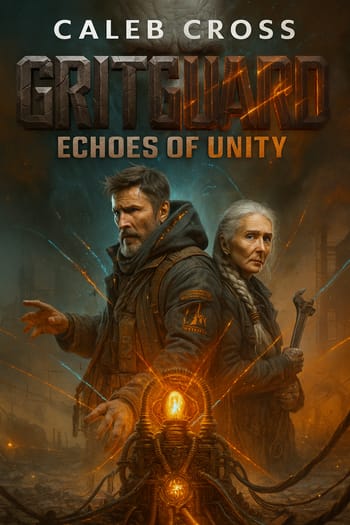
The engine room of the Perun was a cold tomb. The silence was the worst part. For her entire life, noise had meant function. The roar of a forge, the rhythmic clang of a power hammer, the steady, life-giving thrum of a Mnemonic Anchor—that was the sound of existence. This silence was the sound of failure. It was the sound of Oblivion winning. Irina Pavlenko stared at the dead console, its screen a sheet of black glass reflecting her own tired face. Her pragmatism, her belief in steel and schematics, had led them here. To a broken alliance and a failed mission, trapped in a sterile, white city that felt more like a mausoleum than a sanctuary.
Her hands, resting on the cold steel of the console, were still. The work was done. The work had failed. Sineus’s psychic collapse had shattered everything. The man who was supposed to be their weapon had become a liability, his power a wild, uncontrolled force that had terrified their allies and broken her trust. She had built her life on the principle that what you could measure, you could control. She could not measure him. And so he had broken them.
The hiss of the engine room door sliding open was a violation of the quiet. Sineus entered. He did not look like a man who had screamed his grief into the minds of his comrades. He looked like what he had always been: a scout returning from a long patrol, his greatcoat dusted with the grime of the real world, his face calm and unreadable. He did not apologize. He did not explain.
He walked to a clear workbench, the metal surface scarred with the marks of honest labor. From a fold in his coat, he produced a roll of schematics. Not the clean, light-projected diagrams of The Dome, but real, physical sheets of processed fiber, drawn on with what looked like a stick of charcoal. He unrolled them, the rough paper scraping against the steel.
— We don't need to find the Archive, — he said, his voice low and even, cutting through the dead air. — Not yet. We need to create a memory strong enough to fight the void.
Irina turned from her dead console, a bitter laugh catching in her throat. — Create a memory? We are engineers, not poets. We are out of time, out of allies, and you offer philosophy.
— I offer a schematic, — Sineus corrected, his finger tapping the drawing. He did not look at her, his eyes fixed on the lines he had made. He was speaking to the work, not to her doubt. He was proposing a new goal, an active one.
He detailed the mechanism. His plan was insane. It was the logic of a mystic, a dreamer. He proposed linking the three Keys—the Resonance Compass they held, the Celestial Cipher locked in The Dome’s core, and the Sun-Seed held by the Solar Caliphate—not to find a path, but to become a source. He wanted to wire them into the Perun’s Mnemonic Anchor and The Dome’s colossal reactor.
— We won’t be looking for a memory, — he explained, his finger tracing a path of energy flow that defied every engineering principle she knew. — We will be broadcasting one. A new one. A memory of unity itself.
Irina pushed herself off her console and walked over, compelled by the sheer audacity of the idea. She leaned over the workbench, her engineer’s mind taking over, her despair momentarily forgotten. She expected to see mad scribbles, the ramblings of a broken man. Instead, she saw a design. It was crude, but the principles were there. He had laid out power conduits, resonance frequencies, amplification cascades. He had treated the Keys not as magical relics, but as components.
Her eyes traced the lines, translating his mysticism into physics. The Keys were resonators. The Dome’s reactor was a power source of unimaginable output, an amplifier. Her anchor, her beautiful, damaged anchor, was the focusing lens. He was proposing to turn their entire alliance, their combined technologies, into a broadcast antenna. An antenna for an idea. It was impossible. It was illogical.
And it was beautiful.
She saw it then. The place where his world met hers. The point of fusion. He saw the soul of the machine; she knew its bones. He spoke of faith; she understood frequency. He provided the purpose; she could build the engine to house it. In the center of his schematic, where the three energies of the Keys converged, he had drawn a familiar shape, a ghost of a symbol from a world long dead. A simple, three-spoked gear. The same mark stamped on the old tools her grandfather had used. The mark of a forgotten guild that believed in building things that lasted.
— This… — she whispered, her own finger now tracing the lines of the schematic, her touch hesitant, then firm. — This fuses your faith with my craft.
The words hung in the silent engine room. It was a synthesis. Not a compromise, but a new, third way. A way that was neither his nor hers, but theirs. The silence in the room no longer felt like an ending. It felt like potential. The air itself seemed to shift, to hold a new charge. The axis of their broken world had just been given a new direction, a vector pointing toward unity.
A spark of something she had thought extinguished—hope—flickered to life in her chest. It was not the easy hope of a prayer, but the hard, earned hope of an engineer who sees a flawed but viable design. She looked up from the schematic and met his eyes. For the first time, she did not see a mystic or a weapon. She saw a builder.
— It could work, — she said, her voice steady, the pragmatist returning, but changed. She tapped a section of the drawing where the power demands were astronomical. — It could work, if we had The Dome. And the Caliphate. It could work, if everyone works.
The price of this new hope was the same as the old one: unity. But now it was not a vague desire; it was an engineering requirement. They looked at each other over the crude drawing, the shared understanding a silent, binding contract. The alliance was not dead. Its heart had just been restarted, here in the cold and the dark, on a workbench covered in charcoal and impossible ideas. The bond between them was reforged, stronger than before, built not on desperation, but on a new, shared purpose.
The low, amber light of a single diagnostic panel cast their long shadows across the floor. The air tasted of cold steel and the faint, clean scent of ozone from the schematic’s strange energy.