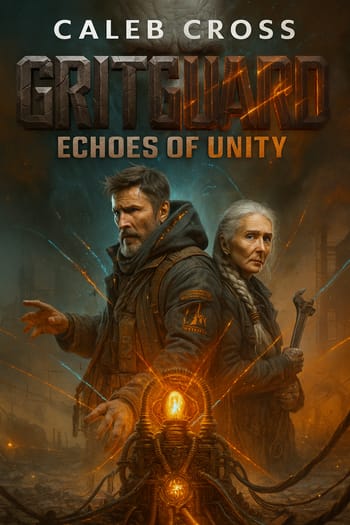
The light in the observation chamber was sterile, a perfect and unwavering luminescence that left no shadows. It was the light of certainty. Administrator Elara Vance stood before the main display, a seamless sheet of black glass that reflected her own placid features. Her hands were clasped behind her back, her white uniform immaculate. Below, in the simulation chamber, the two outsiders materialized. The scout, Sineus, and the engineer, Irina Pavlenko. The trial had begun. Her models predicted failure. Their world was built on chaos and desperation; they would not understand the logic of creation.
The simulation parameters were simple, designed to expose their inherent flaws. A barren landscape under a harsh, simulated sun. A handful of demoralized settlers, their code weighted toward inaction and despair. A single, failing water pump, its internal mechanics deliberately scrambled. Vance watched the data streams, her expression unchanged. The objective was not to fix the pump, but to organize a society. A task for leaders, for administrators. A task for The Dome.
The engineer, Irina, went straight to the pump, her movements economical and precise. She ran a diagnostic hand over its rusted casing, her brow furrowed in concentration. Predictable. A technician addressing a technical problem. The scout, Sineus, did something that did not compute. He ignored the settlers. He ignored the pump. He picked up a rusted spade, walked to the dry creek bed, and began to dig.
The steady scrape of his spade against the hard-packed, simulated earth was the only sound. He did not give orders. He did not make speeches. He simply worked, his back bent to the task, creating a shallow irrigation ditch. Vance leaned closer to the display, a flicker of something—not annoyance, but dissonance—disturbing the calm lattice of her thoughts. This was not leadership. This was manual labor. It was inefficient.
The engineer had the pump disassembled, its components laid out on a dirty canvas sheet. She spoke to herself in a low murmur, a litany of parts and pressures. The scout continued to dig, his rhythm steady, a human metronome marking time against a backdrop of hopelessness. The simulated settlers watched, their expressions blank. Vance’s models showed their morale holding at a flat twenty percent. The simulation was proceeding as expected. They were two individuals working on separate problems, a perfect example of the fragmentation that had doomed their world.
Then one of the settlers, a young woman with despair coded into her posture, stood up. She walked over to where the scout was digging, picked up a second spade, and began to work alongside him. She did not speak. She simply copied his rhythm. A few minutes later, a man joined the engineer, pointing at a component she was cleaning. She paused, explained its function with a simple gesture, and handed him a rag. He began to clean.
Vance’s fingers tightened behind her back. This was not in the projections. There was no command structure, no issuance of authority. The group was forming organically, drawn together not by a leader’s charisma, but by the simple, undeniable gravity of the work itself. Hope was not being given to them; they were building it from the simulated dirt.
The ditch grew longer. The pump began to take shape. Sineus paused his digging to show a settler how to reinforce the ditch wall with stones. He scratched a diagram in the dirt with a stick, a simple shape of a gear with three spokes, to explain the principle of interlocking support. The symbol meant nothing to Vance, a piece of random geometry. But the settler nodded, his understanding clear. Irina, her hands now guiding the settler at the pump, was no longer just a technician. She was a teacher. They were not solving the problem for the settlers. They were giving them the tools to solve it themselves.
The work accelerated. The sound of one spade became the sound of ten. The quiet murmur at the pump became a shared language of repair. They were a system, self-organizing and resilient. Vance felt a cold knot of certainty in her gut begin to loosen. Her definition of unity had always been one of perfect, centralized control. This was something else. Messy. Inefficient. And undeniably effective.
With a final, solid thunk, the last bolt was tightened on the pump. The settlers, their faces now alive with purpose, stood back. Irina gave a sharp nod. The lead settler gripped the pump handle and pushed down. A gush of clear, simulated water poured from the spout, flowing into the ditch Sineus and his crew had dug. It snaked its way across the barren landscape, a line of life drawn in the dust. The trial’s success condition had been met.
The simulation ended. The black glass of the display went dark, plunging the observation chamber into a soft, quiet twilight. The sterile light was gone, and in its place was an unfamiliar silence. Vance stood motionless, the reflection of her own face in the dark screen now seeming uncertain. The data was irrefutable. Her hypothesis was wrong. Her entire worldview, built on generations of pristine isolation and theoretical perfection, had been challenged not by a superior argument, but by the sight of two people choosing to serve instead of command. They had not led from the front. They had anchored from the center.
She processed the result, the silence stretching. It was a failure of her models, a failure of her understanding of the world outside her perfect, sterile cage. Or perhaps, it was a success. The trial had, after all, been one of understanding. And she, more than anyone, had just been taught a lesson.
The two outsiders were brought before her. They were covered in simulated dust and sweat, their faces streaked with grime. They looked tired but solid, their presence a stark contrast to the clean, white perfection of the hall. They did not speak. They simply stood, waiting for her verdict.
— You did not seek to lead, — Vance said, her voice a quiet admission, the words tasting strange and new. — You sought to serve.
It was the only explanation that fit the data. It was a philosophy so alien to The Dome that it had no metric, no category. It was a force she could not measure, but whose effect she had just witnessed. She had offered them a place at the top of her world, and they had answered by starting at the bottom.
She turned to her console and keyed in a command. A section of the far wall slid away, revealing a dark, recessed chamber. From it, a single object floated forward on a cushion of anti-gravity. It was a slate of dark, unblemished crystal that seemed to drink the light, its surface a map of stars that no longer existed in the sky above. The Celestial Cipher.
— The Dome honors its agreements, — she stated, the words a formality. The real transaction had already taken place. She had offered them sanctuary, and they had given her a blueprint for survival. — The second Key is yours.
The air in the hall was still and cool. The scent of recycled oxygen was clean and unchanging.
Now they had to convince the rest of a dying world to work together.