The main hall of The Dome was a place of hard light and harder silence. The air, scrubbed of all scent, tasted of nothing. It was the clean, sterile emptiness of a world that had forgotten the smell of rain on hot dust. Envoys from the scattered nations of a broken Earth stood on the seamless white floor, their worn gear and weathered faces a stain against the room’s perfection. They had been brought here by the promise of a weapon, a final answer to the silence of Oblivion, but the air between them was thick with the memory of old wars and broken treaties. Trust was a currency no one here could afford to spend.
Sineus stood with Irina Pavlenko before them. He felt the weight of their suspicion, a low, discordant hum in the room’s otherwise perfect quiet. To his left, the delegate from the River Commons, a woman whose hands were permanently stained with the rust of water-gate machinery, watched him with narrowed eyes. Beside her, the envoy from the Andean Concord, a man wrapped in textiles woven with conductive thread from the deep-earth battery vaults, remained perfectly still, his expression unreadable.
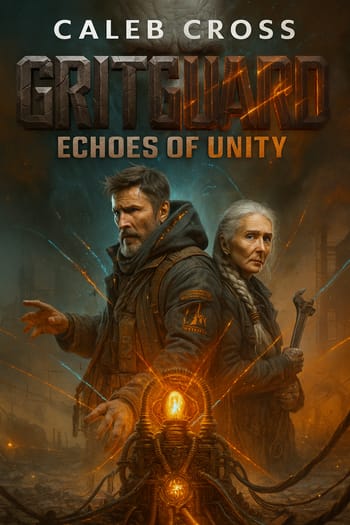
Irina unrolled their charcoal schematic on a floating dais. The rough fiber paper was an insult to the hall’s pristine aesthetic. It was a piece of the real world, a world of grit and consequence. She spoke first, her voice the clear, practical tone of an engineer outlining a problem. She explained the mechanics of the Unity Pulse, her words grounded in physics and power outputs, in the language of her Perun’s engine room. She spoke of resonators and amplifiers, of her anchor and The Dome’s reactor.
Then Sineus spoke. He did not talk of power, but of purpose. He described how the pulse would not be a weapon of destruction, but a story broadcast to the world. A memory of shared work, of hands building, of communities holding together. A memory strong enough to remind the world of its own will to exist.
— We offer a plan for mutual survival, — Sineus finished, his voice quiet in the vast hall. — Not conquest.
Silence followed. The delegates looked at the crude drawing, then at each other. It was the ambassador from the Solar Caliphate who broke the quiet. He was a tall man named Tariq, his skin the color of baked earth, his robes the pale gold of a sun his people had never seen but refused to forget.
— A bold plan, scout, — Tariq said, his voice a dry rasp. — But memory is a weapon. You have shown this. What guarantees do we have that this… story… will not be your story alone? That this unity will not be the unity of the wolf and the lamb?
The fear was old and solid. It was the reason their world had shattered in the first place. The River Commons delegate nodded, her hand resting on a heavy wrench at her belt, a tool that bore the faint, worn mark of a three-spoked gear. Every faction had been betrayed. Every alliance had ended in dust.
— We will give you the Sun-Seed, — Tariq continued, his gaze sweeping across the other envoys, then settling on Sineus. The Sun-Seed was the third Key, the biological archive of life itself, the most sacred relic of his people. The price for its use would be absolute. — On one condition. This unity you speak of must be a binding pact. A law of mutual defense, with all oaths remembered equally, by all.
The hall erupted in argument. The Andean envoy spoke of energy debts owed by the Federation. The River Commons delegate demanded water rights be codified. The old wounds, the deep fractures of a fragmented world, split open. They were not allies. They were survivors haggling at the edge of the abyss, each trying to ensure their own piece of the raft was the last to sink.
Sineus watched them, his heart a cold weight in his chest. He felt the ghost of his mentor, Morozov, a fresh wound that ached with the memory of failure. He had brought them this far only to watch them tear each other apart over the ghosts of the past.
It was Irina who stepped forward, her voice cutting through the noise like a hammer striking steel.
— You speak of debts and rights. These are words. They are wind. They are the promises the old world broke, — she declared, her hands, callused and sure, resting on the dais. She looked not at the delegates, but at their hands, at the tools they carried, at the scars of their labor. — We are builders. Let us build a promise that cannot be broken.
She turned to Administrator Vance, who watched from the edge of the hall with clinical detachment. — We need a forge. And steel.
The delegates fell silent, confused. Irina’s proposal was simple, drawn from the heart of her Union 9 culture. They would not write their pact on flimsy paper or store it as flickering data. They would forge it. Each article of their new alliance would be a contract stamped onto a heavy plate of steel. Debts and obligations would be measured not in words, but in kilowatts of power, in liters of clean water, in man-hours of labor. A promise you could hold. A law with weight.
A slow understanding dawned on the faces of the envoys. This was a language they all understood. The language of work. The language of tangible things. The Andean envoy nodded, his hand tracing the conductive threads of his mantle. The River Commons delegate looked at the three-spoked gear on her wrench, then at Irina, and gave a sharp, affirmative jerk of her chin.
Vance, seeing the consensus form, gave a curt nod. A section of the floor slid away, revealing a compact, high-temperature forge. Steel plates, thick and dark, were brought forward. For the next hour, the sterile hall of The Dome echoed with a sound it had never known: the rhythmic clang of hammers. The Pact of Mutual Defense was forged, each clause a ringing declaration of shared purpose, each signature a maker’s mark stamped into hot metal. A new symbol was agreed upon for the final plate: the three-spoked gear of the Union, the shield-arc of The Dome, and the rail-sun of the Caliphate, all interlocked. Unity, made real.
When the last hammer fell, the silence that returned was different. It was not the silence of sterility, but of shared accomplishment. The air itself felt warmer, charged with a new and powerful memory.
Ambassador Tariq approached Sineus. He opened a small, insulated case. Inside, resting on a bed of dark cloth, was the Sun-Seed. It was no larger than Sineus’s thumb, but it pulsed with a faint, internal golden light, warm to thetouch. It was the memory of life itself, a perfect, uncorrupted archive of photosynthesis. Sineus reached out and took it. The third Key was theirs. He held it in his palm, its warmth a stark contrast to the cold crystal of the Celestial Cipher and the heavy brass of the Resonance Compass in his pack.
The light from the seed pulsed in Sineus's palm, a tiny, living star. In its warmth, the cold perfection of the hall seemed to retreat.
Alarms shrieked through the sterile air.