The hum was a physical thing inside Monolit. It was a foundation of sound that vibrated in the concrete floors, in the steel walls, in the bones of the fifty thousand souls who lived within the fortress-city. This was the Mnemonic Chorus, the great, unending act of remembrance that held the Citadel together. Every day, at the same hour, the subliminal broadcast rose in volume, and every citizen, from the highest engineer to the lowest hydroponics worker, would join the recitation. They spoke the litanies of function, the chemical formulas of the air recyclers, the load-bearing specifications of every girder. They remembered the city into existence, pushing back the gnawing silence of the Unraveling with the sheer, brute force of collective will.
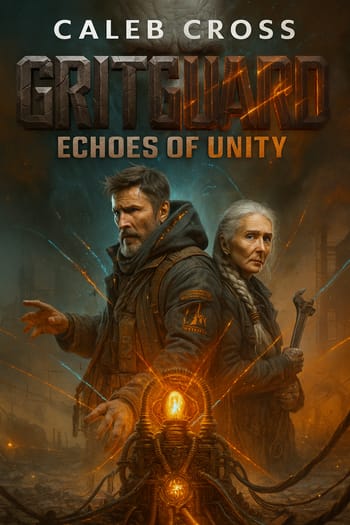
In a small, shielded alcove deep within the Citadel’s data nexus, Ferapont Lazarev did not participate. His duty was not to reinforce the present, but to capture the past. He was a Chronicler of the Order of Memory, a faction of scholars given sanctuary but not trust within the Federation’s walls. His world was a bank of salvaged consoles, their amber screens flickering with the endless stream of the Chorus broadcast. His left eye, a cybernetic lens of dull, non-reflective brass, scanned the data flow for patterns. His right eye, human and the color of a faded sky, watched the dust motes dance in the shafts of flat, artificial light. Strapped to his back, the brass coils and glass tubes of his Chronicle Engine emitted a low, ozonic hum of its own, a quiet counterpoint to the city’s roar.
A new data stream flickered onto his primary screen, a log from the Western Gate. A trade caravan from Union 9 had arrived. Ferapont adjusted his console, pulling up a visual feed. The image was grainy, but clear enough. He saw the Union 9 workers, broad-shouldered men and women in patched canvas and leather, their hands and faces smeared with the grease of their trade. They moved with a physical competence, heaving heavy drums of engine lubricant from their armored flatbed railcar. They were a people of muscle and steel, their knowledge held in their hands, not on data slates.
The Federation guards who oversaw the exchange were their opposite. They stood in clean, grey uniforms, their rifles held at a precise, ceremonial ready. Their faces were impassive, their hands clean. The trade was for hydroponic grain, a resource Union 9 could not produce on the open rails. The exchange was slow, each drum scanned and weighed, each kilogram of grain measured with bureaucratic precision. The tension was a visible thing, a shimmering in the air between the two groups. Ferapont watched the log update. Trade efficiency: 70%. A number that captured the mechanics of the transaction but none of the simmering resentment. The Federation saw Union 9 as useful scavengers. Union 9 saw the Federation as sterile parasites, hiding behind walls they no longer knew how to build. It was a fragile peace, a crack in the foundation of unity that the Unraveling was always waiting to exploit.
Ferapont turned his attention back to the main data stream of the Mnemonic Chorus. His purpose was not to analyze politics, but to listen for echoes. His brass-rimmed eye scanned the wave-forms, the endless, repeating litanies of concrete composition and atmospheric pressure. It was a wall of sound, a fortress of data designed to be impenetrable. But for weeks, he had sensed something else. A flicker. A ghost.
There.
It was a whisper beneath a roar, a thread of static so faint it was almost imperceptible. A deviation of less than three percent in the carrier wave. To the Federation’s diagnostic systems, it was noise, a rounding error. To Ferapont, whose entire life was the study of such errors, it was a signal. His long, thin fingers danced across the console, his movements economical and precise. He began to build a filter, layering protocols to strip away the overwhelming signal of the Chorus. He worked like a mason, chipping away at a mountain of stone to reveal the fossil within.
The process was slow. He had to borrow processing power without alerting the Citadel’s system monitors, a quiet act of theft for the sake of preservation. The Union 9 caravan departed, the great steel gate of the Western Wall sliding shut behind them. The trade was done. The city was sealed again. But Ferapont did not notice. His world had shrunk to the amber screen and the ghost in the machine. He felt the familiar thrum of the hunt, the quiet joy of a librarian finding a lost page.
After an hour of painstaking work, he had it. He isolated the signal, amplifying it, cleaning it of the Chorus’s bleed. It was not noise. It was structured. A repeating pattern of modulated pulses, ancient and complex. It was a language. A pre-Blast lexicon, something no one had heard for a century. The signal was coming from above, a faint echo from one of the dead orbital stations that littered the sky, a ghost speaking from a steel tomb. It was a fragment of the world that was, a piece of the great, shattered memory of humanity.
He had to capture it. The signal was degrading, each repetition fainter than the last. His own equipment was insufficient to record it at this strength. He needed more power. He needed to route a fraction of the Citadel’s main energy supply to his comms array, just for a few minutes. And for that, he needed permission.
He stood, his tall, thin frame unfolding from the cramped alcove. The Chronicle Engine on his back felt heavy. He left his sanctuary of screens and wires and walked into the sterile, ordered world of the Federation. The corridors were grey and featureless, designed to guide and contain. He passed officers and functionaries, their faces set with the grim purpose of maintaining the machine. On every uniform, he saw the small, polished brass pin of the tri-spoke symbol, its three arms representing the Federation’s pillars: Order, Duty, Memory. Ferapont’s Order had only one pillar. Memory. And it was absolute.
The command office for his sector was like all the others, a functional cube of steel. The officer on duty was a young man, his face smooth and unlined by the hardships of the wastes. He sat behind a steel desk, the very picture of Federation discipline. On his desk, a heavy brass tri-spoke symbol served as a paperweight, holding down a stack of flimsy printouts. The air smelled of clean, recycled air and the faint, sharp scent of ozone from the data console.
— State your purpose, Chronicler, — the officer said, his voice flat and devoid of curiosity. He did not look up from his screen.
— I require a temporary diversion of power to my station’s communications array, — Ferapont said, his own voice a low monotone. — I have detected a structured, pre-Blast data fragment. It is of potentially high value.
The officer finally looked up. His eyes were clear and untroubled. He did not see a scholar on the verge of a historic discovery. He saw a deviation from the daily schedule. He saw a request that did not fit the established protocols.
— Submit the request through your terminal, — the officer said, and looked back down at his screen.
Ferapont returned to his alcove. He typed the formal request, citing the potential value of the data, estimating the power draw, and setting the priority level to medium. He knew a high-priority request would be rejected instantly as alarmist. He sent the request into the Citadel’s digital bureaucracy. On his other screen, the ghost signal continued its faint, desperate repetition, a dying voice whispering the secrets of a lost world. He could only wait, and hope.
The wait was not long. The Federation’s system was nothing if not efficient. The officer in the command cube received the request. His console displayed Ferapont’s words alongside the day’s power allocation priorities. The list was stark and uncompromising. Air Filtration and Water Purification: Priority Alpha. Mnemonic Chorus Broadcast Integrity: Priority Alpha. Defensive Systems: Priority Beta. Non-essential Mnemonic Research: Priority Gamma.
The officer’s duty was not to think or to wonder. It was to enforce the system. The system was designed to keep fifty thousand people alive. A potential data fragment from a dead satellite did not factor into that equation. He moved his cursor. His finger tapped a key. The decision was made.
In his alcove, Ferapont saw the notification appear on his screen. A single, sterile word stamped in digital red: DENIED.
He felt a familiar, hollow ache. The opportunity was gone. He watched the waveform of the ghost signal, and as if the denial had been a physical blow, it flickered and died. The whisper was gone, submerged forever beneath the roar of the Chorus. A voice from the past, a piece of the world’s memory, had been silenced by a choice made for the sake of recycled air. He closed his human eye, the brass lens of his cybernetic one continuing its useless, empty scan. Another fragment lost. Another step toward the final, silent dust.
Then, a new sound cut through the city’s hum.
It was a sound that did not belong in the controlled, ordered world of Monolit. It was not the rumble of machinery or the murmur of the Chorus. It was a piercing, high-frequency shriek that tore through the fabric of the Citadel’s peace. It was the alarm. The alarm from the Western Gate, a sound of catastrophic failure, a sound of a wall that had forgotten its own strength.
The alarm shrieked of a breach, but it was not a warning of an attack to come. It was the announcement of a horror that had already happened.