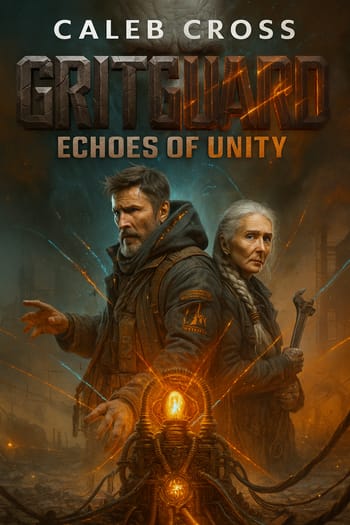
The heavy alloy of the door to the reactor core groaned, its memory of being a barrier failing under the focused assault from the corridor. Each impact was a dull, final thud, the sound of the world ending one meter of steel at a time. Irina Pavlenko’s hand, slick with sweat and grime, rested beside Sineus’s on the activation key. The console was a chaotic altar of their own making, a web of cables and repurposed conduits that fused the deep thrum of her Perun’s anchor with the clean, immense power of The Dome’s reactor. The three Keys, artifacts of a lost age, pulsed at the heart of the lattice, their separate songs now a single, resonant chord that vibrated up through the floor, through the soles of their boots, and into their bones.
— The door won’t hold, — Irina said, her voice a low rasp, not of fear, but of engineering fact. The last scream from Pavel Orlov’s squad still echoed in the sudden silence from the corridor, a silence more terrifying than the noise of battle.
Sineus did not take his eyes from the console, from the faint, interlocking symbols of the three-spoked gear, the shield-arc, and the rail-sun etched into the activation key. — It doesn’t have to.
He looked at her then. The engineer who had built a bridge of faith with him across a chasm of non-existence. Her face was smudged with soot, a fresh burn blistering on her cheek, but her eyes were clear. They held the same terrible, fragile certainty. This was the final act of their shared work. He nodded once. They had made their choice when they drew the first line of the schematic. Now they had to pay the price, knowing the Keys, their only guide to the Archive, would likely be consumed in the fire.
— For the future, — they said together, the words a quiet oath against the encroaching silence.
They pressed the activation key.
There was no explosion. No blinding flash of light. There was only a wave, a silent, non-destructive tide of pure memory that rolled out from The Dome. It was not a weapon designed to break things, but a story intended to build them. The pulse expanded at the speed of thought, a ripple of existence itself. It carried the memory of a hand laying a brick, the grit of mortar on calloused skin. It carried the memory of a rail being forged, the smell of hot steel and the rhythmic clang of a hammer shaping its purpose. It carried the memory of a child being taught to read, the faint scent of old paper and the quiet triumph of a new word understood. It was a billion small, cool memories of creation, of shared labor, of a world being built one piece at a time.
The Mnemonic Vultures, the hounds of Oblivion, had been a focused storm, a cutting edge of erasure aimed at the heart of The Dome. Their programming was simple: find the hottest, most powerful, most singular locus of memory and consume it. But the Unity Pulse was not one memory. It was an ocean of them. The Vultures were overwhelmed by a flood of countless small, quiet acts of purpose. Their targeting logic, designed for a single, arrogant flame, shattered against the distributed warmth of a billion candles.
Their unified assault broke. The spinning vortex of erasure dissolved into a chaotic, panicked swarm. The creatures of the void, their purpose scrambled, flailed in the psychic tide, their shimmering forms flickering as they sought a new anchor, a new command. Their broken logic defaulted. They abandoned the complex, layered memory of The Dome and the alliance. They turned as one, a river of pure hunger, and flowed toward the only thing left on the battlefield that fit their original programming: the densest, most arrogant, most singular point of will they could find.
They turned on their master.
Lev Dementiev, on the command deck of his sterile locus, felt the shift. He felt the wave of creation wash over him, a disgusting tide of hope and effort. He felt his Vultures, his beautiful tools of dissolution, lose their focus. Then he felt them find a new one. He had made himself a god of the void, a singular point of pure, nihilistic will. And in that moment, his own power became his undoing. The swarm, his own creation, saw him as the brightest, hottest, most singular memory in a world suddenly filled with the quiet warmth of community.
He had a single, silent moment to understand his mistake. Then they were upon him. He did not scream. He simply ceased to be, his singular consciousness a feast for the hungry void he had sought to unleash. He vanished in a silent implosion of his own creed, erased not by a greater power, but by a billion small memories of simple, honest work. The psychic pressure of Oblivion that had been pressing down on the world for months, for years, suddenly receded. The air itself felt lighter.
In the reactor core of The Dome, the three Keys on the console flared with a final, desperate intensity. Then, with a sound like ice cracking in a sudden thaw, a network of fine fissures spread across their surfaces. The golden light of the Sun-Seed, the cool starlight of the Celestial Cipher, and the steady hum of the Resonance Compass all dimmed, their power spent. The integrity of the priceless artifacts had dropped to a mere 10 percent. They had paid the price. The light on the console flickered, and the interlocking symbol of the three-spoked gear, the shield-arc, and the rail-sun went dark.
The battle was over. The accelerated Unraveling, the weaponized forgetting that had threatened to unmake existence, had been halted. The world, for the first time in a long time, was stable.
The silence in the reactor core was absolute, broken only by the soft hiss of a severed coolant line. The smell of ozone and burnt insulation hung heavy in the air.
Sineus and Irina stood before the dead console, their hands still resting on the activation key, the last tremor of the pulse fading from their bones. They had won. Now they had to build the world they had saved.