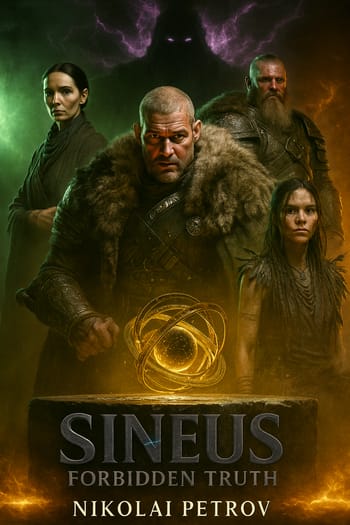
A ramp of black iron lowered from the darkness ahead, its movement accompanied by a low grinding sound, the protest of metal on metal. Sineus pushed himself to his feet, his hands scraping against the jagged, uneven surface of the platform. They were floating in a pocket of stillness carved from chaos, a place where someone had taken the world’s agony and given it a purpose. He had to find a way out.
Fedor was already standing, his heavy round shield held ready, his axe in hand. The captain of his guard was pale, but his eyes were sharp, scanning the impossible structure taking shape before them. Alani, the guide from the Forest Folk, pushed herself upright in her saddle, her face ashen. Her horse stood with its head low, trembling. The other horse, Sineus’s own, lay dead, its legs bent at unnatural angles.
The grinding ceased. The ramp connected their floating island of iron to a fortress. It was a mobile, monstrous thing, a structure of dark metal and what looked like bone, fused together in defiance of any sane architecture. Towers rose into the hazy gloom, their silhouettes jagged and wrong. It was not built, but grown from malice.
Rostislav Kurov waited for them at the top of the ramp.
He was a man, tall and broad in the shoulders, encased in armor that seemed to drink the dim light. It was not the polished steel of a northern lord or the etched plate of the Khevsur. It was a dark, matte material, like calcified despair. It had no shine, only an unnerving depth that pulled at the eye.
Sineus focused, his sight pushing past the physical form into the Pod-sloy. The ache behind his eyes sharpened into a spike. The armor was not metal. It was a tapestry of memory, woven from the purest forms of agony and shame. He could see the threads—the terror of the Forest Folk during a blight-scourge, the bitter shame of the Khevsur’s greatest betrayal, the gnawing hunger of a forgotten famine. The man wore the stolen traumas of nations as a shield.
This armor made him invisible to the Blight. He was not an anomaly to it. He was one of its own.
The man on the ramp took a step forward, his movements slow and deliberate. He did not carry a weapon. He did not need one. His presence was a weight, a cold pressure that smothered hope.
“You see things, little prince.”
The voice echoed, seeming to come from the fortress itself rather than the man. It was a low, resonant tone, devoid of warmth. The man knew what Sineus was. The translocation had not been an accident. It had been a capture.
Fedor took a half-step forward, placing himself slightly in front of Sineus. “Who are you?”
Kurov ignored him. His gaze, hidden behind a simple, unadorned helmet, remained fixed on Sineus. The darkness of his armor seemed to deepen, the stolen memories within it stirring like snakes in a pit.
“Such a unique perspective,” the voice continued, a chillingly casual statement in the heart of this impossible place. “A pleasing acquisition.”
The words hung in the cold, thin air. An acquisition. The chillingly casual statement suggested Sineus was not a prisoner to be interrogated, but a resource to be collected.
The grinding of the ramp had ceased. Dust motes, ancient and forgotten, danced in the non-light.
He understood then that he was not a simple captive, but a prize for a power he could not yet see.