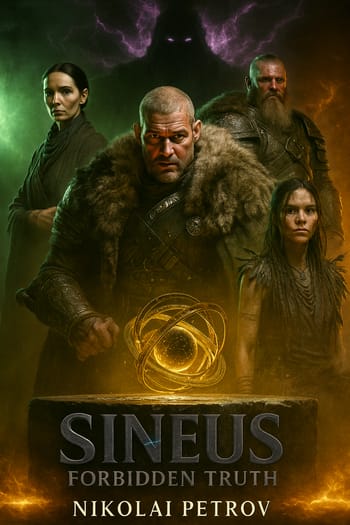
The journey from the impossible fortress had been a pilgrimage of dust and thirst. They walked for weeks, their path dictated by the sun and the slow draining of their water skins. The memory of the Blightforge, of its screaming architecture and the silent fall of its acolytes, was a fresh scar behind Sineus’s eyes. They had lost their horses in the collapse, their packs, everything but the clothes on their backs and the mission itself.
They crested a final, sun-baked ridge. Below them, the world fell away into a wound in the earth, a canyon so vast it seemed to swallow the sky. The wind that rose to meet them carried no whispers of forgotten pain, no chill of encroaching fog. It was hot, dry, and clean. For the first time in months, the constant, dull ache in Sineus’s skull eased. The Pod-sloy here was thin, a faint and ancient shimmer, not the chaotic storm of the north.
There was no city in the canyon. The canyon was the city. Buildings, libraries, and great halls were carved directly from the ochre rock, their facades forming a tapestry of windows and colonnades that stretched for kilometers. It was a place of impossible scale, built by a people who valued knowledge above all else. It was the Sunken Scriptorium of Ur.
Fedor Sokolov, his hand never far from his axe, scanned the cliffs. His face was a mask of grim disapproval. He saw no walls, no battlements, no choke points. Only exposure. To his captain, a city without defenses was a tomb waiting to be filled.
Alani Vainu simply closed her eyes, her shoulders slumping with a relief so profound it was almost painful. The land here was not screaming. It was not wounded. It was quiet. The silence was so complete, so absolute, it felt heavier than any sound.
They descended a winding path cut into the cliff face, their worn boots scuffing on the stone. The silence pressed in, broken only by the grit of their own footsteps and the sigh of the wind. As they reached the canyon floor, a figure emerged from the deep shadow of a carved archway. It was not a guard in mail or a noble in finery.
It was a woman. She wore the simple, ink-stained robes of a scholar, grey and functional. Her dark hair was pulled back, though a few strands had escaped to frame a face etched with a weariness that went deeper than exhaustion. Her eyes were sharp, dark, and missed nothing. She was the Lead Archivist, the gatekeeper to this place of quiet truths.
She watched them approach, her gaze sweeping over Fedor’s axe, Alani’s bandaged arm, and finally settling on Sineus. Her eyes noted the silver wolf’s head clasp that marked him as the Knyaz of Belogorod, but her expression remained unchanged. It was the look of a person who had seen kings and beggars arrive with the same dust on their boots.
Sineus halted the small party a few meters from her. The heat was a physical weight. He could feel the sun on his neck, the thirst in his throat. He had rehearsed a speech, a plea for aid, an explanation of the horrors he had seen. All of it felt hollow in the face of this profound silence and the woman’s tired, knowing gaze.
She spoke first, her voice flat, without welcome or malice. It was the voice of stone and dust.
“Another prince with a noble cause.”
The words hung in the dry air, not an accusation, but a simple statement of fact. A cataloging of a recurring event.
“The archives are full of your predecessors.”
Fedor shifted his weight, the leather of his armor creaking. It was the only sound. Sineus felt the weight of his journey, of the lives lost, of the hope he carried like a fragile coal. He would not let it be extinguished by a scholar’s cynicism.
“We did not come for a place in your archives,” Sineus said, his own voice rough from thirst. “We came for a chance to prevent the next one.”
The archivist’s eyes held his for a long moment. She was searching for something—the flicker of arrogance, the gleam of fanaticism. Sineus offered nothing but the quiet resolve that had carried him across a continent. He was a man with a singular, terrible clarity, and she seemed to recognize it.
She gave a small, almost imperceptible nod, not of agreement, but of acknowledgement. It was the gesture of a librarian accepting a new book for the shelf, whether she thought it worthy or not.
“My name is Kira Zaytseva,” she stated, the words a formality and nothing more. “The Scriptorium is neutral. We offer knowledge, not allegiance.”
“Knowledge is what we seek,” Sineus confirmed.
Kira turned without another word, her grey robes swirling around her ankles. She did not look back to see if they followed. She simply expected it.
“This way,” she said, her voice already swallowed by the immense stone archway.
Fedor glanced at Sineus, his expression a mixture of doubt and duty. Alani, leaning on her staff, nodded once. Sineus met his captain’s gaze and gave a slight inclination of his head. They would follow.
He led his two companions out of the oppressive heat and into the cool, quiet depths of the Sunken Scriptorium. The sudden chill was a shock, and the air shifted from the smell of hot dust to the dry, clean scent of old paper and stone. Their footsteps, loud in the canyon, were now muffled by the sheer volume of the space.
The cool air felt like a balm on sunburnt skin. The scent of a million pages settled over them, a dry perfume of history and dust.
She led them into a world of paper, but her eyes promised only a tomb.