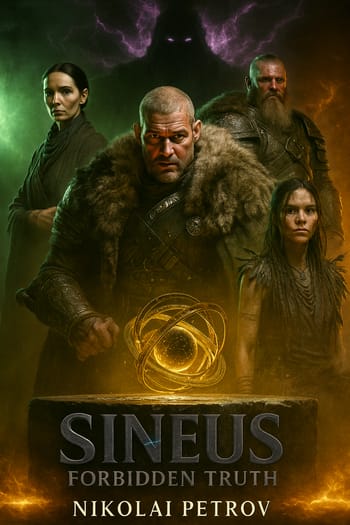
Kira Zaytseva’s purpose was to manage endings. She led the northern prince, Sineus Belov, away from his companions, deeper into the Scriptorium. His guard, a mountain of a man named Fedor Sokolov, had watched them go with open distrust. The forest guide, Alani Vainu, had simply offered a weary nod. They were left in the upper halls with water and bread, as this next part of the journey was for Sineus alone.
She guided him toward a wide, descending staircase carved from the living rock. The air grew cooler, the scent of dust and dry paper becoming thicker. The light from the main canyon faded behind them, replaced by the steady, orange flicker of torches set in iron sconces. Their footsteps were the only sound, a soft scrape and echo that the silence seemed to swallow. She kept a small, sharpened reed tucked behind her ear, a habit from years of marking scrolls. It was a useless comfort down here. There was nothing left to mark.
They arrived at the bottom of the stair. A vast, long chamber opened before them, its ceiling lost in the darkness above the reach of the torchlight. This was the Hall of Lost Worlds.
“We do not keep our own history here,” Kira said, her voice flat in the immense quiet. “This hall is for the others.”
She began to walk down the center of the hall. To their left and right, hundreds of alcoves were carved into the walls, each one a precise, rectangular shadow. Each held the final record of a civilization that had faced the Blight, or a force like it, and had been unmade. The sheer scale of the collection was a physical weight. It was an archive of extinction.
Kira stopped at the first alcove on the right. Inside, resting on a simple stone plinth, was a scroll of cured hide, its surface covered in jagged, aggressive script. The hide was stretched so thin it was nearly translucent.
“These were a warrior people,” she stated, not looking at Sineus but at the record. “They believed strength was the only truth. They met the Blight with armies and fury. They cut away every memory of defeat, every moment of weakness, until their history knew only victory.”
She gestured to the scroll.
“This is their final war banner. It remembers a thousand triumphs. The world it belonged to no longer exists.”
She moved on without waiting for a reply. The prince followed, his silence a neutral space she intended to fill with despair. He was tall for a northerner, his face stern and unreadable in the flickering light. He carried himself with a stillness that she had learned to associate with dangerous men, but his eyes held a different quality. A weariness that matched her own, but his was laced with a terrible, relentless focus.
The next alcove held a series of polished obsidian disks, each etched with patterns of crystalline precision. They hummed with a faint, residual energy that made the teeth ache.
“A society of thinkers,” Kira continued, her voice a monotone drone of established fact. “They believed the Blight was a puzzle to be solved. They calculated its advance. They built engines of logic to predict its patterns. They severed memories of emotion, of doubt, of fear, believing pure reason would save them.”
Her hand hovered over the disks.
“Their final calculations are recorded here. They prove, with perfect logic, why their own extinction was inevitable. The Blight unmade them while they were still proving it could not.”
They walked past alcoves holding prayer wheels from a nation of priests, seed banks from a culture of farmers, and the fluted bone-records of a people who spoke only in song. Each story was different. Each ending was the same. Kira felt the familiar rhythm of the tour settle over her. It was a liturgy of failure she had recited for dignitaries, for scholars, for desperate fools. It had never failed to work. It was an acid that dissolved hope.
She felt the prince’s gaze on her, not on the artifacts. It was disconcerting. He was supposed to be looking at the evidence, at the overwhelming proof of his own futility.
“Why show me this?” he asked. His voice was quiet, yet it carried easily in the dead air.
Kira finally turned to face him. The torchlight carved deep shadows into the lines on her face.
“Because you are not the first, Knyaz of Belogorod. You are not unique. You are a recurring data point in a very old, very predictable set.”
She began walking again, forcing him to follow. Her robes, the color of old ink and dust, rustled against the stone floor.
“I have seen your kind before. The king who believes his will is strong enough. The seer who believes their vision is clear enough. The hero who believes their cause is just enough.”
She stopped and swept her arm, a gesture that encompassed the entire, cavernous hall. The rows of silent graves. The library of apocalypses.
“They all thought they were unique,” she said, her voice hardening, each word a chip of stone. “They all had a hero. They all had hope.”
She let the silence hang for a moment, a suffocating blanket. She looked directly at him, her dark eyes holding his. She delivered the final, crushing weight of her argument.
— And they all ended up as a cautionary tale on my shelves.
There. It was done. She watched him, waiting for the change. The slump of the shoulders. The dimming of the eyes. The slight, defeated bow of the head as the sheer, statistical certainty of his failure settled upon him. She had performed this execution of the spirit many times. She knew its signs.
But Sineus did not break. He did not even flinch. His gaze left hers and returned to the alcoves, his eyes scanning the records with that same unnerving focus. He was not despairing. He was searching. He ignored her perfectly constructed argument, her mountain of proof, as if it were nothing more than idle chatter. A flicker of irritation sparked within her.
He walked past an alcove holding the woven-grass histories of a river-folk. He ignored the silent, metallic skull of a machine-prophet. He moved with a purpose that made a mockery of her lesson. Then, he stopped.
He did not stop at a grand display. There was no gleaming artifact, no epic scroll. He stood before a small, humble alcove near the back of the hall. It was a place she rarely visited on these tours, for the record it held was unimpressive.
Inside, on a plain plinth, was a single, rectangular stone tablet. It was about the length of a man’s forearm, made of a common, pale sandstone. It was covered in a simple, blocky script, worn by time. It was the record of a people so thoroughly erased that their name was not even remembered.
Sineus stared at the tablet. He leaned closer, his shadow falling across the stone. Kira remained where she was, a cold knot of impatience tightening in her chest. What did he see in that pathetic, broken thing?
— This one, — Sineus said, his voice still quiet. He did not look back at her. He pointed a single, steady finger at the tablet.
Kira’s patience frayed.
— It is a fragment, Knyaz. The record is incomplete. It is of no value.
— It says they survived.
The words struck her with the force of a physical blow. For a barest second, the world tilted. Her breath caught in her throat. The professional mask of the Lead Archivist, a construct she had worn for decades, cracked. A tremor of some wild, unfamiliar emotion ran through her—shock, anger, and something else. Something that felt horribly like a door creaking open in a room she had sealed long ago.
She knew the record. Of course she knew it. Every archivist knew of Anomaly 734. The Unfinished Tablet. A record from a forgotten age that detailed a losing war against a Blight-like entity. It chronicled their retreat, their despair, their final, desperate gamble. And then, in the last legible lines, it spoke of a turning tide. Of the Blight receding. Of survival.
The final entry, the one that should have explained how, was missing. The stone was blank.
It was an error. A scribe’s fanciful addition. A broken piece of a larger, more tragic story. A statistical outlier. She had a dozen rationalizations for it, all neat, all logical, all preserving the integrity of her collection and the bleak truth it represented.
She strode toward him, the rustle of her robes loud and angry. She would show him the flaw, the blank space, the proof of its uselessness. She would restore the proper order of things.
She stood beside him, forcing herself to look at the tablet. The worn, carved letters were like old friends who had told her the same comfortable lie for years.
— The record is incomplete, — she said, her voice sharp. — The conclusion is missing. It is a story without an ending, therefore it is not a story at all. It is a failed data set.
Sineus finally turned his head to look at her. The torchlight caught the silver of his wolf’s head clasp, the seal of his office. But in his eyes, she saw no prince, no Knyaz. She saw a man drowning, and this tablet was the only piece of driftwood in a miles-wide sea.
— Is it? — he asked.
The simple question dismantled her. All her arguments, all her history, all her carefully curated despair, felt thin and brittle. He was not looking at the tablet as a historian. He was looking at it as a man who needed it to be true. And his hope, as irrational and foolish as it was, was a force more powerful than her logic. It was a contagion.
The silence of the hall returned, but it was different now. It was no longer the quiet of a graveyard. It was the silence of a held breath.
The dust motes danced in the torchlight. The shadows on the wall seemed to deepen.
Sineus had found it: a record of a world that survived, a single anomaly that challenged all of Kira's cynical truths.