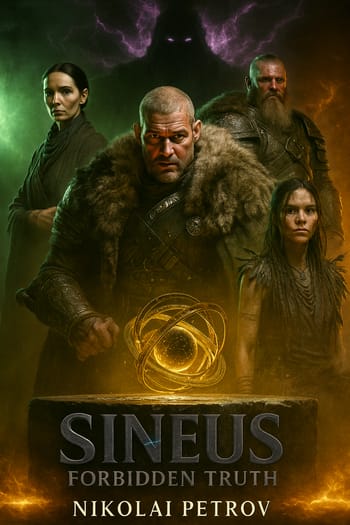
The parchment felt like a ghost in Kira Zaytseva’s hand. A fragile, impossible truth. Sineus watched her face, pale in the lantern light, as she carefully rolled the ancient record and slid it back into its clay cylinder. Zoya Petrova, the keeper, stood by the basalt door, a statue carved from duty and defeat. Her life’s work had been to guard this secret. Now, it was free. Their task was to carry it out of its tomb and into the light.
A sound cut through the profound stillness of the lower levels. It was sharp, clean, and utterly wrong. A single, military horn blast, echoing from the hot, dry world above.
It was not a sound of the Scriptorium.
Kira’s head snapped up, her eyes wide with alarm. Zoya closed her eyes, a flicker of pain crossing her face as if she had expected this, too. Sineus moved past them, pushing the heavy basalt door open just enough to slip through. He took the stairs two at a time, his hand resting on the hilt of his sword. Fedor and Levan met him in the main corridor, their expressions hard.
— What was that? — Fedor Sokolov asked, his voice a low rumble. The veteran warrior’s gaze was already scanning the high, narrow windows that looked out onto the canyon.
— The mountain has a voice, — Levan Dadiani murmured, his hand gripping the pommel of his own blade. The Khevsur warrior’s eyes were fixed on the cliffs. — But that is not its own.
Sineus reached the reception hall and looked up. Through the high arches, against the brilliant ochre of the canyon walls, figures appeared. They moved with disciplined speed, dark silhouettes against the bright sky. They carried crossbows and wore the mark of the wolf’s head devouring a crown.
It was Kurov’s mark.
More figures appeared, not just on one cliff, but on both sides. They took up positions overlooking the narrow entrance to the canyon in the south. Others materialized above the winding exit path to the north. They were not preparing an assault. They were sealing the exits. A cage.
— He found us, — Kira said, coming to stand beside him. She held the clay cylinder against her chest like a shield. — Or he was led here.
Alani was there, too, her face ashen. She looked at the cliffs not with a warrior’s eye, but with a pained grimace, as if the very rock was crying out to her.
Then Sineus saw him. A lone figure, standing on a high promontory, set apart from the others. Even at this distance, the shape was unmistakable. The armor he wore did not reflect the sun; it seemed to drink it, a void in human form. Kurov raised a hand, not in a salute, but a command. He pointed.
His finger was aimed directly at the Scriptorium’s central spire. The bell tower.
A low hum began to vibrate through the flagstones under their feet. It grew into a deep, resonant tone, the sound of a great weight beginning to move. The Vechevy Kolokol, the great bell of the Scriptorium, began to toll. But the sound was wrong. It was not the clear, single note of announcement or warning. It was rhythmic, heavy, funereal.
— His agents are inside the tower, — Kira whispered, her voice tight with horror. — They’ve taken the bell.
The tolling grew faster, the bronze notes blurring together into a continuous, sickening drone. It was not a sound meant for the ears. It was a carrier wave. Sineus felt the shift in the Pod-sloy a moment before the memory hit. A wave of psychic energy, cold and sharp as iron, washed over the canyon.
It was a memory of a siege.
He saw it, felt it. Ghostly images flickered at the edge of his vision. The last stand of the Verian Compact. A history every archivist knew. He saw the broken walls of a city he’d only read about, smelled the smoke of its burning libraries. He felt the gnawing hunger of its starving defenders, the chilling despair as their last hope failed.
The memory was a weapon, and it was aimed at the mind.
Around him, the Scriptorium’s small guard force cried out. They were scholars and keepers, men and women who had taken up spears out of duty. Their faces went slack with a terror that was not their own. One dropped his spear with a clatter, his eyes wide with the remembered horror of a battle fought a thousand years ago. Another sank to his knees, clutching his head.
Their spirits were broken before the first of Kurov’s soldiers had even fired a bolt.
Levan grunted, staggering back a step. The Khevsur warrior’s face was a mask of contemptuous fury as he fought the foreign despair. Fedor stood like a rock, his expression grim, the psychic assault washing over him like a foul wind he could not see but chose to endure.
— He is not fighting us, — Sineus said, his own mind reeling from the cold weight of the broadcasted failure. He forced the ghostly images back, the ache behind his eyes sharpening to a spike of pain. — He is unmaking our will to fight.
The bell’s drone hammered down, a relentless pulse of futility. Each note drove the memory deeper. The memory of a righteous cause that was lost. The memory of a fortress that fell. The memory of hope turning to ash.
The dust motes danced in the shafts of light, indifferent. The ancient quiet of the canyon was filled with the screaming ghosts of a dead city.
Kurov had turned their greatest tool of knowledge into a weapon of despair.
The canyon was sealed. The defenders were crippled. And the enemy had not yet moved.
The air tasted of dust and defeat.
A profound, terrible silence settled as the bell finally stopped, its last note leaving an echo of absolute hopelessness.