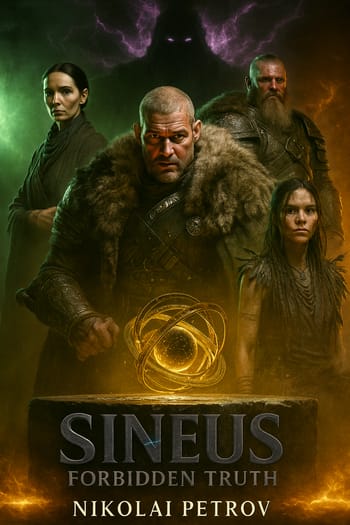
Sineus pushed through the last of the dazed Scriptorium guards, his mind a raw nerve. The echo of the bell’s psychic assault lingered, a cold residue of another’s despair. He had to forge a plan, to find a path through the cage Kurov had built around them. The central chamber offered a temporary sanctuary, its high, shadowed ceiling a promise of space they did not have. His allies followed him in, their faces etched with the same strain. They were trapped.
They gathered around a wide, stone table, a relic from a time of more peaceful councils. The air tasted of dust and the faint, metallic tang of fear. Farid Almasi, a senior archivist whose robes were immaculate but whose face was drawn with defeat, was the first to speak. He stepped forward from among the other Scriptorium scholars, his face a mask of grim certainty.
“We must surrender,” he said, his voice flat and devoid of hope. He spread his hands on the cool stone of the table, a gesture of finality. “The canyon is sealed. Our guards are broken. Kurov’s forces hold the high ground. The tactical reality is absolute. To fight is to guarantee our annihilation.”
He looked directly at Sineus, his eyes pleading for a return to the cold logic of survival. It was the logic of the archives: to preserve the record, even if the people were lost.
— We offer him the artifact. We offer the Knyaz. Perhaps he will spare the Scriptorium. It is the only move that preserves anything.
Sineus felt the weight of cold pragmatism, now heavy as a shroud. He looked away from the archivist, his gaze falling on Levan Dadiani. The Khevsur warrior stood apart from the table, near a pillar carved with the likeness of some forgotten scholar. His magnificent armor, a record of his ancestors’ honor, seemed to weigh him down. His certainty was gone, shattered by the revelation that his people’s shame was now Kurov’s shield.
The warrior’s hands were empty. His sword remained sheathed. He stared at the floor, his jaw tight, lost in a maze of broken oaths and stolen history. He had been the voice of martial pride, the embodiment of the mountain’s strength. Now, he was a hollow space in the room, his silence a more potent argument for despair than the archivist's words. A key weapon in their arsenal was mentally compromised, lost in the ruins of his own identity.
— There is a way, — a quiet voice said.
Alani Vainu, the guide from the Forest Folk, stepped forward into the dim light. The wound on her arm was a dark line against her skin. The psychic chaos of the bell had left her pale, but her eyes were clear. She did not look at the maps or the warriors. She looked at the stone beneath her feet.
— I can feel it. A path. It is old. Forgotten. The rock here does not want to remember it. — She gestured vaguely toward the rear of the chamber. — It is not a grand passage. It is a crack. A waterway that has forgotten it is water. It leads up, into the cliffs. Away from the main canyon exits.
An escape. A path only she could sense, offered by the mystic of their small company. It was a thread of hope, but a thin one. A desperate flight into the unknown.
— Fleeing is not a victory, — a new voice cut in, sharp and precise.
Kira Zaytseva, the Lead Archivist, strode to the table. She had recovered her purpose. Her face was grim, but the weary skepticism had been burned away, replaced by a cold, focused anger. She swept a collection of decorative scrolls aside, clearing a space on the stone. With a series of sharp snaps, she unrolled a set of ancient schematics, maps of the Scriptorium from its first construction.
The parchments were yellowed, the ink faded to brown. They showed layouts of the canyon, choke points, and hidden galleries.
— This place was not built by fools, — Kira stated, her finger tracing a narrow pass near the main entrance. — The first archivists knew knowledge invites attack. There are defensive positions, fallback points, killing grounds. They are not obvious, but they are here. We can hold them. We can make Kurov pay for every meter of stone.
Her proposal was the opposite of Alani’s. Not flight, but a bitter, grinding defense. A scholar’s plan, based on data and the logic of terrain. It was a promise of bloodshed, a trade of lives for time.
Sineus looked at the three options laid before him. Surrender. Flee. Fight. Each was presented by a voice he trusted, and each was incomplete. Each was a path to a different kind of failure.
A rhythmic, scraping sound drew his attention. Near the main doors of the chamber, Fedor Sokolov stood guard. He had not joined the council at the table. His back was to them, his attention on the enemy. He held his heavy axe in one hand and a whetstone in the other, drawing the stone along the blade with slow, steady strokes.
Scrape. Scrape. Scrape.
The sound was simple, real. It cut through the debate. Fedor was not offering a plan. He was preparing for a fight. He was a weapon, waiting for a hand to wield him. His loyalty was absolute, his purpose clear. He would be the instrument of whatever Sineus decided.
Sineus closed his eyes for a moment, the dull ache from the bell’s assault still throbbing behind them. He saw the faces of his council. Pavel, the pragmatist, offering a managed defeat. Alani, the mystic, offering a hidden escape. Kira, the scholar, offering a strategic defense. And Fedor, the warrior, offering his unwavering strength.
They were all right. And they were all wrong.
To surrender was to hand the Heart of Truth to the enemy. Unthinkable. To fight a prolonged siege was to die, slowly and without purpose, trapped in Kurov’s cage. To flee was to survive, but it would mean abandoning the Khevsur warriors and Scriptorium guards who had chosen to stand with them. It would be a flight of shame.
He could not choose one path. He had to weave them together.
He opened his eyes and looked at the faces around the table. He saw their fear, their hope, their broken pride. He saw the pieces of a single, coherent plan. A plan that used surrender as a feint, defense as a delay, and escape as the final, true objective.
Sineus’s voice, quiet but carrying a new weight of command, cut through the chamber’s tension. — You are right, — he said, addressing Farid Almasi. — We cannot win a direct fight. — He turned to Kira. — But you are also right. We will not give up this ground for free.
He looked at Alani. — Your path is our hope. But we will not take it alone.
Then he looked to the door, to the steady, rhythmic scrape of steel on stone. — Fedor.
The sound stopped. The big warrior turned, his axe gleaming in the dim light. He waited.
— We will give them a fight, — Sineus said. — And then, we will disappear.
The dust of ages settled on the ancient maps. The silence in the chamber was no longer one of despair, but of attention.
He looked at the faces around him, at their courage and their fear, and knew he had to make them see the single path he saw, a thread woven from all of them.