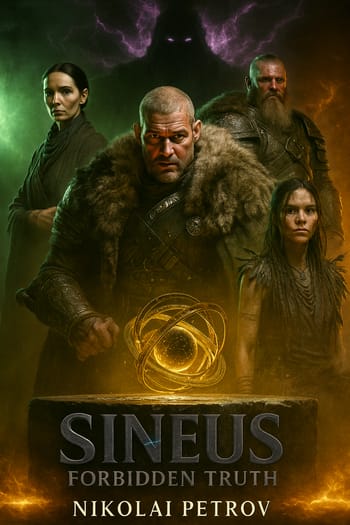
The retreat was a ragged, stumbling thing. Sineus fell back with the others, the grinding clash of the pass fading behind them, replaced by the panicked shouts of Scriptorium guards and the heavy, rhythmic tread of Fedor’s boots on the flagstones. They had held, but they had not won. Something had broken. It was not a breach of the shield wall, but a failure of the mind.
He had felt it, a sudden, sickening ripple in the Pod-sloy. A sound like a dozen Sekach Pamyati blades slicing at once, a high, thin shriek that tore at the edges of his awareness. He saw it as a flicker in the air above the pass—a brief, violent shimmer, and then a void.
From the high ground, figures in robes the color of dried blood and ash had raised their hands. They were not warriors. They were Kurov’s Adepts, the architects of his fortress of pain. They had not launched arrows or stones. They had focused their will on a single, critical point in the Khevsur line. They had reached into the minds of the warriors holding that position.
They cut the memory of the defense from the defenders themselves.
The Khevsur warriors, men who had stood like iron statues moments before, suddenly faltered. Sineus saw it through the swirling dust. One of them lowered his shield, looking at the weapon in his hand as if it were a foreign object. Another turned to his neighbor, his face a mask of pure confusion. They had forgotten why they were there. The purpose of the wall, the identity of the enemy, the oath they had sworn—all of it was gone, carved out of them from a distance.
The defensive line dissolved without a final, desperate clash. It simply ceased to exist. The blank-eyed soldiers of Kurov’s army did not charge the gap. They walked through it, a silent, inexorable tide flooding the Scriptorium’s outer halls. The retreat became a rout.
Now, they were cornered. The last defensible position was the Great Library, a vast, circular chamber whose towering shelves of scrolls and books formed a maze of their own. Fedor and the remaining Khevsur loyal to Levan slammed the great bronze-bound doors shut, the heavy bar dropping into place with a sound of grim finality. The air inside was thick with the smell of old paper and dust, now sharpened by the acrid tang of smoke and fear.
Wounded men slumped against the shelves, their breath coming in ragged gasps. The senior archivist who had argued for surrender stood wringing his hands, his face the color of old parchment. He still clutched a treaty scroll, a useless habit from a world of rules that no longer applied.
Levan Dadiani, the proud warrior of the mountain, leaned against a shelf, his head bowed. The loss of his men to such an unseen weapon had broken something vital within him. He had not spoken a word since they had fallen back.
— They are at the doors, — Fedor Sokolov reported, his voice a low rumble. The big warrior stood by the entrance, his axe held ready. He was a rock in a sea of failing hope.
Kira Zaytseva, the Lead Archivist, her face smudged with soot, strode to the center of the room. The small reed she always kept tucked behind her ear was gone, lost in the chaos. Her eyes, usually filled with a weary cynicism, now burned with a desperate fire. She looked at Sineus, and in that moment, he knew the last truth was about to be revealed. The one she had held back.
— It’s not enough, — she said, her voice cutting through the low moans of the wounded. — Holding this room. It’s not enough.
She took a deep, shuddering breath.
— The Heart of Truth is not a weapon. It is not a bomb to be detonated. It’s a seed.
The word hung in the air, small and terribly simple.
— It must be planted, — Kira continued, her voice dropping, forcing them to lean in to hear. — The seed has to be planted in a place of great, living memory. A place where the world’s true history is still strong. The soil of a sacred grove, the heartwood of an ancient forest. Not here. Not in stone and dead paper.
The hope that had carried them through the siege, the prize they had fought to protect, was useless to them here. Their defense, their sacrifice, had only been to keep the seed from Kurov. It could not be their victory.
— Then it was all for nothing, — Farid whispered, the sound a dry rustle of despair.
Levan looked up, his eyes hollow. — My men… they died holding a pass… for a seed we cannot even plant?
Before Sineus could answer, a sound from the doors silenced them all. Not the thud of a ram, but a sharp, splintering crack. The ancient wood of the doors groaned. The heavy bronze bar shrieked as it bent under an impossible pressure.
With a final, explosive crash, the doors burst inward. Shards of wood and metal flew across the library. Scrolls tumbled from high shelves, a cascade of forgotten histories.
A figure stood in the breach.
It was Kurov. He was a void in the doorway, a silhouette of a man that seemed to drink the dim light of the library. His armor, woven from stolen despair, did not reflect the flickering lamps, but consumed them. The air grew cold. The dull ache behind Sineus’s eyes sharpened into a spike of pure agony.
Kurov took a slow step into the Great Library, his gaze sweeping over the broken defenders. He was not looking for a fight. He was a collector, come to claim his prize.
The dust of ages settled on the fallen scrolls. The time for words had passed.