The wind on the high ledge was sharp and clean. It tasted of dust and distance. Alani Vainu pressed her hand against the rough wall of the fissure, the stone a solid anchor in a world that had come undone. Below, the Sunken Scriptorium of Ur lay exposed in the harsh afternoon light, a patient city of stone awaiting a final, quiet judgment. Her purpose was to see. To bear witness to the cost of their escape.
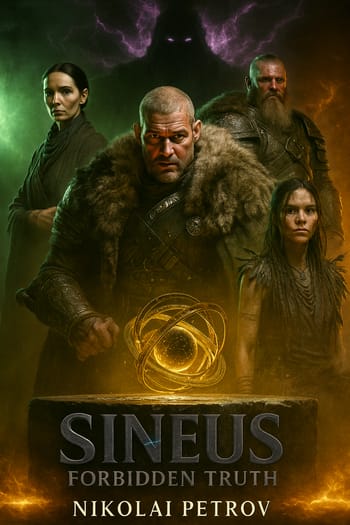
The survivors were a small, broken knot of humanity on the narrow shelf of rock. Fedor Sokolov, the stoic guardsman from Belogorod, stood with his feet planted wide, his shield still strapped to his arm. He and Levan Dadiani, the Khevsur warrior whose pride had been shattered and reforged into something harder, held the unconscious form of Kira Zaytseva between them. The archivist was limp, a scholar of endings who had authored one of her own.
Sineus Belov, the Knyaz who saw ghosts, stood a little apart. His hand was pressed to his chest, guarding the small, hard weight of the clay cylinder that held the Heart of Truth. His gaze was fixed on the scene below, his face a mask of grim acceptance. They were all watching one man.
Down in the canyon, Kurov moved with a chilling lack of haste. His rage was not a fire; it was a glacier. He walked through the grand plaza, his dark armor no longer a shroud of stolen nightmares but simple, functional steel. He was just a man now, but the blade in his hand was not. It was a line of perfect nothingness, a tool of silent, absolute negation. He was not smashing or burning. He was editing.
He approached the Hall of Lost Worlds, the great archive Kira had used as a classroom for despair. He raised the blade. He made no grand swing, only a simple, deliberate cut through the air before the building’s facade. There was no sound. No impact.
The stone of the hall flickered. For a heartbeat, it turned translucent, a ghostly image of itself. Alani could see the rows of alcoves within, the final records of a thousand fallen civilizations shimmering like memories caught in ice. The sight was beautiful and obscene. Then the stone dissolved. It did not crumble or fall. It was unwritten from the world, leaving a smooth, edgeless void where a library of apocalypses had stood for millennia.
Kurov moved on.
Alani felt the unmaking not as a sight, but as a physical agony. It was a tearing deep inside her, a pain that echoed the wound on her arm but was infinitely worse. The Scriptorium was a place of immense memory, a nexus of stories. When the Hall of Lost Worlds vanished, she felt a thousand worlds die for a second time. It was a chorus of silent screams that only she could hear. The pain was a cold knife twisting behind her ribs.
She gasped, stumbling back against the fissure wall.
— What is it? — Fedor’s voice was a low rumble. He had not taken his eyes off Kurov.
— The land, — Alani whispered, her breath short. — It’s screaming. He’s not just breaking it. He’s killing its memory.
Sineus looked at her, his eyes filled with a terrible understanding. He knew the sound she heard. He had heard it in the great hall of Belogorod, a high, thin rasp. But this was that sound magnified a million times over. This was the shriek of history itself being murdered.
Kurov proceeded to the central council chamber, the place where their fragile alliance had been forged. He made another precise, economical cut. The stone walls thinned to glass, then to smoke, then to nothing. The great table where they had laid their maps, the chairs where they had debated their hopeless odds—all of it was gone. Erased.
The destruction was so absolute it felt like a personal violation. He was not just destroying a place; he was stealing the memory of their struggle, of their brief, defiant hope. He was ensuring no one could ever learn from it.
The effect spread. The very air above the canyon began to warp. The clear, dry sky shimmered as if seen through intense heat. The light bent around the edges of the growing void, the sun’s rays distorted by the unravelling of reality. It was a wound not just on the world, but in it.
Alani sank to her knees, overwhelmed. Each building that vanished was a physical blow. She felt the memory of the masons who had carved the stone. She felt the quiet dedication of the archivists, the dry rustle of their robes, the scent of their ink. She felt the weight of the knowledge in the scrolls, the stories of love and war, of triumph and folly. All of it, every memory, every ghost, was being fed into the void.
This was a loss deeper than any fire or flood. A library burned could be rebuilt. A story lost could be retold, however imperfectly. But this was oblivion. The world was not just losing a city; it was losing a part of its own mind. Her heart felt heavy, a cold stone in her chest. She mourned for the knowledge. For the truth. For the one story of survival on a sandstone tablet that had given them a chance.
It was all gone. Everything but the single, tiny seed they carried.
The thought was a spark in the overwhelming darkness. The Scriptorium had been a vessel. A vast, ancient, beautiful vessel. But it was just a vessel. The truth it had guarded was not the scrolls or the tablets. The truth was the Heart of Truth. And they still had it.
Her grief did not vanish. It settled, cooling into something hard and dense. It became resolve. The world could not be allowed to forget itself entirely. Not while they still drew breath.
She pushed herself to her feet, her legs shaking. She ignored the shimmering void below, the sight of a man methodically erasing a city from existence. She turned her back on the ruin. She looked north, toward the distant promise of green forests and deep, living soil. The lands of her people.
— We have to go, — she said, her voice quiet but firm. It cut through the stunned silence on the ledge.
Sineus met her gaze and nodded once. He looked at Fedor and Levan. The warriors, their faces grim, adjusted their hold on the unconscious archivist.
The journey was not over. It had just found a new, desperate purpose.
The wind blew cool against her face, carrying no scent of the destruction below. The sun was a low, orange fire in the west.
They turned their backs on the void and began the long walk north.