The place had no name on any map. It was not a place. It was a process, a constant becoming. Here, at the heart of all things, was the Loom of Ages. It was a labyrinth woven from threads of pure memory. They shimmered in the non-darkness, a billion billion strands of what was, what is, and what could yet be. A figure moved through them. It did not walk. It willed itself along paths that were not paths, through distances that had no measure. The threads parted before it, whispering as they passed.
They whispered of triumphs and sorrows, of births and endings. A bright silver thread pulsed with the joy of a first kiss in a summer field. A strand of dull, greasy grey vibrated with the slow agony of a forgotten famine. The figure paid them no mind. They were merely the raw material, the wool and flax of existence. The figure was the weaver. It moved with a purpose that was older than the mountains, colder than the void between stars.
It paused. Its attention fell upon a single thread, one that had just recently frayed. The thread was the color of rust and ambition, and it had snapped with a final, pathetic whimper. The figure observed the broken end, the memory of Kurov dissolving into the background hum of the Loom. There was no disappointment. No anger. A tool had served its purpose. A pawn had been sacrificed. The space it had occupied on the great board was now empty.
This was good. This was part of the design.
The figure was pleased. Kurov’s defeat was not a failure of the plan, but the successful completion of a necessary stage. The warlord had been a blunt instrument, a hammer to shatter a lock. His chaos had cleared the board, leaving the pieces exactly where the weaver needed them for the final, more delicate work.
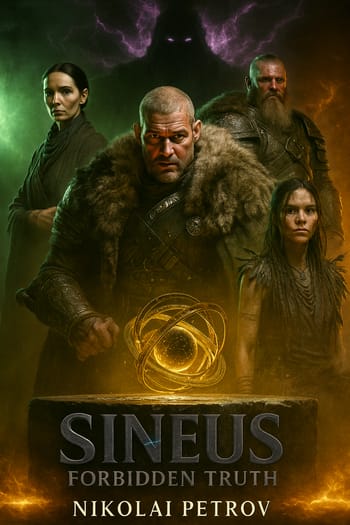
The figure turned its attention from the fading memory of the pawn to the thread of the prince. It was a remarkable thing, this thread of Sineus Belov. It shone with a strange, dual light, a braid of solid, physical reality and the ghostly shimmer of the Pod-sloy. It was a living paradox, a knot in the weave that should not exist. The figure watched the recent events flicker along its length: the flight from the Scriptorium, the planting of the seed, the confrontation in the grove. The hero believed he had won. He believed he had healed the world.
This, too, was part of the design.
From the non-space around it, a shape coalesced into the figure’s hand. It was a small, crystalline vial, capped with dark, non-reflective steel. It was cold to the touch, a piece of precise, deliberate artifice in this place of raw, flowing potential. It was the same vial an acolyte had carried from a weeping prison tower, a thing that had traveled through folded space and broken realities to arrive here, at the center of all things.
Inside the vial, a single drop of blood swirled with a faint inner light. It was the blood of Sineus Belov. It was not merely blood. It was a liquid sample of the paradox, a key forged of flesh and memory. It pulsed with the same dual light as the prince’s thread in the Loom, a tiny, captured star of what should not be. The figure held it up, observing the light within, its expression as neutral and curious as a master craftsman examining a rare and volatile material. The blood was the final component.
The figure moved again, its passage through the sea of memory now direct and swift. It proceeded toward the heart of the Loom, the nexus where all threads converged. The whispers here became a single, overwhelming hum, the sound of reality being perpetually written and rewritten. This was the Altar of the Loom, a dais not of stone or metal, but of pure, solidified light, impossibly bright and utterly silent. It was the control panel for the world.
With a slow, deliberate motion, the figure placed the crystalline vial upon the surface of the altar.
The light of the altar flowed into the vial. The single drop of blood began to pulse, faster and brighter, its rhythm matching the hum of the Loom itself. The paradox was being introduced to the system. The flaw was being written into the code.
The figure watched. A smile touched its lips. It was not a smile of joy, or of malice. It was a smile of cold, perfect, and absolute satisfaction. A plan set in motion before the first cities were built was now reaching its conclusion.
The light from the altar was steady and clean. The hum of the Loom was constant.
The light from the altar pulsed in time with the Loom. The prince's blood, a flaw in the pattern, began to sing.