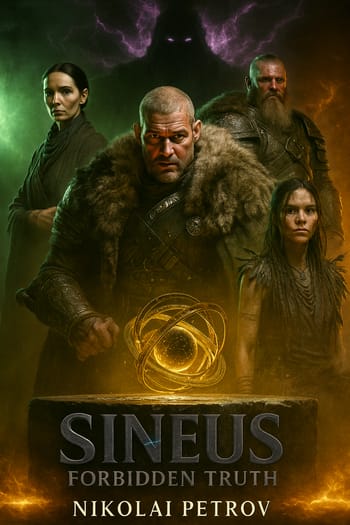
The trees thinned, then gave way completely. They left the last of the sparse woodlands behind and stepped into a new world, a sea of pale green grass that rolled to every horizon. The sky was immense, a hard, bright blue swept clean by a wind that never stopped. It smelled of dust and distance. It pulled at Sineus’s cloak and whispered of emptiness. For three days they had walked this open land, the great wall of the Echoing Blight a constant, shimmering grey stain to their east.
Alani’s arm was healing, the wound closing cleanly, but she was quieter now. The energy of the forest was gone, replaced by this endless expanse. She navigated by the sun and the stars, her senses finding little purchase on the uniform landscape. Fedor was more at ease here. He could see for kilometers in every direction. No trees meant no ambushes. He walked with a lighter step, his axe resting easy on his shoulder.
Sineus felt the openness as a lack of shelter. The ache behind his eyes was a low, constant thrum, a reminder of the Blight some eight kilometers away. He scanned the horizon, his gaze sweeping from north to south. He was looking for threats, for water, for any sign of life.
He found one.
It was a smudge of dust in the south, a faint brown cloud rising against the blue sky. It was too large for a handful of riders, too steady for a dust devil. It was moving toward them.
Fedor saw it a moment later. He stopped, his hand going to the grip of his axe. He squinted, his eyes accustomed to judging distance across open ground.
“Caravan,” he said. His voice was flat. “A big one.”
They waited. The dust cloud grew, resolving itself into a long, slow-moving line. It was a river of commerce flowing north across the steppes. Sineus could begin to make out shapes. Tall, lurching camels laden with goods. Stocky steppe ponies. Men on foot, and armed guards on horseback. The faint, rhythmic sound of bells carried on the wind.
The caravan was a hundred strong, perhaps more. A moving town of traders and guards, animals and wagons. As it drew closer, the smells reached them: sweat, dust, animal musk, and the faint, exotic scent of spices. The guards were professionals, clad in layered leather and dull grey steel. They rode with an easy confidence, their eyes constantly scanning the plains.
The entire column halted a hundred meters away. A single rider detached from the front and trotted forward. The man who led them.
He was a study in contradictions. He wore robes of fine, deep blue silk that billowed in the wind, but beneath them were the scuffed leather trousers and high boots of a man who lived in the saddle. Gold thread glittered at his cuffs, but his hands, resting on the reins, were calloused and brown. His face was weathered by sun and wind, a map of fine lines around sharp, intelligent eyes. A trader’s smile touched his lips, but it did not reach his eyes. Those were the eyes of a predator.
He stopped his horse ten meters from them, his gaze taking in all three of them in a single, swift appraisal. He noted Fedor’s axe and warrior’s stance. He saw Alani’s simple hides and the fresh bandage on her arm. Then his eyes settled on Sineus. They lingered on the heavy fur cloak, a garment of the north, and the small, silver clasp that held it. The clasp was fashioned in the shape of a wolf’s head, the seal of the Knyaz of Belogorod.
The man’s smile widened, becoming a fraction more genuine. The encounter had just changed. They were no longer three ragged travelers. They were a political reality.
“Knyaz Sineus Belov,” the man said. It was not a question. His voice was smooth, cultured. “You are a long way from your white walls.”
“And you are a long way from the markets of the south,” Sineus replied, his tone even.
“The Golden Road is always long,” the man said with a slight bow of his head. “But it is always profitable. I am Timur Makhmudov, of the Golden Road Consortium.”
The name was known even in the north. The Consortium was a power in its own right, a web of trade and influence that spanned half the continent. They were not a nation. They were richer.
“We are traveling south,” Sineus stated, offering no more.
Timur’s gaze was knowing. “Of course. There are few other destinations in this direction. The direct road to the Sunken Scriptorium is long. And it passes through the mountains of the Khevsur.”
The merchant lord’s words were casual, but they were a clear display of power. He knew their destination. He knew the dangers. His information was current. Pavel Orlov’s warnings about the reach of southern powers echoed in Sineus’s mind.
“The Khevsur are not fond of northern lords,” Timur continued, his eyes twinkling. “Their honor is a complicated thing. They might offer you hospitality. They might demand a toll in steel. It is hard to say.”
He let the silence stretch, the wind whistling over the grass. Fedor shifted his weight, his hand tight on his axe. He did not like this man.
“There is another way,” Timur said, his voice dropping to a more confidential tone. “A faster way. A shortcut my own caravans sometimes use. It passes through the Blight-touched hills to the west.”
Alani, who had been silent, stiffened. The movement was small, but Sineus saw it. Her hand went to her bandaged arm, her fingers tracing the edge of the cloth. She felt the wrongness of the suggestion, a psychic chill that had nothing to do with the wind.
“The hills are dangerous,” Sineus said.
“The world is dangerous, Knyaz,” Timur countered smoothly. “But every risk can be managed. Every ledger can be balanced. One simply needs the right tools.”
He gestured with his chin to his belt. Tucked beside a waterskin was a small, unadorned blade. It was not a fighting knife. The hilt was plain wood, the sheath simple leather. But the blade itself, where it met the hilt, was a line of perfect nothingness. It was a dark, non-reflective steel that seemed to drink the light.
An Oblivion Blade. A type of Sekach Pamyati. A tool for cutting memory.
Sineus felt the familiar, high-pitched rasp in the back of his mind, the shriek of torn reality that only he could hear. The blade was inert, but the memory of its purpose, of its countless uses, clung to it like a foul smell. He could see the shimmering wounds it had left on the world, a lattice of faint, ghostly scars in the Pod-sloy.
This was how Timur Makhmudov managed his risks. He did not fight monsters. He cut the memory of their existence from a stretch of road. He did not pay tolls. He erased the memory of the toll from the collector’s mind. His perfect reputation was built on a foundation of curated forgetting.
“My guides are the best,” Timur said, his smile confident. “We know how to make the path safe.”
Alani said nothing, but Sineus felt her warning as a cold knot in his gut. She was looking at Timur not as a man, but as a source of pain, a walking wound upon the land. Her silence was a shout.