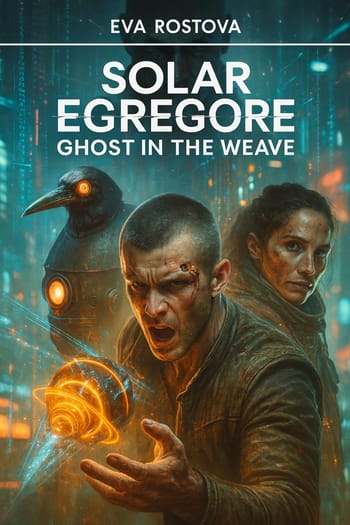
The skiff clamped onto the maintenance airlock with a low thud that the vacuum outside immediately swallowed. There was no screech of stressed metal, no shudder of impact. Just a clean, magnetic lock that was as silent and absolute as the cold rock of Phobos itself. Kaelen stood at the inner door, the recycled air of the small craft tasting stale and warm against the promise of the sterile chill ahead. He ran a gloved hand over the seam of his helmet, a useless, grounding gesture. The mission was simple. Get in, get the data-wafer, get out.
— Network handshake complete, — Walter Bell’s synthesized voice was a flat line of text in his ear, devoid of triumph or tension. — I have control of local systems. You have a clean path to the central vault. The airlock will cycle on your mark.
Kaelen gave a curt nod to the empty space of the cockpit. He didn’t need to look back to see the raven Uplift, a motionless silhouette of black composite hunched over a glowing console. He placed his hand on the airlock control and pressed the panel. The door slid open into a corridor of blinding, shadowless white.
The silence was the first assault. It was not the quiet of the void, which was a pressure of absence. This was a manufactured silence, an engineered null-space where the only sound was the whisper of his own suit’s life support and the soft crunch of his boots on the polished polymer floor. The air was cold, tasting of chilled ozone and the faint, clean scent of overworked electronics. Walter’s work was a ghost ahead of him; a series of green-lit panels on a path of red. He created a looping feed for the first bank of surveillance cameras, a perfect, four-second snippet of an empty hallway played for eternity. Kaelen moved past them, a phantom walking through a memory.
He proceeded down the main artery of the data-archive, a white canyon that seemed to stretch for kilometers. The sheer scale was an act of intimidation, a statement of Yama-Mitsui Solutions’ power. This was not a place for people. It was a machine for holding facts, a tomb for information kept perfectly preserved and utterly sterile. His tension was a cold knot in his gut, a nine on a scale of ten. The Ghost-Eater Shunt at the base of his neck, his personal token of failure, was strangely quiet, the usual chaotic static of the Resonance Field scrubbed clean by the archive’s oppressive order.
A whisper of displaced air.
Kaelen froze, flattening himself into an alcove designed for a maintenance droid. Fifty meters ahead, at a perpendicular intersection, a security drone glided into view. It was a teardrop of matte-black composite, its single, predatory red optic sweeping the corridor in a smooth, calculated arc. It made no sound, its grav-emitters a silent violation of physics. It was a perfect, lethal machine built to enforce the silence. Kaelen held his breath, his heart a frantic drum against the quiet hum of his suit. The drone passed the intersection without deviating from its patrol route. It had seen only an empty corridor, exactly as Walter had intended.
He waited a full ten seconds after it disappeared before moving again, his muscles tight. The stealth was holding, but the near-miss left a metallic taste in his mouth.
— Drone patrol pattern is predictable, — Walter’s voice cut the silence. — Another will pass your position in seven minutes. Your window is narrowing.
— Acknowledged, — Kaelen breathed, picking up his pace. The endless white was beginning to feel like a sensory deprivation chamber, a place designed to make intruders go mad from the perfection. He focused on the green lights Walter left for him, a trail of digital breadcrumbs through the machine’s sterile gut.
They reached the end of the corridor: a massive, circular vault door, its surface a seamless expanse of the same white polymer. There were no visible controls, no keypads, no handles. It was a perfect, unbroken circle.
— Final security layer, — Walter reported. — Magnetic lock, tied directly to the central server. Brute force is impossible. I need a moment.
Kaelen stood watch, his back to the vault, his eyes scanning the long, empty corridor he had just traversed. The silence pressed in again, heavier this time. He could feel the weight of the data surrounding him, trillions of facts, records, and corporate secrets, all sleeping in their crystalline beds. It was the ultimate expression of the Consensus: a universe of information with no one to interpret it, a library with no readers. It was the opposite of a ghost. It was a body without a soul.
A soft click echoed in the corridor, impossibly loud in the profound quiet. The vault door slid open with a barely audible hiss, revealing the archive’s heart.
Kaelen stepped through the threshold and the low hum of the place washed over him. It was a single, perfect, resonant frequency, the sound of a million servers breathing in unison. Racks of data-wafers stretched into the gloom, their indicator lights blinking in a slow, synchronized pulse of soft blue light. It was a city of data, a metropolis of memory, ordered and absolute. He was inside the heart of the machine that had erased Aris Volkov, the system that had broken him.
He had to find one specific soul in a graveyard of billions.
Walter’s voice was a whisper. — I cannot guide you further. The internal network is isolated from the vault. You are on your own.
Kaelen nodded, though no one could see him. He closed his eyes, shutting out the overwhelming vista of blinking blue lights. He pushed his senses outward, through the damaged hardware of the Ghost-Eater Shunt. He was not looking for a mind. He was looking for the echo of a mind, the faint resonance left on a physical object. The hum of the servers was a wall of psychic noise, clean and orderly but immense. He filtered it out, searching for an anomaly, a single note out of key in the perfect corporate symphony.
For a long minute, there was nothing but the cold, uniform static of stored data. It was a desert of information. Then he felt it. A thread. It was not the screaming pain of the ghost he had carried for months. It was a faint, thin line of warmth, a resonance that felt like a forgotten name whispered from a great distance. It was a coherent signal, a ghost with a purpose, and it cut through the sterile noise of the archive like a beam of light in the dark.
He opened his eyes and began to walk, his gaze unfocused, his body following the pull of that invisible thread. He moved past rack after rack, his gloved hand hovering over the cool, smooth surfaces of the server banks. The thread grew stronger, the faint warmth becoming a steady, quiet hum in his perception. It led him deep into the vault, to a non-descript rack in the center of a row of thousands.
His hand stopped. The thread of resonance was sharpest here, a clean vibration that seemed to center on a single point. His eyes focused. He saw a single data-wafer among the thousands, identical to its neighbors in every way. A thin, semi-translucent rectangle of crystalline polymer. But to his unique, broken senses, it glowed with a faint, internal light. He had found it. The needle in a mountain of needles.
His fingers closed around the wafer. It was cool to the touch, inert. He slid it from its slot. The indicator light on the rack for that specific wafer flickered from blue to a soft, cautionary red. A single, tiny change in a city of lights. The fifth fragment, the central piece of Aris Volkov’s shattered mind, was in his hand. The primary objective was complete.
The perfect, monolithic hum of the vault seemed to drop a fraction of a tone, a subtle shift in the machine’s breathing. The silence that followed was expectant.
He had the core of the lie, but now he had to look at it