He left the medbay and walked the length of the Stray Dog. The ship was a wounded animal, its corridors lit by the intermittent pulse of emergency lighting that threw long, dancing shadows. The vibration was a low, dissonant chord that ran from the deck plates through the soles of his boots and into his bones, a constant reminder of Zaina’s brutal feint in Mars orbit and the lanceship plasma that had torn through the port engine. The air, thin and sharp, still carried the ghost of ozone and hot, stressed metal. It was the smell of a fight they had survived, but not won.
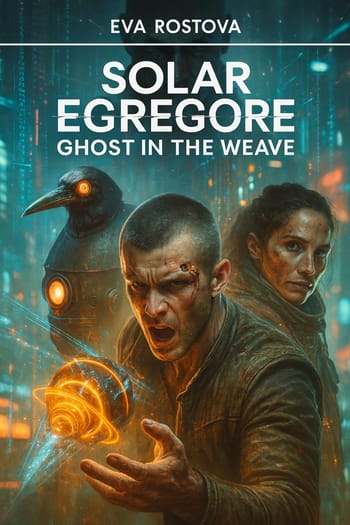
He found his way to the cockpit, a cramped nest of worn-out chairs and dark, sleeping screens. Zaina was there, strapped into the pilot’s seat, her head resting against the viewport as she slept. The fresh cut over her eyebrow was a stark, angry red against the pale skin. Walter Bell stood motionless in the corner, a black composite statue whose single amber optic tracked Kaelen’s entry without a sound. The raven Uplift was in a low-power state, a silent sentinel conserving energy for the next inevitable crisis. Kaelen didn’t disturb them. He moved to the main viewport, a wide curve of reinforced polymer that looked out onto the void.
Outside, a nebula bloomed in silent, impossible color. It was a vast cloud of incandescent gas and stellar dust, a cosmic bruise of violet, magenta, and deep, burning crimson. It was beautiful. The thought was his own, simple and direct.
Stellar nursery designated NGC 7822. Primary composition: ionized hydrogen, trace elements of oxygen and sulfur. Distance: approximately 800 parsecs. The coloration is a false-spectrum representation of gaseous emissions.
The second thought was not his, but it was in him. It was a clean, cool stream of data from the mind of Aris Volkov, an analytical overlay on the raw sensory input. He was Kaelen. He was Volkov. He was plural. He stood there for a long time, watching the slow, majestic swirl of the nebula, feeling the two streams of his consciousness flow side-by-side, a strange and silent harmony. He was at peace with the transformation.
His hand rose, fingers tracing the ugly, raised line of scar tissue on the back of his neck. The place where the Ghost-Eater Shunt had been hammered into his flesh, a brand of his failure. For months, it had been a source of torment, a cracked antenna broadcasting a dead man’s agony into his skull. An incessant, grinding pain. A phantom itch that could never be scratched. Now, there was nothing. The pain was gone. The itch was gone. The shunt beneath the skin was quiet, its purpose transformed. It was no longer a weapon or a compass or a curse. It was a bridge, a silent piece of hardware that fused two minds into one. The scar was just a scar, the healed record of a wound that no longer bled.
He pulled a datapad from the pocket of his jacket. The screen came to life, its light soft in the dim cockpit. On it was the equation. Not just numbers and symbols, but a terrible and elegant poem written in the language of mathematics. It was the core of Volkov’s discovery, the recursive flaw in the architecture of the Weinstein-Khalifa Engine, the ancient AI that held their civilization on a knife’s edge. It was a backdoor, a vulnerability so profound that Yama-Mitsui had built an empire of control upon it. He now carried that truth, not on a fragile wafer of crystal, but in the living architecture of his own mind. He had a mission.
The screen flickered. A single, jarring stutter in the display, the image of the equation ghosting for a half-second before resolving. It was the same glitch he had seen on the junker’s datapad in the Ceres Down-Spiral, a tiny, meaningless imperfection in a piece of cheap hardware. Then, it had been a reality check, a random flaw in a solid world that made the ghost in his head feel all the more unreal.
Now, he saw it differently.
Power fluctuation in the display’s primary capacitor. Probability of cascading failure: 0.03%. A common flaw in unregulated third-party hardware.
Volkov’s mind diagnosed the problem. Kaelen’s mind saw the signal. The system was flawed. All of it. From the great Weinstein-Khalifa Engine buried in the ice of Old Earth to this cheap, flickering screen. The universe wasn't a perfect, polished machine. It was a patchwork of failing components, of glitches and errors and beautiful, chaotic imperfections. The stutter wasn't noise. It was a confirmation. It was part of the truth he now carried. He had given up the chance for a peaceful, anonymous life, but in exchange, he could finally see the system for what it was.
He was no longer erased.
He was the witness.
The nebula burned silently in the void, a smear of impossible color against the black. The low, wounded hum of the ship’s drive was the only sound.
He plotted a course toward the system's broken heart