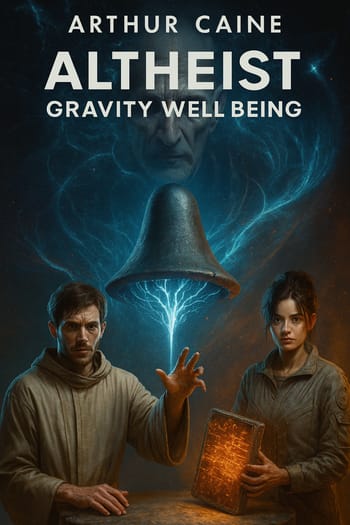
The wheel turned. Elias Vance stood before the viewport, a circle of glass set into the curved wall of the observation deck. Outside was Terminus, a place where the universe had given up. It was not a thing to be seen, but a lack of seeing, a perfect hole punched in the fabric of light and time. He had come here seeking purpose, a quiet room at the end of everything where he could finally think a thought all the way to its conclusion. The station offered that quiet. It was a silence manufactured with the same precision as the air he breathed.
He felt the familiar mix of awe and a deep, cellular loneliness. It was the feeling of being the last man alive, even in a station holding two hundred souls. They were all last men, each in their own private way. That was the point of the Penrose Oratory. It was a monastery for people who had run out of other gods. He raised a hand and wiped a smudge of his own breath from the cold glass, a small act of order against the grand, indifferent chaos. The station demanded such tidiness.
His palm rested flat against the viewport. The glass was cold enough to ache, a constant reminder of the vacuum just millimeters away. He could feel a faint, deep vibration through the material, a thrum that was not quite sound but a resonance in the bones. It was the station itself, breathing. The immense, unseen machinery of life support, gravity plating, and orbital mechanics all humming in a chorus of engineered stability. The nutrient paste he’d had for the morning meal had left a bland, starchy film in his mouth, a taste he was learning to associate with survival.
The silence here was a presence. It was not an absence of noise but a carefully curated soundscape. The life support systems generated a constant, low drone at exactly 15 decibels, a frequency the order’s founders had designated the Equilibrium Hum. It was the sound of not-dying, a constant reassurance that the complex web of machines separating him from the void was functioning as intended. It filled the ears and settled the mind, leaving no room for stray anxieties. It was the first layer of the station’s manufactured peace.
His gaze drifted from the black hole to a nearby diagnostic screen. It was a dark panel, one of thousands that lined the corridors, monitoring the station’s health. It reported nominal status in clean, white text. All systems optimal. All pressures stable. All souls accounted for. But in the upper-left corner, a single pixel on the screen flickered. It blinked from black to a faint grey, then back to black, once every thirty seconds. A tiny, rhythmic imperfection.
A ghost in the machine.
He watched it for a full minute. The station was a monument to flawless operation, a system so perfect it was meant to be a form of prayer. Every component was redundant, every process optimized over generations. Yet here was this tiny, persistent error. A single stitch dropped in an otherwise immaculate tapestry. It was nothing. An anomaly so minor it wouldn't even trigger a low-level maintenance alert. It was just a flicker. But it was there.
The flicker made him aware of the station’s shape. He turned from the viewport and looked down the long, curving corridor. The polished metal walls swept away from him in a perfect, unending circle. The architecture was designed for psychological containment, a wheel that always brought you back to where you began. There were no true straight lines on the Penrose Oratory, no final destinations. There was only the turning. The routine. The orbit.
A sudden shudder ran through the deck plates, stronger than the background hum. It lasted only three seconds, a brief, violent correction from the station’s thrusters. The immense engines on the outer hull had fired, nudging their delicate trajectory, fighting the relentless pull of Terminus. It was a constant, invisible war, a battle fought in silence with jets of superheated plasma. The placid calm of the interior was a lie, purchased every moment by these controlled explosions. The thought was unsettling. This perfect peace was maintained by a series of managed emergencies.
He turned back to the viewport. His own reflection floated there, a pale, translucent mask laid over the abyss. A thin face, dark eyes, the severe cut of his novitiate’s tunic. He looked like a ghost haunting a hole in space. He had come here to escape a universe of easy answers and manufactured meaning, a world that screamed with noise but said nothing. He had chosen the silence. He had chosen the void. But looking at his own faint image, he wondered if he had simply traded one machine for another.
The quiet was broken.
A voice, calm and genderless, bloomed from hidden speakers in the ceiling. It was the Orison Call, the station’s automated scheduler and voice of authority. It spoke with the serene dispassion of a machine that could never feel fear or hope.
"First instruction, Orientation Chamber, 0900."
The unstructured moment was over. The system had a place for him. His journey was about to begin. He pushed himself away from the viewport, his reflection vanishing as he moved. The black hole remained, patient and absolute. The pixel on the diagnostic screen flickered again, unseen.
The hum of the station felt a little louder now. The silence seemed a little thinner.