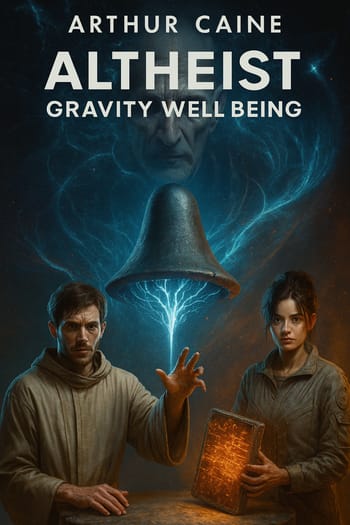
Lena Petrova’s hand did not shake. It moved with the simple, clean economy of a surgeon making the final cut. Her fingers found the switch on the master control console, a small, unassuming toggle of black composite. It was the last piece of a circuit that now included every speaker, every screen, every soul on the Penrose Oratory. She looked at Elias Vance, who sat in the listener’s chair, a living conduit for a billion screaming ghosts. He had given the nod. The price of that nod was sanity, and it was a price to be paid by everyone. She threw the switch.
For a fraction of a second, there was nothing. Only the low, ugly hum of the emergency lights and the distant, rhythmic pounding of guards on the blast door. Then the sound came. It did not start low and build. It was simply there, everywhere, all at once. It was not a noise. It was the sound of being human, played at once, without filter or mercy. It was the tender lullaby of a mother in a forgotten century, crushed by the final, terrified curse of a soldier drowning in mud. It was the sound of a billion car horns, a billion whispered confessions, a billion arguments about nothing. It was the taste of a first kiss and the smell of a burning city.
The Sum roared.
Every screen on the station, from the grand displays in the Scriptorium to the tiny personal datapads in the residential cells, flickered from their placid blue standby light to a chaotic, searing white static. The static was not random. It was a blizzard of faces and places, a storm of memory fragments moving too fast for any single mind to catch. A sun-drenched field. A concrete wall. A smiling face. A bloody hand. A lost dog. A supernova.
The people of the Penrose Oratory had spent their lives listening for a gentle father. What they got was the entire, broken, beautiful, and terrible family.
In the Scriptorium, a Canonist Monk who had spent a decade polishing the word of God into a smooth, paternal stone, looked up from his console. The sound hit him like a physical blow. His carefully crafted scripture about divine judgment was replaced on his screen by the raw, unedited memory of a child skinning her knee in a 20th-century suburb. The pain was so small, so real, so pointless. He screamed and fell from his chair, his hands clamped over his ears, but the sound was already inside his head.
In the hydroponic gardens, a technician watering the broad, waxy leaves of the oxygen-scrubbing plants dropped his hose. He saw his own mother’s face in the static on a nearby diagnostic panel, then the face of a woman he’d never met, weeping for a reason he would never know. He crumpled to the damp soil, his mind a switchboard of crossed wires.
Of the two hundred souls aboard the Penrose Oratory, all but a handful were on the floor. The mass psychic shock was a wave of pure, unmediated reality. Ninety-eight percent of the station’s population, their minds softened by the placid calm of their Cognitive Anchors, had no defense. The anchors were designed to muffle the self. They were not designed to hold back everyone else.
Leo Gallo, the novitiate who had been Elias’s first and only friend, was huddled in a service corridor where he had been hiding. He had prayed for guidance. He had prayed for the voice of God to make sense of his fear. Now the voice was here. It was not a gentle whisper. It was the shriek of a car crash, the sob of a forgotten widow, the laughter of a drunk in a language he didn't know. He wept, not from fear, but from the profound, soul-shattering betrayal. The God he had loved was a lie, and the truth was a cacophony.
Outside the sealed Choir, Deacon Marcus stood beside his Abbot. The pounding on the door had stopped. The guards had fallen back, clutching their heads, their own anchors failing them. Marcus stared in horror at his personal datapad. The screen, which usually showed his schedule of quiet contemplation and administrative duties, was now a swirling vortex of raw data. He saw the waveforms, jagged and violent, the things he had taught his monks to smooth and redact. He saw the truth he had called poison. It was not poison. It was just true. His life’s work, the act of providing a merciful story, was revealed as the act of a man who builds a cage and calls it a home.
— What have they done? — he whispered, his voice thin.
Abbot Clement did not answer. His eyes were fixed on the blast door, his face a mask of cold fury.
In the heart of the storm, inside the Choir, Lena Petrova watched a small diagnostic screen that monitored the raw feed. The chaos was absolute. A wall of noise. But for a single, impossible moment, a pattern resolved from the static. It was not a face. It was not a memory. It was a clean, geometric structure of nested, pulsing lines, a thing of pure mathematics that hummed with an intelligence that was not human. It held for a fraction of a second, a ghost of impossible order in the heart of the human mess. Then it was gone, swallowed again by the screaming. Lena’s breath caught in her throat. She had seen it. A signal within the signal. A vast, quiet murmur beneath the roar.
Elias Vance felt none of it. He heard none of it. He was the eye of the hurricane. He was the silence that gave the noise its shape. The strain was a physical thing now. The dull ache behind his eyes had become a white-hot spike being driven into the base of his skull. He felt the immense, crushing weight of the Sum pressing in on him, a psychic gravity well threatening to pull him apart. He was the dam, and the water was a sea of souls. He held.
He remembered the Cracked Slate of Korbin, the way it had shattered on the floor of the Synod Chamber. A broken thing. He felt the station breaking around him, the single, monolithic faith shattering into two hundred pieces. It was right. It was necessary. Truth was not a whole, smooth thing. It was a collection of sharp, broken shards. You could not hold it without bleeding.
The station screamed. The lights flickered, casting frantic shadows that danced like madmen. The air itself felt thin, vibrating with the psychic overload. The lie was broken. The great, single story was dead. Chaos reigned.
And in the heart of the screaming, Abbot Clement saw his chance.