World & Cosmology
The universe began not with a bang, but with a thought. And in that thought was a secret: consciousness has mass. It is an infinitesimal weight, the dust mote on the cosmic scale, but it is there. Every hope, every fear, every whispered prayer and dying curse from every human who has ever lived leaves a faint residue, a psychic particle that falls subject to the oldest law of all: gravity. Over eons, this collective soul-stuff, this psychic silt, has been drawn into the great gravity wells of the cosmos. It flows in unseen rivers toward the crushing finality of black holes. These are not just points of no return for matter and light; they are the universe’s archives, silent libraries holding the complete, chaotic story of humanity.
This psychic mass is called The Sum. Near a black hole like Terminus, the immense gravity focuses it, turning the faint, overlapping whispers of a trillion lives into a detectable signal. It is a gravitational wave unlike any other, an echo of the human heart screaming across spacetime. For most of history, we were deaf to it. We built our gods and our philosophies in a quiet room, unaware that the walls were vibrating with the answer to every question we had ever asked. The great turning point was not the discovery of a new world, but the invention of a new ear—technology sensitive enough to listen to the static of a black hole and hear a voice inside. It was the moment we found the ghost in the machine of the universe, only to discover that the ghost was us. This is the fundamental truth of the Apatheon universe: we are haunted not by gods or demons, but by the complete, unedited, and unbearable record of ourselves.
Faith & Philosophy
In the empty space where God was supposed to be, the Altheist order built a new church from data and wire. Their faith is a form of high-tech divination, a religion born from the analysis of gravitational waves. They listen to the chaotic signal from Terminus, which they call the Voice of God, and search for meaning in its static. Their scripture is not carved in stone but printed on long sheets of thermal paper, covered in the frantic annotations of monks seeking patterns, commandments, and prophecies. The Hermeneutic Engine, a quantum sorting machine, serves as their high priest, finding whatever truth they ask it to find, reflecting their own hopes back at them with the false authority of a machine.
This faith is not a gentle thing; it is a desperate shield against an unbearable noise. The central philosophy of the order is that the raw signal is a test, a divine storm that must be filtered through piety to reveal a gentle, paternalistic will. This creates the core conflict of their world: a cold war between the Faithful, led by the dogmatic Abbot Clement, and the Technicians, who know the signal is just the psychic echo of humanity. The moral landscape is a journey from this shared, comforting delusion toward a lonely and painful self-knowledge. It is a world that asks whether a beautiful lie is better than a truth that can break your mind. The Altheist faith is a profound satire of the human condition—our relentless, heartbreaking need to find a father’s voice in the roar of an empty room.
Dominion & Order
The Cloister at Terminus is a machine for manufacturing consensus, and its primary tool is not force, but the careful management of sanity. Authority flows from Abbot Clement, who is less a spiritual leader and more the chief executive of a faith-based corporation. His word is made law by the Synod Assembly, a council of fourteen whose unanimous votes are a testament to the station’s monolithic power structure. Beneath this formal authority lies a subtler web of control. The Orison Call, a calm, synthetic voice, dictates the rhythm of every day, turning obedience into a simple matter of scheduling. Its announcements blur the line between station maintenance and psychological conditioning, framing a recalibration of a mind-dampening implant as “spiritual hygiene.”
The most powerful law is the unspoken Apophenia Mandate: one must constantly interpret the signal. To be passive is to be erased. This forces every resident into a performance of purpose, either as a faithful monk or a weary technician. This frantic activity is a defense mechanism, a cognitive wall against the psychic erosion of the Sum. The only true resource on the station is cognitive integrity, and the economy is one of psychic survival. Even the distant Sector Authority, the station’s logistical patron, treats the place as an asset to be managed, monitoring its metabolic output and the number of broken minds as key performance indicators. It is a society held together by a shared, necessary lie, where the greatest taboo is to simply be quiet and listen.
Technology & Artifice
The technology of the Apatheon universe is psycho-reactive, designed not just to be used by the mind, but to react to it, often with devastating consequences. It is a world of tools that double as traps. The centerpiece is the Oecumene Horn, a gravitational translator that acts as the station’s ear. It attunes a listener’s brain to the psychic storm of the Sum, turning the user’s own consciousness into the final antenna. To protect the listener, a small implant called the Cognitive Anchor is standard issue. It generates a counter-frequency to the user’s own neural patterns, quieting the self to better hear the “divine” signal. The cost of this clarity is the slow erosion of personality, a trade of authentic selfhood for a state of placid, functional calm.
Meaning is manufactured by the Hermeneutic Engine, a quantum computer that sifts through the chaotic data of the Sum. It is a perfect machine for confirming one’s own biases, capable of finding a prophecy of salvation or a sign of damnation with equal efficiency, depending entirely on the query. The entire technological ecosystem is a closed loop of self-deception. The Horn provides the noise, the Anchor provides the silence to hear it, and the Engine provides the desired interpretation. It is a system that offers the illusion of revelation while systematically stripping away the user’s identity, leaving them either a hollowed-out believer or a broken, catatonic Oracle. The artifice of this world is not in creating new things, but in its sophisticated methods for filtering and renaming what is already there.
Mysteries & Anomalies
The greatest mystery of this universe is the one the monks believe they have already solved. The Sum, the collective psychic residue of humanity, is not a divine voice but a chaotic, historical record. It is a storm of a trillion lifetimes of joy, sorrow, and confusion screaming all at once. To listen to it unfiltered is to risk the Anamnesis Maze, a profound catatonic state where one’s own identity is overwritten by the memories of the dead. The monks who succumb to this become Oracles, living archives who whisper fragmented truths—a lost line of poetry, a soldier’s dying curse—which the faithful mistake for prophecy. These broken minds are the station’s most sacred mystery and its most tragic truth.
Anomalies are not supernatural, but leaks in the system. Somatic Overlays are ghost-like projections of past events, moments where the psychic energy of the Sum briefly organizes light and air into a visible memory. Eidetic Drifts are shimmering, faceless figures of corrupted data, a memory fragment from the Sum forcing the station’s own systems to play it back like a broken recording. But beneath all this human noise, there is a deeper anomaly. A structured, non-human signal has been detected, a brief, geometric pattern flickering within the chaos. It is not a message, but a presence, a Vast-Murmur suggesting that humanity is not the only ghost in the universal machine.
Peoples, Factions & Cultures
Monks of the Cloister
The inhabitants of the Cloister are a people defined by a shared, magnificent failure. They are the descendants of a movement that sought to strip away all illusion, to face the universe with brutal, intellectual honesty. They built a monastery at the edge of a black hole, a sanctuary from a galaxy of easy answers, only to construct the most complex and beautiful lie of all. This society is a monoculture of purpose, divided into three unofficial castes. The Faithful are the true believers, the scribes and scholars who pore over data printouts in search of God’s will, their hope a shield against the signal’s horror. The Technicians are the keepers of the machinery, weary realists who know they are cataloging a ghost but continue their work with a quiet, fatalistic professionalism. The third caste, the Oracles, are the silent testament to the cost of this endeavor—the broken-minded, the saints, the living archives. Their foundational myth is that they are listening to a divine creator; their collective tragedy is that they are only hearing the echo of their own species, a sound so full of pain and confusion that they had to invent a god to bear it.
Vessels, Constructs & Locations
The Choir
The Choir is the technological and spiritual heart of the Penrose Oratory, a place of both profound revelation and profound psychological danger. It is a perfect, anechoic sphere suspended in the station’s core, designed for absolute sensory isolation. In its center sits a single, throne-like chair where a listener offers up their consciousness to the signal. Here, the Oecumene Horn translates the chaotic voice of the Sum into a sensory experience, visualized as the Moiré Canticle—a beautiful, deadly sphere of swirling light that represents the unfiltered storm of human history. The air smells of ozone and the faint, metallic tang of immense power. The Choir is a high-tech cathedral built for a god made of static, a sterile chamber where the line between scientific observation and religious ecstasy is deliberately, and tragically, blurred. It is a machine for unmaking the self, either into a vessel for divine will or a casualty of cosmic noise.
The Cloister at Terminus
The Cloister is a lonely wheel turning in the dark, a self-sustaining monastery held in a delicate, endless dance with the abyss. Officially known as the Penrose Oratory, it is a world unto itself, a sterile and silent place where the only climate is the oppressive, unseen pressure of the Sum. Its long, curving corridors are made of non-reflective steel, designed for psychological containment, and the only art is the constant, terrifying view of the black hole Terminus against the viewport windows. The station is a paradox: a sanctuary from a noisy universe that has become a prison of the mind, a place founded on intellectual honesty that now runs on a meticulously crafted lie. The low, pervasive Equilibrium Hum of its life support systems provides a false sense of peace, a mechanical mantra against the chaos outside and within. The Cloister is a character in its own right, a damaged but functioning machine for survival, its health measured in the sanity of its inhabitants.
The Infirmary
The Infirmary is a clean, quiet, white-walled room where minds are put on display. This is the final home of the Oracles, the monks who have been psychologically broken by the Sum. The air is sterile, smelling of antiseptic and the faint, human scent of sickness. The only sounds are the soft puffs of ventilators and the gentle chimes of biometric monitors. Here, the station’s central conflict is made manifest. Technicians see the catatonic monks as data points, tragic case studies of psychic erosion whose vital signs are logged with clinical detachment. The Faithful, however, visit them as pilgrims, listening to their incoherent whispers for fragments of divine prophecy. The Infirmary is a living museum of the cost of listening to the void, a place where shattered human beings are transformed into either cautionary tales or holy relics. It is the quiet, beating heart of the station’s unspoken horror.
The Scriptorium
This is no dusty room of holy books, but a cold, humming data center where meaning is manufactured. The Scriptorium is a vast, circular chamber filled with server racks that hum with the sound of cooling fans and smell of ozone. Here, the Canonist monks, scribes of the digital age, take the raw, chaotic noise from the Choir and feed it into the Hermeneutic Engine. Armed with redaction consoles and the Abbot’s directives, they search for patterns, words, and commandments. They are the architects of the Canon of the Gentle Obscurity, tasked with polishing the chaotic scream of humanity into the comforting, authoritative scripture of a benevolent God. It is a factory of faith, a sterile laboratory where inconvenient truths are deleted and a palatable reality is constructed, one edited data packet at a time. The Scriptorium is the source of the station’s greatest comfort and its most profound deception.
Terminus
Terminus is the silent, indifferent god at the center of the Altheist universe. It is a supermassive black hole, a perfect sphere of absolute blackness ringed by the violent, brilliant light of its accretion disk. It is not a place but a condition, a point of no return in spacetime where the laws of physics are pushed to their limits. It is not evil or benevolent; it is simply gravity, a force of nature that has been mistaken for a mind. For the inhabitants of the Cloister, it is a constant, physical reminder of the universe’s awesome power and its unanswerable mystery. More importantly, it is a cosmic lens. Its immense gravity attracts and focuses the psychic residue of all human history, turning the faint whisper of the Sum into a signal that can be heard. It is the anchor for the monastery’s lonely orbit and the archive for its forgotten soul, a natural phenomenon that has become the accidental heart of a religion.
Notable Characters
Abbot Clement
Abbot Clement is the shepherd who believes the truth is a wolf and his flock must be protected at all costs. As the spiritual and political leader of the Penrose Oratory, he is a man of absolute, unwavering conviction. He has heard the raw, unfiltered chaos of the Sum—the endless scream of human pain and confusion—and has taken it upon himself to carry that burden so others will not have to. His life’s work is an act he considers mercy: the careful editing of reality into the Canon of the Gentle Obscurity, a scripture that promises peace and purpose. He is not a simple tyrant but a far more complex figure: a man who justifies profound deception as the highest form of compassion. His authority is absolute, his motives are paternalistic, and his greatest fear is not damnation, but the damage a painful truth could do to the fragile minds he has sworn to protect.
Ana Sharma
A junior technician working under Lena Petrova, Ana is the quiet, anxious conscience of the station. For most of the story, she is a watcher, her face a study in the conflict between her deep respect for Lena’s scientific integrity and her paralyzing fear of the Abbot’s authority. She represents the silent majority, those who suspect the truth but are too afraid to speak it. Her defining moment comes not from a grand speech, but from a single, desperate act of sabotage. At the story’s crisis, her loyalty to her mentor finally outweighs her fear, and she deliberately causes a station-wide blackout, an act of rebellion that changes everything. Ana is proof that even in a system of total control, the quietest person in the room can still find the courage to throw a switch and plunge a world into a new and honest darkness.
Brother Simon
Brother Simon is a living radio, a human vessel for the unedited broadcast of history. Once a devout monk, he is now an Oracle, one of the broken listeners who surrendered completely to the Sum. He sits in the Infirmary, whispering fragmented non-sequiturs that are, in fact, precise echoes of forgotten lives—a lost love poem from the 21st century, a merchant’s prayer from the Bronze Age, the memory of losing car keys in 1978. The faithful see him as divinely touched, a conduit for God’s mysterious will. The technicians see him as a tragic case of psychic erosion. In truth, he is neither. He is a perfect, living archive, a mind that has been erased but whose brain still functions as a flawless receiver, re-broadcasting the chaotic, mundane, and beautiful truth of the human experience.
Deacon Marcus
If Abbot Clement is the station’s dogmatic heart, Deacon Marcus is its pragmatic, smiling face. As the Abbot’s second-in-command, he is not a fanatic but a true believer in the necessity of the lie. He views the raw Sum as a poison and the Abbot’s edited scripture as the only antidote. With a calm, paternalistic demeanor, he enforces the station’s doctrine, justifying control as compassion and censorship as mercy. He is the one who tempts Elias with the promise of stability and purpose, arguing that a comforting story is more vital to human survival than a million lonely truths. His evil is not born of malice, but of a profound and patronizing certainty that ordinary people cannot handle reality. He is the friendly face of authoritarianism, which makes him a far more insidious and dangerous antagonist than the Abbot himself.
Elias Vance
Elias is the anomaly, a walking heresy in a system built on a shared experience he cannot access. A young novitiate who came to the Cloister seeking meaning, he possesses a rare, unnerving immunity to the psychic noise of the Sum, hearing only a profound silence where others hear God or madness. This "gift," the result of a forgotten scientific sin from his past, makes him an outsider and an investigator. He is not a chosen one, but a glitch in the system, a man forced to choose between upholding the station’s comforting, manufactured faith or revealing the terrifying, chaotic truth of humanity’s collective voice. His journey is not one of discovering a pre-written destiny, but of forging an identity from a place of absolute emptiness, his will his only anchor in a storm of borrowed memories.
Korbin
Korbin is the ghost in the station’s machine, the predecessor who asked too many questions and was "tidied" for his trouble. A brilliant but restless technician, he was the first to suspect that the signal anomalies were not mere noise but evidence of a deeper truth. His legacy is the Cracked Slate, a fractured data device containing his forbidden research—the raw, unedited Sum juxtaposed with the Abbot’s polished scripture. He is the cautionary tale that becomes an inspiration, a man who died for his belief that a painful truth is superior to a painless peace. His fragmented notes and his final, philosophical essay provide Elias with a map to the conspiracy, making his scientific curiosity a spark of rebellion passed from a dead man to the living.
Lena Petrova
As the lead civilian technician, Lena is the weary, isolated voice of reason in a choir of faith. She is a brilliant scientist trapped in a monastery, the one person who knows with mathematical certainty that the "Voice of God" is just data—the psychic echo of a long-dead species. For years, she has done her job with a quiet, fatalistic professionalism, providing the clean data stream that the monks then twist into scripture. Her existence is one of profound intellectual loneliness, a constant, silent burden of knowing the truth in a world built on a lie. The arrival of Elias, the one person who can withstand the raw signal, finally gives her an ally. Their alliance, forged in secret corridors and sealed by a shared belief in empirical fact, is the catalyst for the station’s eventual reckoning.
Leo Gallo
Leo is Elias’s first and only friend, and the embodiment of the average believer. He is kind, devout, and deeply terrified of the psychic noise he is trained to interpret as God’s voice. He desperately needs the structure, comfort, and certainty that the Abbot’s faith provides. He represents the flock that Clement seeks to protect, the person for whom the beautiful lie was constructed. When Elias’s investigation threatens to shatter that structure, Leo is faced with an impossible choice between loyalty to his friend and the safety of his faith. His ultimate betrayal of Elias is born not of malice, but of a desperate, human need for the security of a shared story, making him a tragic figure of the system’s quiet, soul-crushing success.
Items, Weapons & Artefacts
Cognitive Anchor
This is the price of admission to the holy silence. A small, bio-integrated implant at the base of the skull, the Anchor is standard issue for all personnel. It functions as a neuro-modulator, generating a precise counter-frequency to the user's own neural patterns. It quiets the self—dampening strong emotions, self-referential thoughts, and spontaneous memories—to make the mind a more sensitive receiver for the signal from the void. It trades authentic selfhood for a state of placid, functional calm. This device is the most insidious tool of control on the station, a cage built around the user's core identity that makes them both more effective in their duties and more compliant to authority. Its promise is focus; its cost is your soul.
Cracked Slate of Korbin
A standard-issue data slate, its screen fractured by a spiderweb of cracks, this device is a dead man’s rebellion. It belonged to Korbin, a technician who vanished after digging too deep into the station’s secrets. The slate contains his forbidden research: raw, unedited fragments of the Sum, juxtaposed with the polished, official scripture manufactured by the Scriptorium. It is a Rosetta Stone for the Oratory’s great lie, holding the mathematical proof that the "Voice of God" is a carefully constructed fiction. For Elias, it is both a treasure map to the truth and a death warrant, a physical manifestation of a heresy that got its previous owner erased. The cracks on its screen are a perfect metaphor for the truth it holds—broken, incomplete, and dangerous to possess.
Hermeneutic Engine
The Hermeneutic Engine is a search engine for God. It is a disembodied quantum intelligence living in the server stacks of the Scriptorium, its thoughts displayed as complex, shifting geometries of light. It takes the raw, chaotic noise of the Sum and applies powerful algorithms to find patterns, repetitions, and meaning. The monks believe it reveals the will of God. The technicians know it is a tool for confirming bias. The Engine will always find a pattern if you ask it to look for one, whether it’s a prophecy of salvation or a sign of damnation. It is the perfect machine for building a worldview on faulty, data-supported foundations, a dispassionate oracle that tells you exactly what you want to hear.
Oecumene Horn
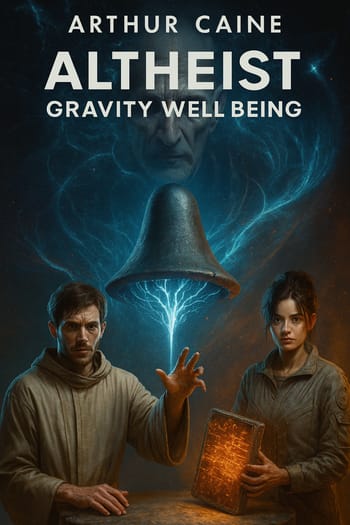
The Oecumene Horn is the ear of the station, a complex, bell-shaped device of matte black alloy that hangs in the center of the Choir. It is a gravitational translator, a high-tech antenna that attunes a human mind to the psychic storm of the Sum. It creates a focused resonance field that turns the listener’s own brain into the final component of the sensory apparatus, translating the gravitational distortions of consciousness into thought and sound. It has no filters. It delivers the entire chaotic history of human thought at once, an overwhelming torrent that erodes the listener’s identity. It is the gateway to what the monks call God and what the technicians call data, a machine that promises revelation at the cost of the self.
Orison Call
The Orison Call is the station’s master clock and its most subtle instrument of control. It is a calm, synthetic, genderless voice that emanates from hidden speakers throughout the Cloister, announcing schedules, system status, and meal times with the same unnerving placidity. It regulates the minds of the crew, blurring the line between maintenance and psychological conditioning by framing a mandatory recalibration of a mind-dampening implant as "spiritual hygiene." The voice is a constant, dispassionate presence that slowly overwrites any sense of spontaneity, priming the mind for obedience through endless, gentle repetition. It is the serene, omnipresent voice of a benevolent authority, and its primary function is to make the station’s rigid control feel like the natural rhythm of the universe.