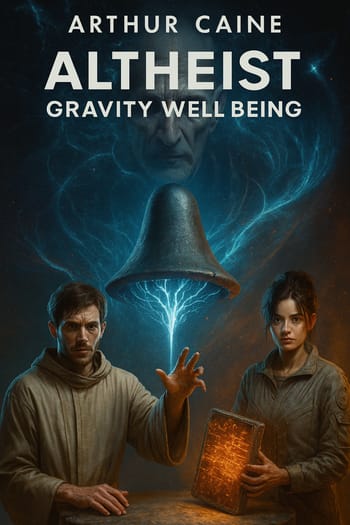
The thought was a cold, clean piece of metal in his mind as he moved through the sleeping station. The Orison Call was silent, the corridors lit by a low, yellow maintenance glow. The only sound was the ever-present Equilibrium Hum, the soft drone of the life support that was meant to be calming but now felt like the purr of a waiting animal. He carried his personal datapad, the five minutes of Brother Simon’s whispers a forbidden weight in his tunic.
Lena Petrova’s workshop was in the station’s technical spine, a place of exposed conduits and the faint, sharp smell of ozone. She was waiting for him. The door slid open to reveal a space that was the opposite of his sterile cell. It was a controlled chaos of tools, diagnostic screens, and half-disassembled hardware. Lena sat at a console, her face illuminated by the cool blue light of a monitor. A mug of a dark, steaming liquid that smelled vaguely of burnt chicory sat at her elbow, a small, human stain in the high-tech environment.
She looked up, her eyes tired but sharp. She didn't waste time with greetings.
— You got it? — she asked, her voice low.
Elias nodded, pulling the datapad from his sleeve. He placed it on the console next to her mug. The price of this meeting was their careers, maybe their lives. The risk felt like a third person in the room. Lena took the datapad and plugged it into her terminal.
— I have a back-door into the raw sensor feed, — she said, her fingers moving across the holographic interface. — It’s not the full Oecumene Horn experience, but it’s the same data stream before the Hermeneutic Engine gets its hands on it. Before the Scriptorium turns it into a bedtime story.
She gestured to a large, dark screen that dominated the wall. — I can run the audio from your recording against the live feed. The data-stream visualizer will map it.
— Can you search it? — Elias asked.
— I can try. It’s like searching an ocean for a specific drop of rain, but the algorithm is good. What are we looking for?
— Phrases, — Elias said, his gaze fixed on the dark screen. — Specific phrases.
Lena finished her work. — Alright. I’m giving you access. The terminal is slaved to your biometrics for the next hour.
The large screen on the wall flickered to life. It was not a screen of text or numbers. It was a swirling, three-dimensional sphere of light, a chaotic dance of blues and violets. It was beautiful. It was the Moiré Canticle, the visual representation of the Sum. It was the storm.
Elias felt a familiar pressure build behind his eyes, the sensation of a great weight pressing in on his mind. It was the feeling of standing at the bottom of a very deep ocean. But where others heard the crushing roar of the water, he heard only the quiet thrum of his own blood. His immunity was holding. He could look at the storm without being swept away. The data rate was immense, 1.2 petabytes of human experience flowing past every second, and he was the only person on the station who could stand in the middle of it and not shatter. The strain was still there, a dull headache that was the price of his unique perception.
— It’s… all of it, — he whispered, watching the endless, silent explosion of light. He saw flashes of color, fragments of images too fast to register, the visual static of a trillion lives lived and lost. It was a storm of images, sounds, and emotions. It was everything.
— That’s the voice of God, — Lena said, her tone bone-dry. — Looks messy, doesn’t it?
Elias turned back to the console. — Play the recording. Run the search.
Lena initiated the program. The sound of Brother Simon’s dry, whispering voice filled the workshop, a stark contrast to the silent, violent beauty on the screen.
— Lost the car keys in ’78…
A search algorithm began to scroll down a small window on the console, a river of code trying to find a match in the petabytes of data flowing from the black hole. The minutes stretched into a long, tense silence, broken only by Simon’s recorded whispers and the low hum of the server racks. This was the cost of knowing. Not a single, heroic moment, but the slow, grinding passage of time spent staring at a screen, waiting for a miracle of mathematics.
— She smiled…
— North pier, page twenty…
The search continued. Elias felt a knot of doubt tighten in his gut. It was impossible. The sheer volume of data was too vast. His hypothesis was a fantasy, a story he’d told himself to make sense of the madness. He was no different from the monks in the Scriptorium, looking for patterns in the noise.
— The rain smelled like wet asphalt…
— Anything? — he asked, his voice tight.
— Noise. Just correlated noise, — Lena said, her eyes scanning the readouts. — The algorithm is finding echoes, harmonic similarities, but nothing concrete. It’s…
A soft chime cut her off. A single line of text on the search window flashed green.
— Wait, — Lena breathed. — I have a flag. A potential match.
Elias leaned in, his heart pounding. The algorithm had flagged Simon’s first phrase. The ridiculous, mundane, utterly human phrase.
— ‘Lost car keys,’ — Elias read from the screen.
— It’s a high-probability match, — Lena said, her voice now charged with an energy that wasn’t there before. She worked quickly, her hands flying across the interface. — I’m isolating the corresponding data packet. It’s old. Very old. The timestamp is…
She trailed off, staring at the screen.
— What is it? — Elias pressed.
— The timestamp is from the late 20th century, Earth standard calendar, — she said, her voice a near whisper. — It’s a memory fragment. From before the diaspora. Before any of this.
She routed the packet to the main screen. The swirling sphere of the Sum collapsed, replaced by a single, grainy image. It was a first-person view. A pair of hands, a man’s hands, were patting the pockets of a strange, coarse blue fabric. Below the hands was a steering wheel, ancient in its design. Through a smudged window of transparent glass, a street scene was visible, lined with boxy, wheeled vehicles and strange, solid architecture.
A voice came through the speakers. Not Simon’s dry whisper, but the original. The voice of a man, frustrated and tired, from centuries ago.
— Ah, hell, — the voice said. — Lost the car keys again.
The image dissolved. The screen went blank.
The workshop was silent, save for the hum of the machines. Elias stared at the empty screen, the man’s simple, frustrated voice echoing in his mind. He thought of the Cracked Slate of Korbin, the broken pieces of truth he kept hidden in his wall. This was the same. A fragment of a life, pulled from the abyss.
It wasn’t a god. It wasn’t a divine plan. It was a man who couldn’t find his keys. It was a woman sobbing. It was a soldier cursing in a trench. It was the beautiful, terrible, mundane storm of being human.
— He wasn’t mad, — Elias said, the words landing with the weight of a verdict. — Brother Simon. He’s a perfect memory. He’s a recording.
Lena leaned back in her chair, running a hand through her hair. She looked from Elias to the blank screen and back again. The scientist in her was stunned into silence. The data was irrefutable. The proof was absolute.
— A living archive, — she said, the term clinical, but her tone was full of awe. — His mind is gone, but the receiver is still on. He’s just… re-broadcasting.
Elias nodded slowly. The foundation of the Penrose Oratory, the entire Altheist faith, was built on the idea that the Sum was the voice of God. A voice that had to be interpreted, filtered, and polished by the Abbot and his monks. But they had just proven it wasn’t a voice to be interpreted. It was a library. A chaotic, unfiltered, and painfully honest library of every human thought and feeling, all screaming at once.
The low hum of the server racks filled the quiet room. The faint, sharp smell of ozone seemed to hang in the air.
The Sum was history. His next task was to find the factory where it was manufactured into scripture.