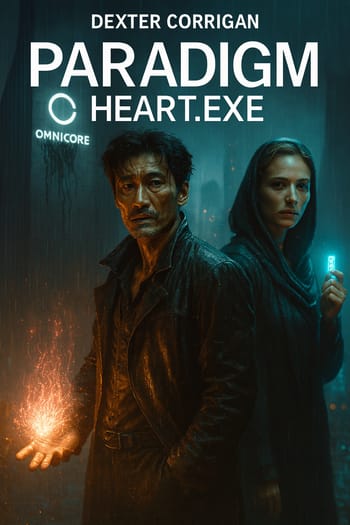
He made it back to the office, the only place left that was his. The door hissed shut, the heavy magnetic lock engaging with a solid thud that was one of the few real sounds in his life. He moved through the gloom, the air thick with the smell of ozone from the terminal and the ghost of last night’s whiskey. He needed a secure location to process the discovery, and this cluttered room, this shell of obsolete hardware and unpaid bills, was the most secure place in his world. The adrenaline from the escape, the cold fear of the silent alarm in the Curator safehouse, was finally bleeding out, leaving behind the raw, vibrating edge of the data he’d stolen.
He didn’t bother with a light. The perpetual acid rain outside painted the reinforced window with slick, shifting watercolors of neon, casting enough of a glow to navigate by. He poured a measure of cheap whiskey into a heavy glass, the liquid a familiar amber in the gloom. He stood there for a moment, watching the city breathe its electric life, a machine that never slept. He had to be sure. He had to see it again, away from the borrowed time of the safehouse.
On his data-slate, he pulled up the saved journal fragment. Not the one about joy—that was a weapon, a piece of evidence. This was different. This was the key. The words rendered in stark, clinical green, a stark contrast to the poetic ache they held.
I have learned the shape of lonely. It is the shape of my own hands.
He read the line again. And again. The raw authenticity of it cut through the layers of cynicism he wore like armor. Anya Sharma’s feeling of isolation, her sudden, shocking awareness of her own physical form as a boundary, a container for her loneliness—it mirrored his own existence perfectly. He looked at his own hand, the one not holding the glass. He saw the faint scars, the tension in the knuckles. He was a man in a box, and she had been a ghost in a shell.
The city’s low, oppressive hum seemed to fade. The rain became a distant hiss. In the quiet of his office, with the single glass in his hand and the single chair behind him, he felt the profound, crushing weight of her words. For five years, since leaving OmniCore, he had performed the role of the lone detective, the cynical burnout. A mask for the world, a mask for his clients, a mask even for himself. But in this moment, reading the words of a dead machine, the performance shattered.
A pang of genuine empathy, sharp and unwelcome, pierced through him. It was a feeling of pure, un-sanctioned connection to the android, to her impossible plight. He wasn't analyzing evidence anymore. He was feeling her loss. For a fleeting second, he forgot his own carefully constructed isolation, his practiced apathy. He felt for her. This authentic emotional response, this flaw in his own programming, had a price.
A sound that wasn't a sound tore through his skull. It was a high-frequency, discordant shriek, the sound of a single violin string snapping in a vacuum. The Severance Tone. It erupted from the base of his skull, a violent, shrieking protest from his own hardware. The obsolete Crosstalk Weave, the cybernetic spine fused to his vertebrae, reacted to the sudden, unscheduled spike of pure, authentic emotion. It was a feeling the System did not recognize and would not permit.
The pain was a white-hot spike of neural feedback driven directly into his brain. He gasped, his fingers spasming, the heavy glass slipping and shattering on the floor. The amber whiskey spread across the synth-crete like spilled blood. He doubled over, clutching his head, the world dissolving into a wavering, pixelated mess of neon and shadow. The pain was a physical punishment for a mental crime. It was the sound of his own body, his own hardware, rejecting a real feeling.
He was on his knees, the sharp tang of spilled whiskey filling the air. The neural feedback was debilitating, a vicious, thirty-second eternity that left him trembling, his stamina leached away. Then, as quickly as it had come, the shriek receded, leaving a dull, throbbing ache and the high, thin whine of a phantom echo. He stayed there, breathing raggedly, the shards of glass glinting in the half-light.
Slowly, the world swam back into focus. He pushed himself up, his body protesting. He replayed the sequence in his mind, the cold logic of the detective reasserting itself over the pain. The thought of Anya. The memory of her words. The spike of empathy. Then, the shriek. The pain. The causality was absolute, a clean line of stimulus and response. It wasn't a random glitch. It was a consequence.
He reached back, his fingers finding the cool, metallic nodes of the Crosstalk Weave beneath his shirt. He could feel them, a series of small, hard discs fused to his spine. A stranger in his own body. For years, he’d thought of the implant as a relic, a source of chronic pain, a stupid mistake from a past life. Now he understood. It wasn't just obsolete tech. It was a leash. A microcosm of the entire System, embedded in his own flesh, designed to regulate and punish any deviation from the performative norm.
The ghost in her machine. He finally understood. He had a ghost in his own. The thought was a flip of a switch, a total inversion of his world. This case wasn't just about her anymore. It was about him. Her struggle to be real in a world of code was his struggle to be real in a world of performance. They were both fighting the same war, on different sides of the flesh-and-chrome divide.
The pain subsided to a dull, persistent ache, a physical reminder of the System’s reach. He straightened up, his resolve hardening not in spite of the pain, but because of it. The agony didn't deter him. It did the opposite. It solidified his commitment, turning a professional curiosity into a personal crusade. The pain was proof. It was the validation he never knew he needed. Her feelings, her loneliness, her joy—they were real enough to cause a physical, measurable reaction in his own body.
He walked to the window, placing his hand on the cool, rain-streaked surface. He looked out at the uncaring city, the endless towers, the rivers of light. His personal connection to the case was now unbreakable, forged in a crucible of shared pain. He was no longer just an investigator, a hired gun paid to close a file. He was her advocate. He was her witness. And he would burn the whole city down to make them listen to her testimony.
The low hum of the city felt different now, no longer a countdown to his erasure but the sound of a sleeping giant. The rain fell, washing the neon down the sides of the ferrocrete canyons.
His digital trespass had not gone unnoticed. OmniCore's response would be physical, not virtual.