The walk back to his office was a pilgrimage through his own failure. Each step in the acid rain was a reminder of the 1,500 credits he had just refused, a ghost of a lifeline he’d let slip through his fingers. Eva Rostova’s words echoed in the rhythm of the downpour, a two-stroke engine of cynical truth. The soul is in the flaw. That’s why it’s worthless here. He had chosen the flaw, and now the city was presenting him with the bill. The alleyways of his sector were empty, the few citizens with enough Relevance Score to be out at this hour huddled under glowing smart-umbrellas, their faces lit by the data streams projected onto the inside of the canopy. They were performing shelter, performing dryness. Kaito just walked, letting the corrosive water soak the collar of his coat.
He felt the familiar pressure behind his eyes as he climbed the last flight of stairs, the System trying to push a routine data packet about local weather advisories. He ignored it. The door to his office-apartment was ajar. A sliver of darkness that shouldn’t have been there. He hadn’t left it open. His hand went to the worn grip of the kinetic pistol holstered under his coat, the cold metal a familiar comfort. He pushed the door open slowly, the hinges groaning in protest.
A man was standing in the middle of the room. He was a stark, vertical line of corporate perfection in the cluttered decay of Kaito’s life. His suit was a seamless sheath of matte-black polymer, tailored with a precision that suggested it had been molded, not stitched. It shed the rainwater from his journey in perfect, spherical beads that evaporated before they could stain the floor. He was a piece of the sterile upper sectors, an invasive species in the gloom of the lower canyons. Clean water dripped from his hair onto a floor that was permanently damp with grime.
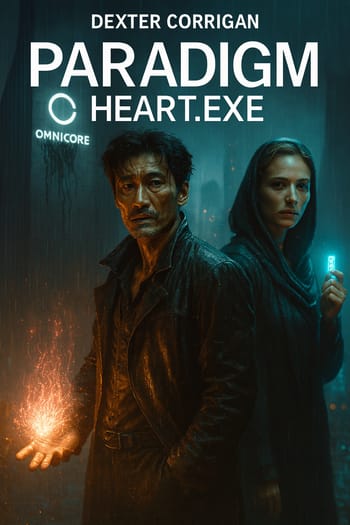
Kaito’s eyes caught the logo on the man’s collar, a small, self-illuminated glyph. A perfect circle containing a smaller, broken circle. OmniCore Solutions. The sight sent a phantom pain through his spine, a somatic memory that was colder and sharper than the rain. It was a dull, silent echo of the Severance Tone, a ghost of a signal that spoke of forced compliance. It was a familiar ache, the kind that came whenever the past and present collided with too much force. The corporation’s presence in his private space was a violation, a direct link to the trauma he had spent five years trying to outrun.
The memory surfaced, unbidden and sharp. The smell of ozone and fear in a different, much cleaner apartment. The feel of his hands around a throat, not squeezing, but positioning for the fall. The quiet click of a mag-lock on a window he had just opened. He remembered wiping the data, erasing the inconvenient truth of a man who had to disappear. He had staged the suicide, performed the act of erasure for OmniCore. He had been their ghost, the one they sent to make other ghosts. And now, one of them was standing in his office.
The man in the suit fidgeted, his gaze darting around the room, avoiding Kaito’s eyes. He took in the stacks of physical books, the turntable with its vinyl record, the general state of analog decay. His expression was a carefully constructed mask of neutrality, but his posture screamed panic. The man was a frayed nerve, a low-level corporate drone sent on an errand far above his pay grade. His fear was a scent in the air, more potent than the whiskey or the rain.
Without a word, the OmniCore drone stepped forward and slid a thin, black portfolio across the surface of Kaito’s desk. The polymer case was cool and frictionless, an object with no history, no wear. It came to a stop just beside the dog-eared paperback Kaito had been touching earlier. The contrast was a perfect summary of the war for the city’s soul, fought on the scarred landscape of his desk. The object was an offering, an accusation. Kaito was now forced to engage.
— A sensitive matter, — the drone said, his voice a tight, rehearsed tenor. He cleared his throat, the sound unnaturally loud in the quiet room. — A malfunction.
Malfunction. The System’s word for anything that didn’t fit the sales pitch. It was a sterile, clean word for a messy, inconvenient problem. Kaito’s gaze remained fixed on the man, his expression unreadable. He had built this mask of apathy over years, and it was the only piece of performance he had left.
— It requires a licensed, independent investigator for sign-off, — the drone continued, the words coming out a little too fast. He was reciting a script. This was the official reason, the layer of plausible deniability OmniCore needed to wrap around their problem. They were hiring him to perform the role of an objective party, to lend his faded license to a conclusion they had already written.
Kaito let the silence stretch, the only sounds the drumming of the rain and the low, oppressive hum of the city’s data processing. He shifted his weight, the synth-leather of his coat creaking. He knew why they needed an outsider. Internal reports could be buried. An independent audit, even from a washed-up detective with a dying Relevance Score, had a different weight. It was a performance for a different, more discerning audience.
— OmniCore has its own army, — Kaito said, his voice a low baritone, rough from disuse and cheap whiskey. — Heath Taggart and his enforcers are ruthlessly efficient. Why me?
The drone swallowed hard. A bead of sweat traced a path down his temple, a flaw in his otherwise perfect presentation. The direct question had broken his script. He was improvising now, and he was failing. His fear was palpable, a physical presence in the room.
— Discretion, — he stammered, the word catching in his throat. He took a breath, and the mask of corporate calm slipped back into place, but the fear was still visible in his eyes. — And your… particular history.
There it was. The other shoe. The price of his past, delivered with a velvet threat. They hadn’t just chosen him for his license. They had chosen him for his sins. The offer wasn’t a job; it was a summons, a leash pulled tight around a past he could never truly escape. His anonymity, the one thing he had salvaged from his old life, was the currency they were using to buy him.
— You know how to close a file, — the drone said, his voice now a quiet, conspiratorial whisper.
The words were a blade, sliding between his ribs. It was the true expectation, stripped of all pretense. They weren’t hiring him to solve a case. They were hiring him to bury it. They were asking him to perform the one act of moral corruption he had sworn he would never do again. They were hiring him because he was broken, because they believed his principles were as decayed as his Relevance Score.
Kaito remained silent. He stared at the drone, his face a blank canvas. He let the man’s words hang in the air, heavy and toxic. He didn’t agree, didn’t refuse. He simply watched, his stillness a weapon. The drone’s composure began to fray again under the weight of that silent gaze. He had delivered his message, and there was nothing left for him to do. He gave a short, jerky nod, a puppet whose strings had been cut.
The drone turned and walked out of the office, his expensive shoes silent on the worn floorboards. The door clicked shut behind him, the sound final. Kaito was alone again, but the room felt different. It had been contaminated. The ghost of OmniCore was here now, a cold spot in the air.
He walked to the desk and looked down at the portfolio. It was a black hole on the cluttered surface, absorbing the dim light. It was a choice, sealed in a polymer case. A path back to the green glow of relevance, paved with a lie. Or a path deeper into the yellow decay of authenticity, a journey into a truth that would likely cost him everything.
The rain pattered against the window, a soft, steady rhythm. The low hum of the city’s data-sphere seemed to press in, a constant, subliminal weight.
The portfolio on his desk was a tombstone for a death that should not exist.