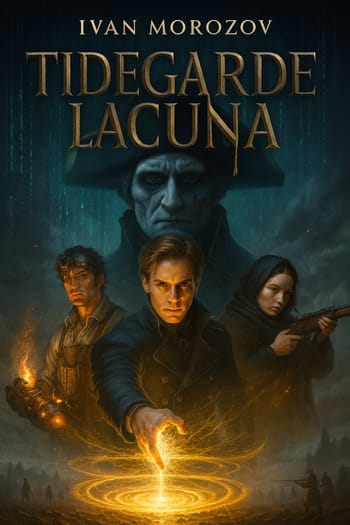
The campaign tent smelled of wet canvas and mud. Two weeks of rain had turned the fields south of Paris into a mire. The dampness was a constant, unwelcome guest, clinging to wool blankets and seeping into leather boots. In the Winter Palace, the air was beeswax and wilting flowers. Here, it was the smell of his new life. The smell of a war fought from the dirt.
Sineus stood over the map, a vast and intimidating expanse of the Russian Empire, its western borders stained with the grey wash of the Ashen Tract. He was no longer alone in a crowd of courtiers. He was surrounded by the eleven other survivors of the Vaucanson Atelier, their faces hollowed by exhaustion but their eyes holding a hard, brittle light. They were his comrades. His new Lodge. The thought was still strange, a coat that did not quite fit his shoulders.
Alessandro Volpe stood opposite him, his finger tracing a line from Paris back toward the border. The Italian inventor was a study in grim pragmatism. His dark hair was matted with sweat, and a fresh scar, a thin white line from the Atelier’s collapse, cut across his cheek. He looked ten years older than he had a month ago. They all did.
— The main French army will regroup here, — Alessandro said, his voice a low rasp. He tapped a town west of Smolensk. — They lost their occult factory, but they still have men. Cannons. They will push. Hard.
Luca, the Carbonari veteran with the burn-scarred jaw, slammed a fist on a nearby crate. — Then we hit their supply lines. Bleed them all the way back to the border. No half measures.
Mikhail, the pale, thin loyalist who had betrayed the Lodge to join them, flinched at the sound. He had not spoken more than a dozen words since they had escaped Paris. He just stared into the weak flame of the oil lamp, as if watching the ghosts of the paradox-constructs flicker in the light.
Sineus listened. This was the new way. Not the silent, coded gestures of the Sovereign’s Waltz, but the loud, messy, and honest work of consensus. It was a slow and inefficient process, a machine of mismatched parts grinding against each other. But it was real. The price of this new command was patience, a currency he had rarely needed in his old life.
He felt a familiar, phantom itch on his right forearm. He glanced down. The arm, from his elbow to the tips of his fingers, was no longer his. It was a sculpture of semi-translucent crystal, a permanent, shimmering lattice that caught the lamplight in a thousand cold, dead points. It did not hurt. It felt of nothing at all. A beautiful, terrible monument to the choice he had made in the heart of the Atelier. The choice not to cut, but to connect. To force a man to feel the weight of his own oblivion.
He saw a loose thread on Mikhail’s worn collar, a single strand of grey against the dark wool. Once, the sight of such an imperfection would have been a sharp annoyance, a thing to be corrected. A frayed detail in a perfect world. Now, it just looked like a part of the world. Frayed. Imperfect. Real.
— Hitting supply lines is good, — Sineus said, his voice quiet but cutting through the low murmur of debate. All eyes turned to him. — It slows them. But it doesn’t stop the Blight.
He gestured on the map with his left hand. His right, the crystalline gauntlet, rested on the table, unmoving. The living hand that could point and plan; the dead one that had paid for the right to do so. It was the mirror of his first mission in the palace ballroom—the perfect, sterile excision performed by a flawless instrument. Now, the instrument was broken, imperfect, and for the first time, truly his own.
— The Lacuna we left in Paris is stable, — he continued. — But the Ashen Tract is not. It spreads. Every day, another village loses its memory. Every day, the soil forgets the sun. We are not just fighting Napoleon. We are fighting a plague of forgetting.
Alessandro looked at him, a flicker of understanding in his tired eyes. They had seen it together. They had felt the land’s grief. They had met the girl, Anya, with her faceless doll and empty eyes.
— What are you proposing, aristocrat? — Alessandro asked. The old nickname was there, but the bite was gone. It was just a name now, a relic of a past that felt a lifetime away.
— We can’t just be a wrench in their war machine, — Sineus said. He looked around at the faces watching him. The faces of men and women who had lost everything. — We have to be a cure. We need to find a way to restore what has been unwritten.
A silence fell over the tent, heavier than the damp air. The idea was absurd. Memory-cutting was a one-way street. You could sever a thread, you could annihilate it, but you could not re-spin it. You could not make a thing remember what it had been forced to forget.
— That’s impossible, — Mikhail whispered, his voice hoarse. — The Lodge has sought that for a hundred years. It cannot be done.
— The Lodge also said the Lethe Mortar was impossible, — Sineus countered, his gaze steady. — They said a man could not be connected to the consequences of his actions. They were wrong.
He felt the familiar linen of the bandage Alessandro had tied around his elbow. It was a clean, tight binding. Not a thread severed, but one tied to hold. A bond.
— We have your knowledge of the script, — Alessandro said slowly, thinking aloud. — And we have my understanding of resonance and alchemy. The Lodge sought to preserve. The French sought to annihilate. We… we are something else. A synthesis.
Sineus nodded. That was it. That was the heart of it. He was no longer just a creature of the Lodge, and Alessandro was more than a revolutionary. They were a coalition. An unwritten alliance.
— We need a laboratory, — Alessandro said, a spark of the old fire returning to his eyes. — A place to work. And we need a source. Something with a powerful, stable memory that we can study. Something that has resisted the Blight.
Sineus’s gaze drifted across the map, past the battle lines and the spreading grey stains. His eyes came to rest on a small, insignificant patch of forest far to the east. A place he had been ordered to, a place he had fled. A place that held the weight of his own history.
— I know a place, — he said.
The Bielski Manor. The ancestral estate with its sealed library and its own deep, sorrowful memories. The place where he had found the courage to defy his masters. The place Lacroix had used as a weapon against him. It was a location locked behind the Lodge’s quarantine, a place only he could enter. A place that might hold an anchor for his own unstable power. The thought of returning was a cold weight in his gut. Another open thread. Another debt to be paid.
Alessandro saw the look on his face and understood. He did not press. He simply nodded. — One war at a time. First, we slow the French advance. We buy ourselves time. Then… then we find a cure.
Sineus looked from the Italian to the other faces in the tent. He saw doubt, fear, and a desperate, flickering ember of hope. It was not the blind loyalty of the Lodge. It was something more fragile, and infinitely more powerful. It was a choice. Their choice.
Outside, the rain had stopped. The air smelled of wet earth and the promise of a cold, clear day.
He picked up the piece of charcoal and drew the first new line on the map.