For eight days, the Orphic Compass had been his only guide. It was not a needle swinging north, but a cold, dense weight in his saddlebag, a twenty-five-kilogram sphere of solid night that hummed a low, discordant note against his hip. The hum grew stronger as he rode deeper into the Ashen Tract, the vast wound in the world’s memory. The vibration was a physical thing, a promise of proximity to the void he hunted. He followed it through a landscape bled of all color, under a sky the color of dishwater.
The town appeared as a smudge on the horizon, then resolved into a collection of broken teeth. It was not a ruin of war, not the honest destruction of cannon and fire he had seen on campaign maps. This was a place of deeper wrongness. Buildings sagged as if their very memory of structural integrity had been cut. A church steeple listed at an angle that defied gravity, its bell silent. The ground, a fine grey dust that looked like ash but felt cold as grave dirt, crunched under his horse’s hooves with a sound like breaking bone. He dismounted, the silence of the place pressing in on him, a tangible weight on his eardrums.
He pulled the Orphic Compass from its bag. In the open air, its low hum was a palpable thrum against his palms. The vibration was stronger here, insistent. He was close. He moved down what might have been a main street, past the hollow shells of homes. A frayed rope, once part of a shop sign, dangled from a rusted bracket, its end a tangle of severed threads that danced in a wind he could not feel. He was a ghost in a city of ghosts, his purpose a cold, hard stone in his gut.
A flicker of movement in a second-story window. He froze.
Too late.
A thin, dark wire stretched taut across his path, nearly invisible against the grey dust. His boot caught it. The wire snapped with a sharp twang, a single, plucked note in the oppressive quiet. It was a sound of purpose. A sound of ambush.
Click.
The noise was sharp, metallic, unmistakable. The sound of a rifle bolt being driven home. It came from the window where he’d seen the movement, to his left. Another click echoed it from a pile of collapsed masonry to his right. A third sounded from the doorway of a ruined bakery directly behind him. He was in a kill box. Perfectly triangulated. These were not bandits.
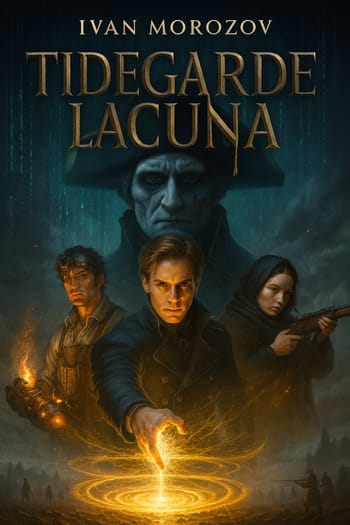
He slowly raised his hands, his gaze sweeping over the three positions. They emerged from the ruins not with a rush, but with a slow, deliberate confidence. They wore no uniform, only a mismatched collection of patched leather, heavy wool, and hardened expressions. The first was a woman, emerging from the rubble to his right. Her face was smudged with soot, her dark hair tied back severely. She held her rifle with an unnerving stillness, its stock pressed tight to her shoulder. She was not a soldier, but she knew her weapon.
The leader stepped out of the bakery behind him, moving to block his only path of retreat. He was tall and lean, with dark, curly hair wild with grease and neglect. His sharp brown eyes burned with a fierce, angry intelligence. He wore a heavy leather apron over a simple linen shirt, and in one hand he held a pistol, its muzzle a dark, unblinking eye. In his other, he carried a strange device of brass and copper, fitted with what looked like a series of tuning forks. Sineus could smell the faint, sharp scent of ozone and strange chemicals clinging to him.
— Another of the Tsar's butchers, come to admire the rot, — the man said. His voice was rough, laced with an Italian accent.
Sineus kept his hands where the man could see them. His heart was a steady, cold drum in his chest. This was the price of his choice. No allies, no authority, only his own skill to keep him alive.
— I am not your enemy, — Sineus said, his voice even.
The man laughed, a short, harsh bark devoid of humor. — Your coat says otherwise. Your boots say otherwise. The way you stand, straight as a parade pike, says otherwise. — He gestured with the pistol. — On your knees.
Sineus did not move. The woman to his right adjusted her aim, the rifle’s sights centering on his chest. The third figure, a burly man in the window, remained a silent, menacing silhouette. This was a test. To kneel was to accept the role of a captive nobleman, to confirm their prejudice. To stand was to risk a bullet. He held the man’s gaze.
— I am hunting the thing that did this, — Sineus said, his voice low and clear. — The weapon that un-makes the world.
That gave the leader a moment’s pause. The angry fire in his eyes was banked by a flicker of surprise, then suspicion. The woman, Elina, tilted her head, her expression less hostile than analytical. She was judging him, weighing his words against the evidence of her own eyes.
— Big words for a man in a fine coat, — the leader sneered, recovering his balance. But the absolute certainty was gone from his voice. He took a step closer, the pistol never wavering. The smell of ozone was stronger now. — What would an aristocrat know of un-making? You only know how to take. Your kind, the Lodge, the French dogs—you are all the same. You cut and carve history to suit your appetites, and you leave this poison behind for the rest of us to choke on.
He knew of the Lodge. This was no simple revolutionary. This was a man who understood the secret war. This was an Alchemical Carbonari. This was Alessandro Volpe.
— I have left the Lodge, — Sineus stated. It was a simple fact, but saying it aloud felt like another betrayal, another thread cut loose. — I act alone.
— A rogue butcher is still a butcher, — Alessandro shot back. He gestured with his chin toward the Orphic Compass, still clutched in Sineus’s hand. — What is that? Another one of your tools for trimming the past?
— It is a guide, — Sineus said. — It points to the voids. To the Lacunae.
Alessandro’s eyes narrowed. He knew the term. He took another step, his gaze fixed on the perfect, black sphere. He was close enough now that Sineus could see the fine lines of exhaustion around his eyes, the permanent black stains under his fingernails. This was a man who worked with his hands, a man who built things. And a man who had seen too much.
— You hunt them? — Alessandro asked, his voice a low growl of disbelief. — Why? A sudden fit of conscience? Did you finally see the bill for all your clean, quiet work in the palaces?
Every word was an accusation, and every accusation was true. Sineus felt the weight of the agent in the Winter Palace, the clean excision, the duty he had performed without question. It felt a lifetime ago. He thought of Pyotr, of his mentor’s shattered mind. The price of this war was no longer an abstract concept.
— I saw what the Lethe Mortar does, — Sineus said, his voice dropping. — I saw it doesn't just cut. It annihilates. I saw the hole it leaves in the world.
The woman, Elina, took a half-step forward, her rifle lowering a few centimeters. The name of the weapon had struck a nerve.
— You saw it? — she asked, her voice quiet but intense. It was the first time she had spoken.
Sineus met her gaze. Her eyes were a deep, steady brown, filled not with Alessandro’s fiery anger, but with a profound, settled grief. — I saw it unmake a village west of Smolensk. I saw the Lacuna spread.
A heavy silence fell over the ruined square. The wind picked up, sending a swirl of grey dust across the cobblestones. Alessandro looked from Sineus to Elina, a silent conversation passing between them. The third man in the window had not moved, had not made a sound. He was pure discipline.
— My town was west of Smolensk, — Elina said, her voice barely a whisper. The statement hung in the air, heavy and cold as lead.
Alessandro’s expression hardened again, but the focus of his anger had shifted. He looked at Sineus, truly looked at him, and for the first time, he seemed to see past the fine wool of his coat.
— Even if you speak the truth, — Alessandro said, his voice tight, — why should we trust you? You are one of them. You were born to a world of lies written on the backs of my people. Your word is worthless here.
He was right. Sineus understood it with a clarity that was as sharp and painful as a shard of glass. His title, his name, his education—everything that gave him authority in his old life was a liability here. These people had been fighting a war against his world long before the French had crossed the border. To them, he was not a rogue agent seeking to save the Empire. He was just a different flavor of tyrant. Words were not enough. His honor was not a currency they accepted.
He had to give them something else. A different kind of proof.
The dust of forgotten lives settled on his shoulders. The grey, empty sky offered no judgment.
He had to give them something they could not deny.