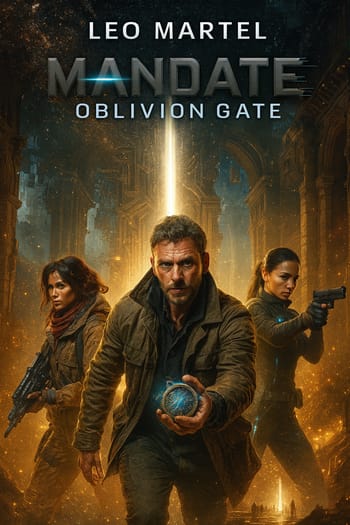
The Kestrel VTOL sliced through a wall of grey fog that had clung to them for the last hour. Inside the cockpit, the air was cold, recycled, and sharp with the scent of ozone from the humming avionics. Sineus stood behind Isabelle Moreau, his eyes fixed on the green glow of the forward display. The coordinates they had bled for, stolen from tombs and towers across the world, were less than a kilometer away. He took a sip of scalding black coffee from a battered steel thermos, the bitterness a familiar anchor.
The VTOL shuddered as it passed through a pocket of turbulence. Moreau’s hands moved with practiced economy over the controls, her knuckles white. She did not fight the aircraft; she guided it. Beside him, Nadia Petrova, the young archaeologist whose mind moved as fast as the VTOL, stared at her own screen, her face a mask of tense anticipation. They were on time. The thirty-six-hour clock had run down, and the entry window was open.
Then, the fog broke. It did not dissipate or thin. It parted like a curtain, pulled back by an unseen hand. Before them, under a sky the color of slate, was the impossible. An island rose from the churning grey waters of the North Atlantic, a place that had no right to exist. It was a collage of stolen time. Towers of black basalt, smooth as polished glass, stood beside pylons of weathered bronze that belonged to an age of myth. Cloisters of green, crystalline material looked out over jungles of primeval fern and cycad. A waterfall cascaded from a floating rock, its water turning to mist before it ever reached the sea.
— My God, — Nadia whispered, her voice tight with awe. — Is it real?
— Coordinates match, — Moreau stated, her voice flat, but Sineus caught the flicker of triumph in her eyes. — Taking us in.
The Kestrel banked, descending toward a stretch of black volcanic sand. They had pieced together the map, outrun the world’s intelligence agencies, and defeated the Axiom Group’s enforcers. They had reached the gateway to the Chronos Engine, the great artifact that could preserve history.
A sharp crackle of static erupted from every speaker in the aircraft, overriding their encrypted comms. The sound was clean, without distortion. It was followed by a voice, a calm, cultured baritone that was colder than the arctic ice they had escaped. It was Lars Magnusson.
— Thank you, Professor Sineus.
The words hung in the air, a poison injected into their moment of triumph. Moreau’s hands froze on the controls. Nadia’s head snapped up from her console. The sense of victory evaporated, replaced by a sudden, chilling dread. Magnusson, the visionary CEO of the Axiom Group, was not supposed to be here. He was supposed to be half a world away, chasing their ghosts.
— The island only manifests when a key is brought near, — Magnusson’s voice continued, conversational and utterly dominant.
A cold knot tightened in Sineus’s gut. He had not outrun the trap; he had willingly walked into its jaws.
— Someone like you, — Magnusson said, and the words were aimed directly at Sineus, a rifle shot in the quiet cabin. — With a native connection to the Memorum script. You haven’t found the door, Professor. You are the door.
— And you’ve just opened it for everyone.
As if summoned by Magnusson’s final, devastating sentence, the horizon changed. On the edge of the fog bank, lights began to appear. First one, then a dozen. The sleek, predatory forms of Axiom Group fast-attack craft, their hulls painted a non-reflective black, their running lights a cold blue. Beyond them, larger silhouettes emerged: the brutish, powerful shapes of Russian Northern Fleet destroyers and the clean, angular lines of a Chinese carrier group. They were all there, waiting. They had not been racing Sineus to the island. They had been racing to his arrival.
Sineus pulled the small, brass gimbaled compass from his pocket. He held it in his palm, the metal cool against his skin. The needle was perfectly steady, pointing north toward the heart of the impossible island. The world was stable. The physics held. But the truth it represented had inverted. It was no longer a tool showing him the way. It was a marker, pointing to the center of a cage he had just willingly entered.
The fleets were converging, their wakes carving white scars into the grey Atlantic. The hunt was over.
The gauntlet was just beginning.
They had found the prize, but now they must defend it from the entire world.