The new objective hung in the cold air, sharp and absolute. Find the Russians. Sineus gave a curt nod of assent. The spire, a jagged tooth of black rock tearing at the grey sky, remained the strategic goal, but this detour was a necessary gamble.
They pushed inland, leaving the wreck of the Kestrel VTOL to the hungry surf. The black volcanic sand gave way to a landscape that fought itself. Twisted basalt formations, glistening and wet, shouldered through a primeval jungle of enormous ferns and thick, fleshy leaves that belonged to no known epoch. The air was heavy, smelling of ozone, wet earth, and something else, a faint, metallic tang like old blood. Every step was a conscious effort, a push against a world that felt fundamentally wrong.
The island was not just a place; it was an active event. A continuous, large-scale reality glitch. The ground beneath their feet seemed to tilt, a nauseating lurch that had nothing to do with the terrain. To their left, a waterfall cascaded down a cliff face, then abruptly flowed sideways for twenty meters before crashing to the ground in a place it should never have reached. The sound of their own footsteps was a disorienting echo, arriving a half-second after their boots hit the ground.
— Keep moving, — Moreau’s voice was tight, clipped. She moved with a predator’s focus, her rifle held at a low ready, her eyes scanning everything.
For Sineus, the visual and physical distortions were the least of it. The Memorum hum, the ambient psychic sound of reality’s script that was usually a subtle guide, was a physical roar on Thule Ultima. It was a deafening, discordant shriek inside his skull, a billion screaming threads of information with no order, no syntax. It was the sound of a library burning, of every book dissolving into meaningless, warring letters. His unique ability, the gift that allowed him to navigate the hidden currents of the world, had become a liability. It was a radio tuned to a frequency that was shattering the speaker.
The pressure built behind his eyes, a white-hot spike of pain. He stumbled, a wave of dizziness washing over him. He dropped to one knee in the damp, alien soil, the world dissolving into a smear of green and black. A warm trickle of blood ran from his nose, the metallic taste sharp on his tongue. His body was failing under the strain.
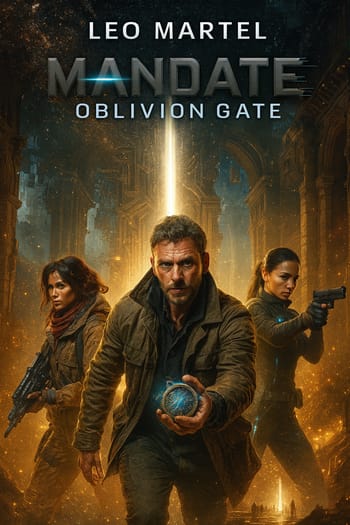
He fumbled in a pouch on his belt, his fingers closing around a familiar weight. The small, brass gimbaled compass. His father’s personal compass. A symbol of objective, mechanical truth. He brought it up, his hand shaking. The needle, which should have held a steady north, was spinning wildly, a frantic, useless blur of magnetized steel. The island was so fundamentally broken that it had defeated the simple laws of physics. The compass, his token of stability, was just another piece of scrap metal here.
A firm hand gripped his arm, hauling him to his feet. It was Moreau. Her face was a mask of grim determination, her eyes cold and focused. She didn’t ask if he was alright. She didn’t have to.
— Focus on the mission, not the noise, — she said, her voice a low command. It was an anchor of cold pragmatism against the psychic storm tearing him apart. He nodded, wiping the blood from his lip with the back of his glove, and forced himself to move.
They had covered another hundred meters when the attack came. No warning, no sound of approach. One moment the path was clear, the next it was filled with figures in matte black polymer armor, the advanced combat gear of the Axiom Group. They rose from the twisted vegetation like phantoms, their weapons already shouldered. Automatic fire ripped through the air, the sound flat and dead in the thick atmosphere.
Sineus and his team dove for cover behind a ridge of glistening basalt. The Axiom squad was also struggling with the island’s physics. Their disciplined bursts of fire went wide, bullets smacking into rock formations ten meters to the left of their targets. One of the soldiers threw a grenade. It sailed through the air, then simply vanished, its detonation never arriving. The soldiers looked confused, their rigid training useless in a place where cause and effect were negotiable.
The combat was a chaotic, unpredictable mess.
— They can’t aim! — Nadia Petrova yelled from her position twenty meters to Sineus’s right. The young archaeologist had a rifle in her hands, and her eyes were wide, not with fear, but with intense concentration. She was not a soldier, but she was a brilliant reader of patterns.
She raised her weapon. Instead of aiming at one of the Axiom troopers, she fired at a patch of empty air five meters to his left. For a second, nothing happened. Then, the space between her and the target seemed to fold. The bullet reappeared, striking the soldier squarely in the chest and throwing him backward. She had not fought the glitch; she had used it. She was calculating the warped geometry, turning the island’s hostility into a weapon.
Inspired, Sineus followed her lead. He stopped trying to perceive the world as it should be and began to accept it as it was. He saw the currents of Memorum, not as a hum, but as visible, shimmering distortions in the air. He fired his own weapon into one of those currents. The bullet vanished, then reappeared behind the Axiom line, striking a soldier in the back.
Moreau, ever the pragmatist, was not trying to perform trick shots. She laid down a methodical, overwhelming volume of fire, forcing the remaining Axiom soldiers to keep their heads down. Trapped between Nadia’s impossible accuracy and Moreau’s relentless suppression, the surviving troopers broke. They scrambled back into the jungle, melting away as silently as they had appeared.
The silence that followed was heavy, broken only by the sound of the upward-falling rain.
They were alive. For now.
But the spire was still distant, a promise of an even greater madness. And the roaring in Sineus’s head was getting louder.