He found them in a cloister where the laws of physics had surrendered. Rain fell not down, but up, rising from the polished black floor in silent, silvery streams that vanished into the gloom above. Sineus sat with his back against a pillar of cold basalt, his focus on a single task: breathing. In, out. The simple mechanics of it were an anchor in the screaming chaos left by the void. The memory of non-existence was a fresh wound, a phantom limb where his identity had been. He had been erased for six seconds, and the echo of that perfect, featureless null was a terror colder than any arctic wind.
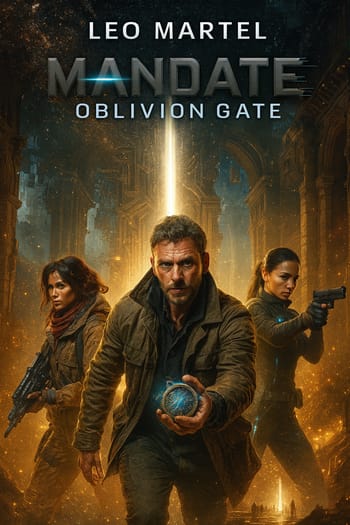
He had lost his compass. Not just the small, brass instrument his father had carried, now shattered fragments on the stone floor miles behind them, but the internal one. The one that pointed toward a fixed, reliable truth. The void had taken that. It had shown him the ultimate goal of Oblivion, the clean, sterile peace of absolute erasure that Magnusson sought to impose on the world. He understood his enemy now, not as a tyrant, but as a missionary for nothingness. The thought left a taste like iron and ozone in his mouth.
He needed a new bearing. A new north.
The words of Archivist Cato, the last guardian, returned to him, not as a memory but as a piece of operational data. The Engine is a binary tyrant if you treat it like a machine. Approach it as a native, and it offers a third path. A native. The same word Magnusson had used. It wasn't an insult; it was a technical designation. His bloodline, his innate connection to the Memorum script, was not a gift. It was a key. A living key.
The realization did not come as a flash of insight. It settled with the cold, hard certainty of an engineering schematic locking into place. Magnusson wanted to be the administrator, the user with ultimate control. Cato had been a guardian, a protector of the system from the outside. Both had treated the Chronos Engine as an object to be manipulated. The third path was not to use the machine. It was to become part of it. To integrate. To become the firewall.
He pushed himself to his feet, the movement stiff. The upward rain parted around him as if he were a stone in a river. He walked to a section of the cloister wall, a seamless expanse of black basalt. This was a test. A choice. He had to know if the theory was sound, and the only way to know was to act. He pressed his right palm flat against the cold, smooth stone. The price of this knowledge would be paid in the currency of his own body.
He reached into his memory, not for a complex counter-frequency, but for something older. A line of Memorum script from his family’s private texts, a simple verse of binding and purpose. He spoke the words aloud, his voice a low rasp in the quiet cloister. The script was a key, and his blood was the hand that turned it. Pain, sharp and electric, shot up his arm, a searing fire that made his vision swim. The basalt under his palm grew warm, then hot.
With a low hum that vibrated through the floor, a section of the wall slid away. It revealed not a passage, but a cavity filled with a soft, pulsing light. Inside, interwoven strands of living energy shifted and writhed. It was not a console of buttons and screens. It was an organ. A native interface. The theory was correct. He had found the third path. The cost was pain, a down payment on a much larger debt.
He pulled his hand back, the skin red and tingling. The panel slid shut, leaving the wall seamless once more. He had his plan. It was simple. It was absolute. It was the only way. He reached into a pocket of his worn jacket and pulled out a flat, octagonal carpenter’s pencil, its graphite tip sharpened to a chisel point. It was a simple, practical tool, a relic from his father’s world of gears and reliable mechanics.
He turned his left hand over, palm up. With the steady, precise movements of an engineer drafting a blueprint, he began to write on his own skin. He drew the Memorum commands, the lines of operational script that would initiate the integration. His hand would be the final page of his notes. His body, the final component.
The terror of the void had not vanished. It was still there, a cold weight in his gut. But it was no longer a paralyzing force. It was a metric. A known variable in a final, terrible equation. The despair was gone, burned away by the cold fire of purpose. He knew the price of holding the line, the absolute price Cato had spoken of. And he accepted it. Not with heroic fanfare, but with the quiet, grim resolve of a man who has to fix the engine because no one else can.
The upward rain felt cool on his face. The spire’s strange light cast long, steady shadows.
He had to tell Moreau the new price of victory.