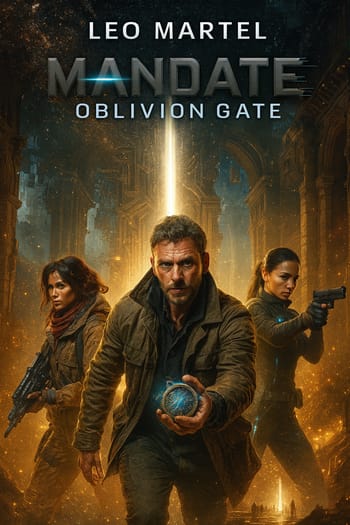
The heavy circular door hissed open, and Sineus plunged through, his momentum carrying him into the heart of the Spire. The chaos of the firefight, the clash of steel and the roar of explosions, vanished as if severed by a blade. Silence descended, thick and absolute, broken only by a low, perfect hum that vibrated not in his ears, but in the marrow of his bones. He was in the control room of the Chronos Engine.
It was not a room of wires and servers. It was a cathedral of impossible scale, a vast, circular chamber whose walls were made of the same polished black basalt as the Spire itself. The air was cold, sterile, and carried the sharp, clean scent of ozone, like the air after a lightning strike. In the center of the chamber, a pillar of slow, churning white light rose from the floor to a point of darkness high above, so distant it felt like a starless patch of night sky. This was the Engine. Not a machine of gears and pistons, but a column of pure, weaponized meaning. It was the source code of reality, contained and burning with a cold, silent fire.
High above, on a narrow mezzanine of black steel that circled the chamber, a single figure stood watching him. Lars Magnusson. He was not dressed in armor or tactical gear, but in a simple, tailored grey suit that seemed utterly out of place, yet perfectly at home. He held no weapon. He simply stood with his hands clasped behind his back, a surgeon observing his operating theater. He offered a thin, clinical smile.
— Behold, Professor, — Magnusson’s voice filled the chamber, amplified by the strange acoustics of the place. It was calm, reasonable, the voice of a lecturer, not a tyrant. — The source code of reality. Corrupted. Bloated. Inefficient. For ten thousand years, humanity has done nothing but write errors into the draft. War, hatred, superstition, decay. A dataset so hopelessly flawed it threatens to collapse the entire system.
Sineus ignored him. His focus was on the room, on the Engine. He moved cautiously toward the central pillar of light, his boots making no sound on the polished floor. His every instinct, honed in a hundred forgotten tombs and firefights, screamed that this was a trap. The silence was the bait. Magnusson’s calm was the trigger. He felt for the familiar weight of the gimbaled compass in his pocket, a habit born of a lifetime of seeking a true and steady north. His fingers met only empty fabric. The compass, his father’s compass, was gone, shattered on the floor of the entrance chamber. There was no simple truth here.
As Magnusson spoke, a section of the floor before the pillar of light began to glow. A slab of polished black stone, a console unlike any he had ever seen, rose silently from the floor. It was featureless, a perfect mirror of the darkness above, until glowing glyphs began to bleed across its surface. The language was Memorum, but the meaning was brutally, universally clear.
— You see it as history, Professor. A thing to be preserved, cherished in all its messy, contradictory glory, — Magnusson continued, his voice a velvet hammer. — I see it as a chronic disease. A pathology. And like any good surgeon, I am here to cure the patient. Even if the patient resists.
The glyphs on the console solidified. They presented a choice, a binary trap laid by a machine that thought in absolutes. It was the ultimate expression of the Engine’s nature as a binary tyrant, the very thing Cato had warned him about. The choice was stark, presented with the cold, irrefutable logic of a weapon.
Option A glowed on the left side of the console. The glyphs formed a map of Europe, a pulsing red light highlighting the nation of Austria. Then, the image shifted, showing a cascade of symbols representing music, art, philosophy, centuries of culture and identity, all being unwritten. Mozart’s symphonies dissolving into static. The works of Freud and Wittgenstein turning to blank pages. The memory of an entire nation, its contribution to the human story, erased in an instant. The price was the genocide of a people’s soul. The outcome, the glyphs promised, would be a system cascade, a catastrophic failure that would lock the entire Chronos Engine, freezing it and making it inaccessible to anyone. A great evil to prevent a greater one.
— A difficult choice, I admit, — Magnusson said, sensing Sineus’s hesitation. — To sacrifice one small, corrupted file to save the entire drive. A surgeon’s choice. The kind of choice weak men are afraid to make.
Then, the glyphs for Option B appeared on the right. They showed Magnusson’s own face, serene and confident, superimposed over a globe. The image shifted, showing cities remade into clean, perfect lines. There was no chaos, no dissent, no poverty, no art, no struggle. Only a silent, harmonious order, a world curated and edited by a single, benevolent will. The price was the surrender of everything. Cede control of the Engine to the waiting user. Allow one man to rewrite the past, present, and future for every soul on the planet.
The console pulsed with a cold, white light, the two options burning into Sineus’s eyes. Erasure or tyranny. Destroy a nation’s identity or surrender the world’s. The air grew colder, the hum of the Engine seeming to sharpen, to press in on him. This was the trap. Not just a choice between two horrors, but a test designed to force him to accept the premise that such choices were necessary. To choose either was to validate Magnusson’s entire philosophy.
— Cut the rot, Professor, — Magnusson urged, his voice dropping to a conspiratorial whisper. — Make the hard choice. Prove you have the strength to do what is necessary. Or let me.
Sineus stared at the glowing glyphs, his hands clenched into fists at his sides. The memory of the void, the six seconds of absolute nothingness he had experienced, washed over him. That was the promise of Magnusson’s world. A clean, perfect, empty peace. He thought of the shattered brass of his father’s compass. It had only ever pointed to one true thing. It never offered a choice between two lies.
He was trapped. The path forward was blocked by an impossible moral choice, a surgeon’s gambit where the only patient on the table was the soul of the world. And Lars Magnusson stood watching, scalpel in hand, waiting for him to make the first cut.
To save the world, must he destroy a nation?
Or was there a price only he could pay?