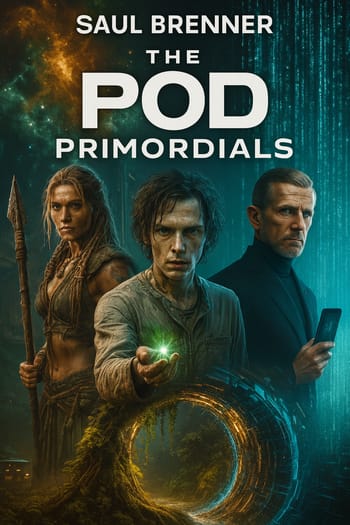
The atomizer was cool and smooth in Julian’s hand, a perfect cylinder of glass and chrome that felt like a lie. It was a piece of high-end corporate tech, something you’d see in an ad for personalized nutrient infusions or mood enhancers. It did not look like a key to another world. It did not look like the end of his own. He had paid all his credits for this ghost, for one full charge of refined Staticbloom. His Dynamic Quotient, the number that defined his existence, was a flat and pathetic 0.01. He was already a dead man in the eyes of the Grid. So it goes.
He lifted the atomizer to his lips. The choice was a physical thing, a weight in his throat. To press the cap was to trade the slow, managed death of the Grid for a fast, unknown one. It was the only real choice he had made in years. He pressed down. A fine, cold mist hit the back of his throat. It tasted of ozone and wet earth, the flavor of a circuit board left out in the rain. The effect was not a slow bloom of enlightenment. It was a system crash.
The Grid did not fade. It shattered. The holographic ads, the floating data streams, the placid face of the Synoptic Muse—it all fractured into a blizzard of broken data. His Neural Feed, the device that had been his window to the world since birth, was hijacked. The signal decoupled from the network with a sound like tearing metal. His DQ, flickering from 0.01 to a meaningless 0.5 as the device drew power, vanished. He was untethered, a ghost in the machine, and the machine was screaming. His consciousness became a needle skipping across a record of a billion realities, searching for one specific groove, one parallel quantum signature. Then, a click. A clean, sharp lock.
For Garran, the spirit song stopped being a hum. It became a physical blow. The sound inside his head, the thin metallic whine of the ghost, swelled into a deafening roar that blotted out the world. The familiar shapes of the ruins, the scent of the night-blooming flowers, the solid ground beneath his feet—it all dissolved into a storm of pure noise. The world, his world of leaf and stone and sky, was peeled away from his bones. He was being pulled out of himself, a hook in his soul dragging him into the heart of the machine-sound.
They materialized in a place that was no place. The Pod. It was a shared hallucination, a dreamscape built from the wreckage of two realities. A chrome cubicle, identical to the one Julian had just left, stood half-sunk in a patch of swampy ground. A nutrient paste dispenser grew from the trunk of an ancient, moss-covered tree, weeping grey sludge onto its roots. The air was a glitching fusion of sterile, recycled oxygen and the rich, damp smell of decay. And in the center of the chaos, they saw each other.
He was looking at his own face. A version of it, anyway. The man across from him had the same bone structure, the same grey eyes. But this man’s skin was pale, worn thin by a life lived under artificial light. His eyes were tired, ringed with the faint, silvery lines of a Neural Interface Device. He was thin in a way that spoke of malnutrition, not lean muscle. Julian saw a man worn down by data. Garran saw a man who had never truly lived. The recognition was instant, absolute, and horrifying. They were two halves of a single soul, staring at each other across a wound in reality.
The universe, it turned out, did not like paradoxes. It had an immune system. The stable, conscious link between two alternate selves was a foreign body, a virus in the source code of spacetime. And the immune response was coming. It began as a pressure that started outside of space and pushed inward, a deep, resonant hum that wasn't a sound but the vibration of the rules themselves. The world began to flicker, a massive STATIC_GLITCH between the forest and the cubicle. The Ontological Offset was triggered.
The tearing began. For Julian, his body became a suggestion. The clean lines of his jumpsuit, the pale skin of his hands, the very idea of his physical form dissolved into a cascade of shimmering, corrupted data. He was a file being deleted, his component parts scattered into the noise. He felt a moment of pure, disembodied terror, the feeling of being nowhere and nothing, a ghost without even a memory of a house to haunt.
For Garran, the process was more violent. His flesh and bone, the solid facts of his life, became noise. The feeling of the ground, the weight of his own body, the rhythm of his heart—it was all overwritten by the screaming static of the connection. He was a song being drowned out by a hurricane of raw information. He was unmade, his shape forgotten by a world that was itself forgetting its shape.
Then, reconstruction. A violent, instantaneous arrival.
Julian rematerialized face down. The first sensation was the taste of mud and stagnant water. The second was the smell, a thick, choking perfume of rot and life, of things growing and dying in the same breath. He pushed himself up, gasping, his lungs burning. He was in a swamp. Thick, green water lapped at his knees. Giant, pulsating fungi cast a sickly blue light on the canopy of unfamiliar trees above him. Something with too many legs crawled across the back of his neck. He had wanted to escape. He had wanted to see the wild. He was here.
Garran rematerialized on his hands and knees, collapsing onto a floor so smooth and cold it felt like ice. He choked, his lungs desperate for air that wasn't dead and recycled. His senses, tuned for the subtle signals of the forest, were assaulted. A thousand silent advertisements screamed for his attention, their colors piercing and unnatural. The low, oppressive hum of the pod’s life support system was a physical weight on his skull. He was in a box. A clean, white, sterile box made of light and plastic. A cage. A tomb.
The escape was a trap and the cage was real, and now they both had to learn how to breathe.