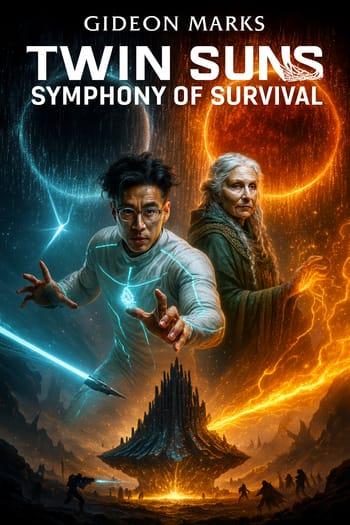
Anja Farid moved through the bruised twilight of the Exclusion Zone with a quiet economy of motion that Jian found both infuriating and mesmerizing. She led him away from the mangled wreck of his transport, her steps sure on the shifting, unstable ground. His own progress was a clumsy, limping parody of her grace. Each step sent a jolt of fire up his damaged leg, a constant, throbbing reminder of the price of his escape. His goal was simple: find shelter, a place to restore some semblance of order to the chaos that was now his life.
She stopped before a fissure in a rock face, a dark crack barely wide enough for a person to slip through. From within, a soft, pulsing luminescence beckoned. Anja gestured for him to enter, and he complied, half-stumbling into the narrow opening. The air inside was cool and still, smelling of damp earth and something else, something clean and alive. The fissure opened into a small cavern, its walls and ceiling threaded with a vast network of glowing fungal filaments that pulsed with a soft, rhythmic light. It was a pocket of impossible peace carved into the heart of a violent paradox.
He slid down against a smooth rock wall, his leg screaming in protest. The moment he was settled, his hands went to the device he had protected during the crash. The Resonance Engine. Its crystalline lattice was cracked, and several conduits were bent out of alignment. He ignored his own pain and the alien beauty of the cave, his entire focus narrowing to the familiar logic of his work. He unclipped a diagnostic tool from his belt and began the methodical process of assessing the damage. This was his comfort, his area of control.
Anja watched him work in silence for several minutes. He was a creature of the Union, even in exile. Faced with a world of emergent, living patterns, his first instinct was to turn to his machine, to impose his own system of understanding upon it. She saw the tension in his shoulders, the way his focus on the damaged engine was a shield against the overwhelming reality of their situation.
"They sing," she said, her voice a low note in the quiet cave. She pointed a slender finger toward the glowing fungal threads that crisscrossed the ceiling. "Can you hear it?"
Jian paused, his diagnostic tool hovering over a fractured conduit. He looked up at the pulsing light, then back at her. The statement was pure Hunter-Gatherer mysticism. Fungi did not sing. They grew, they decayed, they existed as complex biological systems. They did not compose music. His training, his entire worldview, compelled him to dismiss her words as primitive poetry. It was an observation without data, a claim without proof.
"They emit light through a chemical reaction," he stated, the words clipped and precise. It was a correction, a small reassertion of his own paradigm.
"That is one of the notes," Anja replied, her calm unshaken. "It is not the whole song."
He almost argued, but a memory stopped him. The sound he had created to tear a hole in the Aethelburg perimeter. That grating, composed shriek of schism static was a paradox he had written and played. He had turned a contradiction into a physical force. What if she was simply describing a different kind of composition, one born not of paradox, but of harmony? The thought was a heresy, but his curiosity, the relentless engine of the scientist within him, overrode his skepticism. The price of his certainty was the possibility of a new discovery. He had to know.
"Show me," he said, his voice tight.
He turned back to the Resonance Engine. The crash had damaged the primary broadcast array, but the diagnostic sensors were still functional. He activated the bio-sensor, a delicate instrument designed to parse the quantum signatures of organic matter. He had used it in his lab to analyze the restricted biological data he’d bought, the raw material for his secret compositions. Now, he was pointing it at the source.
He aimed the sensor at the densest cluster of fungal threads. A waveform bloomed on the engine’s small display screen. It was not the clean, predictable sine wave of Union mathematics, nor was it the chaotic, tearing noise of schism static. It was something else entirely. The signal was complex, a cascade of overlapping frequencies and repeating patterns, a structure as intricate as a Bach fugue but written in a language he did not understand. His technology had confirmed her claim. The fungi were singing. The price of his skepticism was a single, undeniable data point that shattered his assumptions.
"It’s a signal," he murmured, his own voice filled with a wonder he could not suppress. "A complex, repeating bio-signal."
He began to work, his earlier repairs forgotten. His fingers moved across the interface, isolating the core frequencies of the signal, translating the biological data into a mathematical structure he could understand. He was bridging the gap between their two worlds, turning her living song into his ordered score. He found the central motif, a simple, elegant progression, and assigned it a tonal value. He was ready to play it back.
With a tap of his finger, he sent the translated motif through the engine’s small, undamaged speaker. It was a simple melody, just a few notes played on a synthesized tone. But the moment the sound filled the cave, the world answered. The fungal threads on the ceiling, which had been pulsing with their own slow, steady rhythm, flared with a brighter light. Their pulses shifted, synchronizing perfectly with the notes Jian was playing.
He played the motif again, and again the cave’s living light pulsed in perfect time. A direct, visible feedback loop. A conversation. He was not imposing his will on the environment; he was listening to it and repeating what it said, and the environment was acknowledging him. This was not a paradox. It was a resonance. It was the clean, clear opposite of the tearing schism static he had known. It was harmony, and it was beautiful.
"You hear with your eyes," Anja observed, her voice soft but carrying no judgment.
Jian looked from the pulsing lights to the waveform on his screen, then to her. She was right. He had been unable to perceive the song until his instruments had translated it into a visual form he could accept. His senses were filtered through the lens of his technology. He nodded, a slow, deliberate gesture of acceptance. The price of his Union pride was the admission of his own limitations. Their alliance, born of desperation in the wreckage of his transport, was beginning to shift into something else. It was becoming a partnership of mutual respect.
With a new sense of purpose, he turned back to the Resonance Engine. The diagnostic was complete, the major faults identified. The primary broadcast array was shattered, but he could reroute power through the secondary emitters. It would be less powerful, less precise, but it would function. He worked with a focus he hadn’t felt since his secret sessions in his lab, his hands steady, his mind clear.
An hour later, the work was done. He ran a final system check. The engine’s core functions were restored. Its operational capacity was at 85%. His primary tool was functional again, but his understanding of it, and of the universe it was designed to interpret, had been irrevocably altered.
The cave was quiet again, save for the soft, rhythmic pulsing of the fungal threads. The air hummed with the low, steady thrum of the repaired engine.
They had to leave the song behind and face the noise.