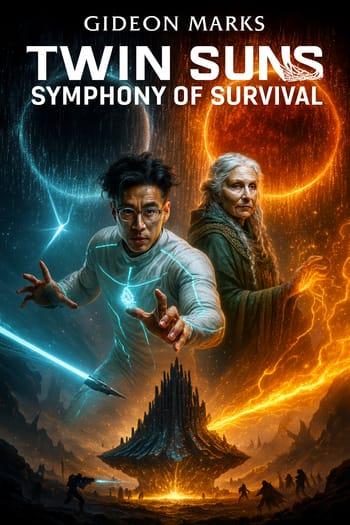
Anja Farid did not speak. She stepped forward, her movement as deliberate as a root finding its way through stone, and placed the Symbiotic Bloom seed in Jian’s unmoving hand. The seed was small and dormant, a smooth, dense knot of potential against his palm. It was a physical object, a tangible argument against the formless despair that had consumed him. He did not flinch. He did not acknowledge it.
— She did not die for nothing, — Anja’s voice was a low hum, a frequency that seemed to vibrate in the air itself rather than travel through it. The words were not a comfort; they were a challenge, a direct refutation of the guilt that had become his entire world. She was challenging his interpretation of the final, terrible equation.
She knelt beside him, her presence a quiet counterpoint to the raging storm on the horizon. Anja gently guided his hand, the one holding the seed, down to the earth. The soil was cool and damp, a mixture of dust and pulverized rock. The contact was a grounding shock, pulling him from the abstract horror in his mind and anchoring him to the physical, living world. It was an act of forced connection to her paradigm.
— Listen, — she whispered, her voice barely disturbing the air. — Hear the counterpoint.
He wanted to resist, to retreat back into the clean, absolute certainty of his nihilism. But Lena’s last words echoed, a command to run, to live. He owed her that much. He closed his eyes, not in prayer, but in focus. He tried to listen in her way, without the aid of a single sensor or diagnostic. He let go of the need to measure and quantify, and simply felt.
— The predator and the prey, — Anja continued, her voice a steady rhythm. — The decay and the growth. It is all one song.
At first, there was nothing. Only the distant, grinding noise of the mega-storm, the schism static that was the soundtrack to his failure. But he pushed past it, focusing on the point of contact between his hand and the earth. He felt for the vibration she had taught him to find in the edible lichen, but this was deeper, more complex. It was not a single frequency but a chord, a vast, slow-moving harmony of countless individual notes. He felt the slow grind of tectonic plates, the frantic scramble of unseen insects, the patient thirst of a root system. He felt life and death, not as opposing forces, but as a single, interwoven process. A deep, complex harmony vibrated up from the ground.
His shattered worldview, a landscape of broken axioms and failed proofs, began to find a new foundation. This was not the forced, sterile order of the Union, nor was it the simple, benevolent harmony he had accused the Gatherers of dreaming about. This was something more real. It was messy, brutal, and beautiful. It was a system that not only tolerated flaws but required them to function.
A sound escaped his lips, quiet and involuntary. He began to hum a new motif, translating the feeling of the earth back into the only language he truly understood. It was not a melody of triumph or hope. It was a dirge, a slow, melancholic piece in a minor key. But it was a dirge that accepted the finality of the chord. It did not fight against the sorrow; it wove the note of his loss into a larger, more profound composition. The music acknowledged that pain was a necessary part of the song.
As the quiet motif found its structure, the dormant seed in his palm reacted. A faint, internal light pulsed from its core, a soft, warm glow that beat in time with the rhythm of his humming. It was not a flicker; it was a heartbeat. The seed was responding to his new music, a composition that was neither pure math nor pure biology, but a true synthesis of both. It was tangible proof. His new path was a creative, living force.
The light from the seed pushed back the shadows in his mind. His purpose, which he thought had been shattered into dust, was reborn. It was not a denial of his pain, but a purpose forged from its acceptance. He was not a failure who had broken the world. He was an instrument that had played a wrong note, and now, finally, he was beginning to understand the true scale of the composition.
He opened his eyes. The despair had not vanished, but it no longer had the power to paralyze him. It was simply a note, a deep and resonant bass tone in the song of his life. He looked at the damaged Resonance Engine, its cracked conduits and dead power cells. He no longer saw a broken tool, a symbol of his failure. He saw a challenge. He saw a new design.
The air was still, the dust settled. The distant storm raged on, a problem yet to be solved.
He looked at the broken engine and saw a new schematic taking shape in his mind.