He needed a smaller room. The main chamber of Das Gewirr, with its cathedral-like ceiling of concrete and rust, felt too open, too exposed. The ghosts of the books, thousands of them stacked in their metal shelves, seemed to watch him. He had just seen his own face used as a mask for mass murder on the Consensus Chorus, and the silence of the library now felt less like a sanctuary and more like an accusation. He needed a corner where he could think. He needed a plan that wasn't just about running faster.
Sineus moved away from the scavenged screens, his footsteps echoing softly in the vast, quiet space. He passed a stack of real paperbacks, their covers bright with the forgotten art of the last century, and slipped into a narrow alcove carved out between a defunct ventilation shaft and a wall of ancient, dead servers. The air here was warmer, thick with the smell of dust and hot metal. It was a space barely wider than his shoulders, a coffin for one. It was perfect. He slid down the wall, his back against the cold steel of a server rack, and pulled the satchel onto his lap.
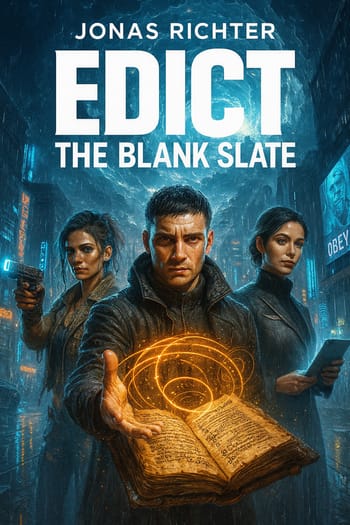
His hands were steady as he unbuckled the straps. The object inside was the one thing in his life that felt true. It was the reason he was here, the reason he was hunted, and maybe the only reason he might survive. He drew out the Volkov Codex. It was heavy, bound in dark synth-leather that was cool and smooth to the touch. In a world of weightless data, its physical presence was a rebellion in itself. It was a book. An artifact from a time before the Ministry of Public Harmony had decided history was a product to be curated and sold.
He opened it. The pages were thick, real paper, yellowed at the edges. And the ink, his ancestor’s ink, shimmered. It was mixed with trace amounts of stabilized Memorum, the very substance of memory, and it caught the low light from the alcove’s single utility bulb with a faint, blue glow. The light pulsed softly, a slow and steady heartbeat. It was like the flicker of the Datenspuk he’d seen in the dark screen, the ghost of the erased protest. But this was different. That had been a wound. This felt like a weapon.
He turned the pages, the dry rasp of paper a defiant sound in the digital silence. His fingers traced the dense, ciphered script of his ancestor, Jonas Volkov. He wasn't just reading. He was having a conversation with a dead man, a radical from a forgotten noble bloodline who had seen this smiling, sterile dystopia coming from 150 years ago. He found the passage he was looking for, the one he had read a dozen times but never truly understood until now.
"They will build a prison of comfort and call it peace," the shimmering words seemed to say. The ink was a quiet, insistent voice in his head. "You cannot erase a lie. That only feeds the void."
Sineus stopped. He thought of the Lacuna Cascade, the wave of un-reality that had dissolved a city block, the void that had been weaponized. He thought of the Ministry’s endless corrections, their seamless removal of inconvenient truths. They were erasing lies every second of every day. And according to his ancestor, they were just making the monster hungrier. The reactive path, the path of denial and defense, was a feedback loop. It was a strategy for losing slowly.
He read the next line, and the certainty he’d been clinging to—the simple hope of proving his innocence—crumbled. The price of this new knowledge was the comfortable illusion that he could ever go back to his old life.
"You must replace it with a bigger truth."
A bigger truth. Not a correction. Not an apology. A replacement. An act of narrative dominance. The idea was terrifying. It wasn't the philosophy of a victim trying to clear his name. It was the philosophy of a rival creator, a god fighting a god. It meant he couldn't just say, "That wasn't me." He had to create a story so powerful, so undeniable, that the lie of his guilt became an irrelevant footnote.
The final sentence of the passage landed like a physical blow.
"A truth so loud it shatters the walls."
Shatters the walls. Not opens the doors. Not convinces the guards. Shatters. The implication was clear: catastrophic, collateral damage. It meant breaking the consensus reality that kept billions of people safe and placid in their ignorance. It was the logic of a terrorist. Or a revolutionary. He felt a cold knot tighten in his stomach. Was there a difference?
His eyes scanned the page, and for the first time, he noticed a small, crude schematic in the margin, drawn with a finer, more urgent pen. It was a diagram. A series of interlocking circles and wave-forms, with notes scrawled around them. He recognized the symbol for a planetary broadcast system—the Chorus Spire. And he recognized the flow of energy. It was a plan. A technical method for hijacking a civic broadcast signal.
He leaned closer, the blue shimmer of the ink illuminating the details. The schematic showed how to splice a stream of raw, unedited Memorum directly onto the primary carrier wave. It wasn't a hack in the traditional sense. It was psychic surgery on an industrial scale. It was a way to force a single, raw memory into the minds of everyone connected to the network. Everyone with an Autonomic Ledger. Everyone.
Sineus traced the lines of the diagram with his index finger, the paper rough beneath his skin. He felt the ghost of his ancestor’s hand moving with his. This was the machine that could shout the bigger truth. This was the engine that could shatter the walls. The risk was absolute. A miscalculation could corrupt the entire broadcast, triggering a cascade of psychic noise that might do more damage than a thousand Void Catalysts. The choice to even consider this was a step off a cliff. He was no longer a director framed for a crime; he was a man holding a detonator, weighing the cost of pressing the button.
He closed the book. The blue light vanished, plunging the alcove back into near darkness. The hum of the dead servers seemed louder now. He had come into this alcove looking for a way to fight back. A way to survive. But the Volkov Codex had given him something far more dangerous. It had given him a plan not for defense, but for a war against reality itself. He had a theory. A terrible, beautiful, world-breaking theory.
Now he just needed an army.