He sat alone in the dark. The silence was a physical weight, heavier than the concrete ceiling above. The psychic echo of Ansel’s violation had faded, leaving behind only the mundane aftertaste of blood and the cold, damp smell of the tunnel. Ksenia and Zora had given him space, a silent, respectful distance that felt more like a quarantine. He was the one who had been touched by the enemy’s mind, and the stain was still on him. He pushed himself to his feet, his muscles screaming in protest. He needed to be alone. Truly alone.
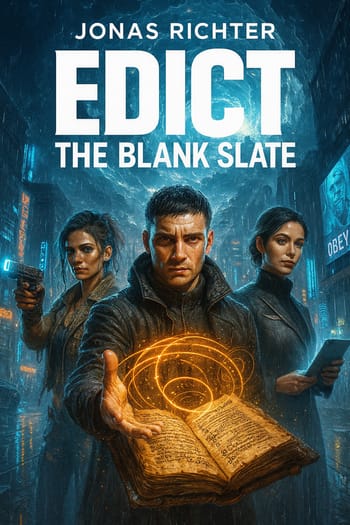
He walked deeper into the service network, his footsteps the only sound. He followed a narrow conduit that branched off from the main tunnel, a forgotten artery in the city’s buried anatomy. It ended in a small, circular chamber, a nexus of dead pipes and silent machinery. He slid down the curved wall, the rough concrete scraping against his jacket, and sat on the grimy floor. The Volkov Codex was a dense, heavy square in his satchel. He pulled it out, the worn synth-leather cool and solid in his hands. It was an anchor in a world that had come unmoored.
He opened the book. The only light came from his small utility lamp, casting a weak circle on the paper pages. The ink, mixed with trace amounts of stabilized Memorum, seemed to drink the light, shimmering with a faint, internal energy. He didn't search for a specific passage. He let the book fall open near its end, where the pages were damaged, stained by water and time. The script here was different. Tighter. More frantic. It was the writing of a man at the end of his rope. He began to read.
The text described a choice. His ancestor, Jonas Volkov, had been cornered, not in a tunnel, but in a high mountain pass. He was not protecting a book. He was protecting a component of a device meant to stabilize reality, an artifact of immense power. And he was not alone. His brother was with him. The enemy was closing in. They had only one escape vehicle, and it could not carry the weight of two men and the artifact. The logic was simple. It was brutal.
The script was a confession. Jonas Volkov described how he had looked at his brother, the person he had fought alongside for years. He described the cold calculus of the mission. The artifact was everything. The future of a world free from erasure depended on it. A single life was a small, regrettable price. He wrote of the argument, the disbelief in his brother’s eyes, the final, terrible moment of decision. He had left him there. He had taken the artifact and saved the world.
Sineus’s breath caught in his throat. He read the final line of the entry, the ink blurred as if by a tear that had fallen a century and a half ago.
I saved the world and lost the person.
He closed his eyes. The words did not feel like ancient history. They felt like the psychic echo from an hour ago. The cold logic of his ancestor, the man who fought for truth, was no different from the cold sadism of Maximilian Voss. Both saw people as assets to be used or discarded. Both were willing to perform the surgery, to make the cut, to justify the loss for a greater gain. One for profit, one for principle. The result was the same. A person was erased. A brother left in the snow. A friend’s mind flensed for data. Two sides of the same brutal coin.
He thought of Ansel. He saw the image from the echo, the small, brass-cased compass falling from his friend’s hand. The needle spinning uselessly. A man who carried a broken compass because he remembered a world with fixed points, a world with a north. Voss had taken that from him. His ancestor would have understood the necessity of it. He would have called it a tragic but logical cost.
Sineus opened his eyes. He saw his own face reflected in a shallow puddle of stagnant water on the floor. The image was distorted, the features wavering, broken by the ripples from his own unsteady breath. It was the face of a ghost. A counterfeit. A man about to follow a script written by the dead.
No.
The thought was not a shout. It was a quiet, solid thing that settled in the pit of his stomach. He would not become his ancestor. He would not become Voss. He would not leave Ansel to be a footnote in a history book he was trying to write. He would not sacrifice the person to save the world. He would save the person, and the world would have to deal with the consequences. He rejected the cruel calculus. He rejected the choice itself.
He reached into his satchel and pulled out a stylus, its tip fine and sharp. He turned back to the last page of the Codex, to the final, heartbreaking confession of Jonas Volkov. With a steady hand, an act of supreme defiance against the ghost that haunted him, he placed the tip of the stylus in the empty margin beside his ancestor’s last words. He was not just reading the book anymore. He was writing his own chapter.
The scratch of the stylus on the old paper was a small, sharp sound in the silence. He did not write a long treatise. He did not argue with the dead. He wrote a new creed. A new law. Three short sentences.
We expose. We remember. We pay together.
He lifted the stylus. The words sat there in the margin, stark and clean. They were not a strategy. They were a promise. A truth louder than his ancestor’s logic. A truth louder than Voss’s power. It was not a plan for victory. It was a plan for reclamation.
He closed the book. The weight of it in his hands felt different now. It was no longer the burden of a legacy he had to live up to. It was a tool he had just re-forged. He looked at its smooth, dark cover, and saw his reflection again. This time, the image was not wavering. It was still. It was just his face—tired, strained, but whole. The flicker was gone. In its place was a quiet, terrible clarity.
The pain in his head was still there, a dull throb behind his eye. But it was just pain now. It was not a void. It was the price he had already paid.
He stood up, the book in his hand. The old plan was dead. Ansel was gone. The Codex was compromised. They were beaten.
He had a truth.
Now he needed a weapon.