The cold in Finland was a different animal. It didn’t just bite; it gnawed, a deep, aching cold that got into the iron of the rails and the marrow of your bones. Sineus felt it as he moved between two long lines of silent, snow-dusted freight cars. The rail yard was a graveyard of steel, stretching for kilometers under a sky the color of a dirty bandage. Their goal was simple: find the transport Thorne had promised, a ghost train heading east into the Soviet Union.
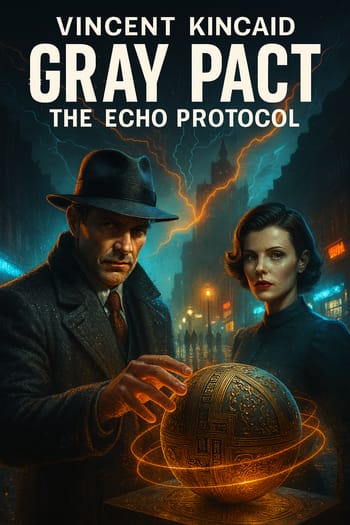
Anja Petrova walked a few paces behind him, the heavy case containing the Aegis Conduit held tight in her gloved hands. She moved with the same grim economy as Sineus, her breath pluming in the frigid air. They were fugitives with a hall pass, a temporary reprieve bought with the threat of a world-ending weapon. The air itself felt thin and brittle, humming with a low, persistent static that was more a feeling in the teeth than a sound. It was the background noise of a world coming apart at the seams.
They were not alone.
The three men appeared without a sound, materializing from the thin flurry of snow between the train cars. They were ghosts of a different sort, dressed in dark, heavy wool coats that absorbed the gray light. They held their pistols low and ready, a gesture of professional calm that was more menacing than any overt threat. At their center was Robert Thorne, the high-ranking CIA officer who had been Sineus’s handler. His face was sharp and impassive, chiseled from the same cold pragmatism that ran the Unseen War.
Thorne had tracked them. The net had closed. They were trapped between a wall of steel and the men who had once paid their salaries.
— That’s far enough, Sineus, — Thorne’s voice cut through the quiet hum of the yard, devoid of warmth or anger. It was the voice of a man closing a file. His two agents fanned out, creating a perfect field of fire. There was no escape route.
Thorne’s eyes were not on Sineus. They were fixed on the case in Petrova’s hands. He took a step forward, the snow crunching under his polished shoe.
— I’m not here for you. I’m here for the asset. Hand it over, Sineus. The Aegis Conduit is too dangerous for you to hold.
His tone was reasonable, logical. He was a manager correcting an inventory error. The demand was the only move on his board. For the CIA, controlling the counter-weapon was as important as controlling the weapon itself. It was a subjugation of their last piece of leverage.
Sineus did not move. He met Thorne’s gaze across the twenty meters of frozen ground that separated them. The air crackled, the faint visual static at the edge of his vision seeming to thicken, blurring the hard lines of the freight cars.
— No.
The word was flat. Absolute. It hung in the freezing air, a small, hard stone of defiance. It was a choice, and the price was the immediate escalation from a conversation to a confrontation. Thorne’s expression didn’t change, but the agent to his right shifted his weight, his knuckles white on the grip of his pistol.
The standoff tightened, a wire pulled taut. Then Petrova moved. She stepped forward, placing herself beside Sineus, her hand resting protectively on the Conduit’s case. Her eyes, cold and clear, locked onto Thorne.
— It stays with us.
Her voice was firm, a declaration that sealed their pact. They were no longer a rogue agent and a defector. They were a unit. In that moment, the oppressive hum of static in Sineus’s head seemed to quiet, the world snapping into sharper focus. The gray sky, the black steel of the trains, the determined line of Petrova’s jaw—it all felt more real, more solid. They had chosen their own path, and reality, for a brief second, seemed to agree.
Thorne was silent for a long moment. He was a man who understood leverage, and he saw it shift. He was facing two opponents, not one. Two desperate, determined people who had fought their way across a continent and would not be disarmed by a simple order. He was a pragmatist, and the primary threat was still Kestrel.
He gave a short, almost imperceptible nod. His agents relaxed their posture by a fraction of a degree. The immediate threat of violence receded, replaced by the cold chill of negotiation.
— You’re a liability, Sineus. Both of you. But Kestrel is a catastrophe.
Thorne reached into his coat and pulled out a thick manila envelope. He tossed it onto the snow between them.
— New identification. A transport manifest for agricultural equipment. There’s a freight car on track seven, heading for the border. It’s not comfortable, but it’s clean. It will get you into the USSR.
It was not a surrender. It was a strategic investment. He was giving them a path forward, aiming them like a weapon at his own enemy. The temporary non-aggression pact was born of mutual need, not trust.
Sineus watched him, his expression unreadable. He bent down and picked up the envelope. The papers were inside, crisp and official.
Thorne turned to leave, his agents falling into formation around him. He paused and looked back at Sineus, his eyes like chips of ice. The truce was temporary, and the bill would come due.
— Get it done. Then you and I will have a talk.
The three men vanished back into the snow as silently as they had appeared. The only proof they had been there was the envelope in Sineus’s hand and the footprints darkening in the snow. The faint hum of static returned, a quiet reminder of the war that was waiting for them.
The train rumbled on, carrying us into the heart of the Soviet Union.