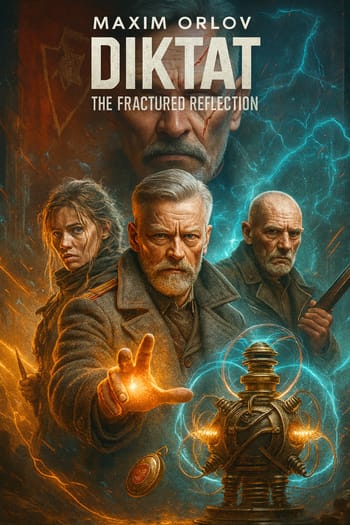
The air tasted of iron and frost. Commander Sineus lay flat behind a shattered wall of concrete, the grit pressing into the rough wool of his greatcoat. Snowflakes, thin and sharp as dust, settled on the frozen mud and the twisted steel of the rail yard. His objective was a hundred meters away: a raised signal house where a German machine gun crew commanded the junction. They had been pinned for an hour. The cost in blood was rising.
He signaled to Sergeant Major Boris Kulagin, his trusted veteran, who lay ten meters to his left. Kulagin was a man made of iron filings and black tobacco, his face a roadmap of old campaigns. Sineus pointed with two fingers, tracing a path through the labyrinth of skeletal boxcars and craters. The flanking route. It was risky. The Wehrmacht defenders were dug in, disciplined. But staying here was a slow death. Kulagin gave a single, sharp nod. He understood the geometry of the problem. He always did.
— First and third squads, on my mark, — Sineus’s voice was a low rasp, barely audible over the wind. — We move to the collapsed water tower. Kulagin, you provide suppression.
— Understood, Commander.
Sineus watched as the first squad began to move, their grey winter uniforms blending with the ruins of the Stalingrad Cauldron. They moved low and fast, ghosts in a city of ghosts. He felt the familiar tension, the cold calculus of command. He was sending men into a meat grinder. His men. The price of this frozen dirt was paid in their lives. It was his job to make sure the price was not paid for nothing. He committed the route to memory, every piece of cover, every open field of fire.
Then the pressure started.
It began behind his eyes, a familiar spike of pain that was more than a simple headache. It was a physical weight, as if his skull were being squeezed in a vise. The sounds of the battlefield—the distant crack of rifles, the groan of stressed metal in the wind—faded to a dull, underwater drone. His vision blurred at the edges, tunneling into a single point. He fought it. He always fought it. A commander could not afford weakness. Not here.
He blinked, trying to clear his sight. The world swam back into focus, but it was wrong. Ten meters ahead of his command squad’s position, where an open patch of rubble offered no cover, the air shimmered. It was like heat haze on a summer road, but this was a place of absolute cold. The shimmering coalesced. For a single, impossible second, he saw it. A ghostly image of an artillery shell, grey and finned, hanging in the air before it plunged into the ground and erupted in a silent, spectral bloom of dirt and shrapnel.
A memory of the future. Or madness.
There was no time to decide. His body reacted before his mind could object. The choice was instinct. The price was his authority if he was wrong.
— Down! — The word was torn from his throat, a raw, desperate bark.
His command squad, men conditioned by months of brutal fighting, did not hesitate. They hit the dirt on pure reflex, their trust in him absolute. They trusted him even when his orders made no sense. The half-second of their reaction felt like an eternity. He waited for the laughter, the confused questions. He waited to be proven a fool, a man cracking under the strain.
The air screamed.
A real shell, its whistle a sharp, rising crescendo, slammed into the earth. It struck the exact spot where the phantom had been. The impact deviation was zero meters. A geyser of frozen dirt, ice, and metal fragments erupted, scouring the air where his men would have been standing. The shockwave hit him like a fist, rattling his teeth. The men were safe. He had been right. And that was the most terrifying thing of all.
He pushed himself up, his ears ringing. The headache was gone, leaving only a hollow ache in its place. He refused to look at the crater. He refused to acknowledge what had just happened. It was shell-shock. A trick of a tired mind. It had to be. He had seen men break in a dozen different ways. This was just his way. He was a commander in the Red Army. He believed in material reality. He believed in the Party, the plan, and the power of massed artillery. He did not believe in ghosts.
Kulagin crawled over to him, his face caked in grime.
— Commander? You are well?
— I am fine, Sergeant Major, — Sineus said, his voice flat. He forced himself to meet the man’s gaze. There was no judgment in Kulagin’s eyes. Only concern. — A lucky guess.
He pushed the event into a locked box in his mind and turned the key. There was a battle to win. He scanned the chaos, his eyes landing on a shard of glass from a shattered signal lantern, half-buried in the icy mud. For a moment, he saw his reflection. The face was gaunt, bearded, a stranger’s mask of exhaustion. But beside it, for a fraction of a second, was another face. A distorted, fractured image of a man he did not know, its features twisted in a silent scream.
His own face, but not.
With a curse, he kicked the shard of glass, sending it spinning into a snowdrift. He would not look at it again. He would not think about it. He was Sineus. A commander. His identity was his uniform, his rank, his duty. Nothing else. He suppressed the tremor in his hand, clenching it into a fist. The cold was a welcome distraction, a clean and honest pain.
He raised his arm, signaling the general advance.
— All units, forward! — he roared, his voice carrying across the ruined yard.
The battle began again. His 105 men rose from the rubble, a wave of grey against the white snow, and surged toward the final German positions. There were perhaps 30 defenders left, but they were fanatics, fighting for every meter of frozen ground. The air filled with the chatter of submachine guns and the flat crack of rifles.
Sineus moved with his men, a part of the machine. He was no longer a man with a splitting headache or a fractured reflection. He was an instrument of war. He directed fire, pointed out targets, his mind a cold engine of tactical necessity. He saw a machine gun nest open up from a blasted-out window on their flank.
— Kulagin! Second floor, left side! Suppress!
The Sergeant Major’s squad laid down a withering hail of fire, forcing the German gunners to duck back. Under that cover, Zoya Koval, the partisan girl attached to his unit, led a small team forward with grenades. The explosions were muffled thuds, followed by silence. One nest gone.
They moved from one piece of cover to the next, a brutal, systematic process of erasure. The fighting was close, ugly work. A man fell to his right, a dark stain spreading on the snow. Another crumpled silently behind him. The cost was eight men. Eight lives for a hundred meters of twisted track and broken concrete. Sineus did not allow himself to feel it. He would feel it later. Or he would not. It did not matter.
The final assault on the signal house was a storm of grenades and point-blank fire. He was at the front, his pistol in his hand, the smell of cordite sharp in his nostrils. He kicked in the door and shot the man who turned to face him. The fight was over in twenty seconds of savage violence.
Silence fell. It was a heavy, unnatural quiet, broken only by the wind whistling through the bullet holes in the thin metal walls. The air was thick with the coppery smell of blood and the stink of spent powder. He stood on the captured rail junction, his chest heaving. Below him, the last pockets of German resistance were being mopped up. The objective was secure. Area control was 100%. He had done his duty. He was a good soldier. A loyal commander.
The snow fell harder, a clean white sheet covering the filth of the battle. He watched the flakes land on the barrel of his pistol, melting instantly.
Then he saw the runner. A young soldier, barely a man, picking his way through the rubble, heading directly for the signal house. The boy was not from his unit. He carried a sealed dispatch case. He moved with an urgency that cut through the post-battle exhaustion. The routine of war was broken.
The courier scrambled up the embankment, his face flushed. He saluted, his eyes wide.
— Commander Sineus?
— I am Sineus.
— A dispatch for you, Commander. From General Volkov.
The courier handed him the oilskin pouch. Sineus took it. The seal was heavy, wax stamped with the insignia of the Directorate. Not the army. The Directorate. He knew the name Volkov only by reputation, a whisper in the high command, a man of immense and unseen power. A summons from such a man, delivered directly to the front line, bypassed every protocol. It was not a request.
It was a chain being fastened around his neck.
He broke the seal, his fingers numb from the cold. He pulled out the single sheet of paper and read the order. His presence was required immediately.