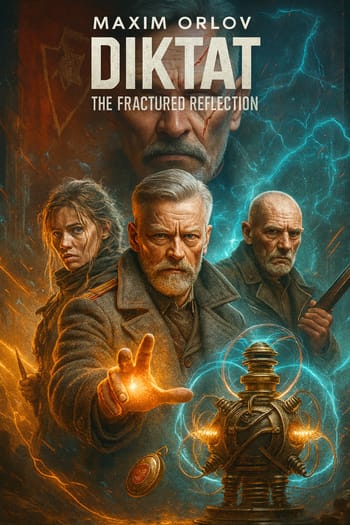
The room smelled of old paper and floor wax. General Ivan Volkov stood before the twelve men of the Red Directorate’s Supreme Committee, the highest governing body of the secret war. They sat around a vast, circular table of polished dark mahogany, their faces pale islands in the dim light. The air was heavy, recycled, tasting of stale tobacco and the quiet fear of men who held immense power but understood very little of it. He needed their vote. He needed their unanimous authorization for the first field test of the Oscillator at Kavkaz-4.
He took a sip of scalding black tea from the glass on the lectern. The bitter heat was a familiar anchor. It was the taste of work. The taste of control. He set the glass down with a soft click that was loud in the carpeted silence.
— Comrades, — he began. His voice was calm, reasonable. The voice of a father, not a general. — We are here today to discuss not a weapon, but a tool. A surgeon’s scalpel for the body of the state.
He let the words settle. He saw them exchange glances. Old Orlov, the academic, frowned. Ratnikov, the logistics man, was already sweating. They were afraid. Good. Fear was a resource.
— The project you know as the Oscillator is the final guarantee of victory. It is not a bomb to level a city. It is a wave that will wash it clean. We are not in the business of making rubble. We are in the business of making history. This device allows us to practice historical sanitation on an industrial scale.
He paused. Sanitation. A clean, sterile word for an act of absolute erasure. He saw comprehension dawn on a few faces, and with it, a deeper shade of fear.
— Imagine a front that has collapsed. A city lost. A population poisoned by fascist ideology. With the Oscillator, we do not merely retake the ground. We erase the memory of the defeat. We erase the memory of the poison. We are left with a clean slate. A patch of earth and a population ready to be educated in the Soviet ideal, with no memory of anything else.
Comrade Orlov, a thin man with a face like crumpled parchment, cleared his throat. He was the committee’s designated conscience. A necessary, but irritating, component of the machine.
— General, your reports on the… side effects. This Whispering Plague. The field data is alarming. We have entire sectors of the front where reality is becoming… unstable. Where our own men are lost to unnatural silences.
Volkov met his gaze. He did not look away. He gave the old man’s fear the respect it was due, the way a butcher respects the twitching of a dying animal.
— The risks are known, Comrade Orlov. And they are acceptable.
He began to walk slowly around the outer edge of the table. His footsteps were silent on the thick red carpet. He was a shark circling a small boat.
— Every great endeavor has a cost. When we built the great dams, we flooded villages. When we forged the steel for our tanks, the furnaces took their share of men. This is no different. The Whispering Plague is a regrettable, but manageable, consequence. A small price for a perfect Soviet future, a future free from the mistakes of the past.
He stopped behind Orlov’s chair. He could smell the man’s fear, a scent like sour milk.
— The Ahnenerbe are not burdened by such sentiment. They see the Plague as a weapon in itself. They would gladly unwrite half of Europe to achieve their aims. Are we to be less bold than our enemies? Are we to lose this war, the final war, because we were afraid to pay the price of victory?
The room was silent. He had framed their caution as cowardice. He had turned their morality into a liability. He saw the shift in their eyes, from doubt to a grim, reluctant necessity. He saw his own reflection in the polished surface of the table, a solid, determined face. Beside it, the reflections of the other men were distorted, fragmented things. Fractured images of weakness.
He returned to the lectern. It was time for the final move. The one that would seal their decision.
— There is the matter of security. The fear of this technology falling into the wrong hands.
He gestured to an aide standing by the door. The young man stepped forward and placed a thin file on the lectern. It was bound in grey cardboard.
— As you know, the chief architect of the Oscillator’s core, Dr. Viktor Sokolov, defected. He took with him research of the highest sensitivity. A grave breach.
He let the weight of that failure settle in the room. It was their failure, as a committee. A calculated risk. Sokolov was the bait. And a certain commander of noble birth was the hound he had sent to track him.
— I assigned one of our best field commanders to this task. A man of unique instincts. Commander Sineus.
He opened the file. He took out a single sheet of paper. A radio transcript.
— I have his final report here. Received two days ago from the Pripet Marshes.
He held the paper up. He did not need to read it. He knew the words by heart. They were a perfect, beautiful lie. A lie he would now make the foundation of their future.
— “Target neutralized during engagement with Ahnenerbe forces. Body lost in the marsh. The Sokolov Cipher is irrecoverable.”
He placed the paper back on the file. He closed it. The sound was soft, final.
— The leak has been contained. The traitor is dead. The man who created this problem is gone. We are left only with his solution. The tool that will win us the war.
He looked at each man in turn, holding his gaze. He was not asking for their permission. He was giving them the justification they needed to do what they already knew they must. He was absolving them of the choice. The price was his, and his alone. A lie, built upon a lie.
— The time for debate is over, Comrades. The time for action is now. I ask for your vote. All in favor of authorizing the first operational test of the Oscillator at Kavkaz-4.
Silence. The only sound was the faint hum of the ventilation system. Then, slowly, a hand went up. Ratnikov, the logistics man. Then another. And another. Orlov was the last. His hand trembled as he raised it. His face was the color of ash. But he raised it.
Twelve hands. A unanimous decision.
Volkov gave a single, sharp nod.
— It is done.
The committee members rose, their chairs scraping against the floor. They filed out of the room, not looking at him, not looking at each other. They were ghosts leaving their own haunting. Volkov remained. He was alone in the vast, silent room. He had won.
He walked to the tall, armored window that overlooked the snow-dusted towers of the Kremlin. The sky was a sheet of grey steel. He saw his reflection in the dark glass. A single, solid figure against the backdrop of the heart of the empire. Whole. Unbroken.
The snow fell softly on the silent city. The world outside was quiet, blanketed in white.
An aide entered the room, his footsteps quick and quiet on the carpet.
— General. A priority signal from the Istanbul station.
Volkov turned from the window, his reflection vanishing.
— Report.
— We have located the Ahnenerbe artifact, sir. The Chronos Anomaly Detector. And we have confirmed the presence of the traitor, Sineus. He is with Sokolov. They are both alive.
Volkov felt a slow, cold smile spread across his face. Everything was proceeding perfectly. The committee had given him his weapon. And Sineus, his loyal, broken hound, had just led him to the prize he truly wanted.