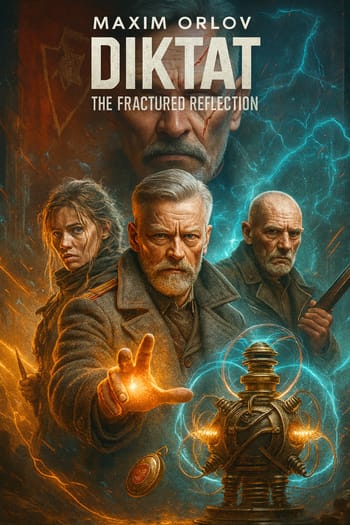
The aide led them away from the light. One moment they were in a corridor of cool marble, the muffled pulse of the consulate party behind them. The next, they were in a narrow alley smelling of wet stone and charcoal smoke. The aide moved with a liquid silence, his crimson fez a single point of color in the oppressive dark. Sokolov followed close behind Sineus, his steps hurried and uncertain, a man of laboratories lost in a world of shadows. Sineus walked with his hand near the Tokarev holstered under his jacket, his senses sharp, mapping every cross-alley, every darkened doorway. He was a commander again, but his battlefield was a maze of garbage and sleeping cats.
They walked for twenty minutes, a twisting path that erased any sense of direction. The aide stopped before a heavy, featureless wooden door. He did not knock. He simply waited. A moment later, a series of clicks echoed from within, and the door swung inward on silent hinges. The aide gestured for them to enter, then melted back into the night without a word.
The air inside was thick and heavy, saturated with the weight of a thousand forgotten lives. It smelled of dust, decaying paper, and the faint, metallic tang of ozone. The shop was a labyrinth of towering shelves, crammed with objects that seemed to absorb the weak yellow light from a few bare bulbs. Clocks ticked out of sync, their sounds weaving a fractured, stuttering rhythm. Brass instruments gleamed dully. Stacks of books leaned at precarious angles, their leather spines cracked like old skin. It was not a shop. It was a mausoleum of memory.
Adem Kurtoglu stood behind a wide, cluttered counter. The memory broker was a thin, stooped man, his face a map of deep wrinkles. He wore a simple dark vest over a white shirt, his own crimson fez a match for his departed aide’s. He was cleaning a pair of spectacles with a small square of silk. He did not seem surprised to see them.
— Commander Sineus, — Kurtoglu said, his voice a dry rustle of leaves. — Dr. Sokolov. Please. The city has ears, but my walls are deaf.
Sokolov flinched at the sound of his name, but Sineus gave a slow, deliberate nod. He walked to the counter, placing his worn satchel upon it. He felt Sokolov’s anxiety like a low hum in the air. He ignored it. He unbuckled the flap and carefully removed the quartz plates of the Sokolov Cipher. He laid them on the dark wood of the counter. The plates were cool to the touch, their surfaces holding a faint, internal luminescence. They were the reason Kulagin was dead. They were the reason they were here.
— We need to transmit this, — Sineus said. His voice was flat. A statement of fact. — To the Athenaeum. You said you could make the introduction.
Kurtoglu looked at the plates, but did not touch them. His dark eyes held a deep, ancient stillness. He set aside his spectacles and picked up a small object from the counter. It was a brass eyepiece, a Memorum Loupe, fitted with a series of crystal discs that clicked softly as he adjusted them. The device was a tool for seeing what was, not just what is. He raised the loupe to his right eye and leaned over the quartz plates.
— The work of a master, — Kurtoglu murmured, his visible eye narrowed in concentration. The discs of the loupe spun with a quiet whir. — The data structure is dense. Elegant. And very, very dangerous. Yes. The Athenaeum will be most interested.
He straightened up, placing the loupe back on the counter. The appraisal was complete.
— I will transmit it, — the broker said. — My equipment is shielded. The signal will be buried in the noise of a dozen other diplomatic cables leaving the city tonight. It will arrive.
Sokolov let out a breath he had been holding for a week.
— Our payment, — Sineus began, reaching for the small pouch of gold he had held back from The Turk. It was not much. A few coins. An insult, probably.
— I do not want your gold, Commander, — Kurtoglu said, raising a hand. The gesture was small but absolute. It stopped Sineus cold. — Gold is a memory of value. It is loud. It can be traced. I deal in a more stable currency.
Sokolov looked confused. Sineus felt a familiar coldness settle in his gut. The coldness of a trap he had walked into willingly.
— What is your price? — Sineus asked.
— A debt, — Kurtoglu said simply. His eyes met Sineus’s. They were not unkind, but they were as hard as river stones. — You are a man of unique talents and unfortunate circumstances. Such men are rare. More valuable than any metal. I will transmit your data. In exchange, you will owe me one future service. Unspecified. To be called upon when I have need of a man like you.
Soklov started to speak. — That is insane. We can’t agree to—
— Be silent, Doctor, — Sineus said, his voice quiet but carrying the weight of command. He did not look at Sokolov. He looked at Kurtoglu. He understood the transaction perfectly. A favor was a chain. A debt was a leash. But they had no other options. The choice was between a future debt and a present death. The price was a piece of his will, traded for their lives.
— I accept, — Sineus said.
Kurtoglu gave a slow, satisfied nod. He reached under the counter and brought out a heavy object. It was the Broker’s Ledger. It was not a book, but an abacus made of dark, polished wood. The beads were not wood or stone, but spheres of dull, black iron that seemed to drink the light. The artifact felt ancient, heavy with the weight of a thousand such promises.
— The ledger must be marked, — the broker said. — The memory of the agreement must be stored. It is a simple process. We both touch it. The ledger will do the rest.
He slid one of the iron beads to the center of its wire. It moved with a dry, grating sound. He placed his thin, ink-stained fingers on the wooden frame. He looked at Sineus and waited.
Sineus hesitated for a fraction of a second. He thought of Kulagin’s locket. He thought of the child’s drawing. This was the hard right. It was harder for a reason. He placed his hand on the ledger, his fingers next to Kurtoglu’s.
The jolt was not electric. It was a feeling of sudden, immense cold. A psychic drain. He felt a phantom pressure against his mind, and he saw an image of himself in his mind’s eye—his own face, grim and determined, making the promise. He felt the memory of the moment, the smell of the dusty shop, the weight of his choice, being pulled from him. It was a clean, surgical extraction. The memory was no longer just his. It belonged to the ledger.
He pulled his hand back. The iron bead in the center of the wire was a shade darker than the others, a spot of absolute black. He had paid the price.
He glanced at his reflection in the curved glass of a nearby display case. The image was still fractured, broken by the old glass, but the pieces seemed sharper now, more defined. The face of a man who had made a choice and owned it.
— The debt is recorded, — Kurtoglu said. He pushed the ledger back under the counter. He then walked to a corner of the shop, where a complex apparatus of brass coils and vacuum tubes sat on a table. He flipped a series of switches. A low hum filled the room, and a pale blue light began to pulse from a crystal at the device’s center. — The transmission has begun. It will be complete in ten minutes.
The hum of the machine was a steady, reassuring sound. The blue light pulsed like a slow, calm heartbeat. For the first time in weeks, a fragile sense of victory settled over Sineus. They had done it. The truth was on its way.
The dust motes danced in the weak yellow light, each a tiny world with its own history. The clocks on the shelves ticked on, measuring a time that no longer felt entirely real.