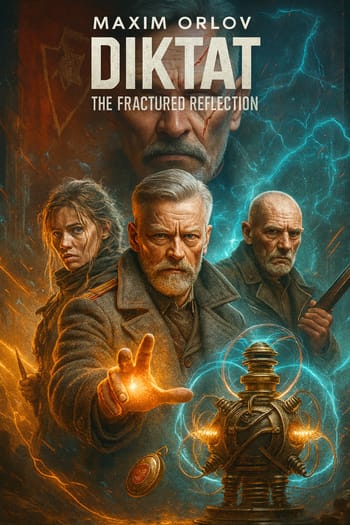
The fortress wall was a sheer cliff of grey concrete, thirty meters high and stained dark by the blizzard. The wind was a physical force, trying to tear him from his footing. Beneath the howl of the storm, the Oscillator at Kavkaz-4 sang its high, unholy note, a sound that vibrated in his teeth and bones. Sineus knelt in the snow, his movements stiff with cold. He unslung the Chronos Anomaly Detector, the heavy brass and steel device that could measure reality's decay. Its weight was a comfort, a solid fact in a world of screaming ghosts.
He pressed the flat base of the Detector against the frozen concrete. The metal groaned in protest. This was the first step of the suicide plan. The only step that mattered. His fingers, clumsy in their thin gloves, found the secondary activation switch Sokolov had shown him. A small, unguarded toggle, an afterthought in the device's design. To use it was to weaponize the physics of the world, to pay for a door with a piece of reality itself.
Sineus flipped the switch.
The Detector did not explode. It emitted a low, resonant hum that cut through the blizzard's roar. The air in front of the wall began to shimmer, like heat haze over summer asphalt. Then, with a silent scream that tore through Sineus’s mind, the concrete tore open. It was not a hole. It was a seam, a vertical, shimmering flaw in the world, two meters tall and a meter wide. Inside, reality was a distorted, wavering mess of bruised light. The gateway was open.
The consequence was immediate. The whispers of the Whispering Plague, the cancerous void of severed memories that had been a constant pressure at the edge of his hearing, became a deafening roar. It was the sound of a billion forgotten moments all screaming for attention at once. The price for the door was his sanity, and the bill was coming due. On the face of the Detector, a needle that had been steady in the green zone spiked violently into a solid band of red. The seam flickered, its edges wavering like a dying flame. It was unstable. It could collapse at any second.
In the polished brass casing of the device, Sineus saw his own face, a fractured reflection twisted by the curve of the metal and the terror of the moment. He met Zoya’s eyes. She stood beside him, a ghost in the swirling snow, her face a pale, determined mask. There was no need for words. They had made their choice in the cave. This was just the falling of the stone. He gave a sharp nod. She returned it.
Together, they stepped through the seam.
It was like diving into an ocean of broken glass. Not of pain, but of sensation. A chaotic, violent barrage of memory hit him. The smell of baking bread from a forgotten kitchen. The rough texture of a father’s wool coat. The sharp, metallic taste of fear in a trench. A woman’s laughter, warm and intimate. The gut-wrenching vertigo of falling from a great height. A thousand lives, a million moments, none of them his own, all of them screaming for purchase in his mind. The sensory overload was absolute, a memory bombardment that threatened to tear his consciousness apart.
His vision dissolved into a kaleidoscope of other people’s lives. He was a boy stealing an apple. He was an old woman dying in a warm bed. He was a soldier charging a machine gun nest, his heart a frantic drum. He stumbled, his knees buckling under the weight of so many ghosts. Madness was a cold, smooth hand closing around his throat.
Then, a memory that was his own. Sokolov’s voice, thin and reedy in the dripping dark of the cistern. Anchor yourself, Commander. Find a rock in the ocean. Something real. Something simple.
His hand went to the Tokarev pistol holstered under his arm. He focused on it. The worn wooden grip. The cold, hard reality of the steel. The simple, mechanical memory of its purpose. The slide racking back. The shell ejecting. The sharp, clean crack of a shot. It was a simple, brutal machine, and its memory was pure. He clung to that simplicity, using it as a shield.
The storm of foreign memories did not vanish, but it receded. The screaming voices became a manageable roar. The chaotic images resolved back into the dim, wavering light of the fracture. He could think again. He could function. He was still himself, however scarred.
He looked at Zoya. She was gritting her teeth, her knuckles white where she gripped her rifle. She was not a sensitive, but she felt the wrongness of this place. The unnatural pressure. The psychic filth. But she was a soldier forged in the fires of the front. She met his gaze, her eyes burning with a cold, hard resolve. She pushed through the pain, her focus absolute. She was a weapon aimed at the heart of the fortress.
They took another step, and another. The world inside the seam was a corridor of shifting, impossible colors. Then, they were through. They stumbled out onto the cold concrete floor of a service tunnel. The air was still, smelling of sterile dust and the faint, sharp tang of ozone. The distant, rhythmic thrum of heavy machinery vibrated through the soles of their boots.
Behind them, the seam in reality snapped shut. There was no sound, but the sudden absence of its psychic scream was like a physical blow. The pressure in Sineus’s mind eased. The roar of the Plague faded back to a constant, nagging whisper.
They were inside. They were trapped.
Zoya moved first. She looked down the long, grey corridor, then back at him. Her part of the plan was simple. And loud. She gave him a final, sharp nod, a promise and a farewell.
— Give them hell, Commander, — she said, her voice a low rasp.
Then she melted into the shadows, a ghost moving toward the sound of the fortress’s beating heart.
He was alone. He turned, facing the opposite direction, toward the deeper, more resonant hum. Toward the Oscillator. Toward Volkov.