The first shot was not a Soviet weapon. It was the hard, flat crack of a German rifle. The sound cut through the hiss of the freezing rain. A gout of black water and mud erupted less than a meter from Sokolov’s leg. The scientist flinched, a puppet whose strings had been jerked. He was the target.
Sineus did not think. He acted. His objective, burned into his mind by a decade of command, was to secure the asset. But the images Sokolov had shown him—the Oscillator, the city erased from a map, the graph of the Whispering Plague climbing toward infinity—had overwritten that objective. The asset was not Sokolov. The asset was the truth the man carried.
He lunged, grabbing the thin fabric of Sokolov’s coat. He hauled the scientist down into the freezing water, the shock of the cold a distant, unimportant fact.
— Fall back! — Sineus roared, his voice raw. — To the trees! Now!
The world dissolved into noise and motion. Muzzle flashes winked from the skeletal trees fifty meters to the west. Bullets slapped into the water around them, each impact a sharp, angry splash. The Ahnenerbe. They had been waiting. They had let him do the work of finding Sokolov, and now they were here to collect the prize.
Zoya Koval was already firing. She had dropped to one knee on the bank, her rifle a part of her. There was no wasted motion. The weapon cracked once. A figure in the distant trees jerked and fell. She worked the bolt. The rifle cracked again. A second man vanished from sight. Three shots in as many seconds. Three hits. She was not a soldier. She was a predator.
To his right, Kulagin opened up with his submachine gun. The weapon’s chatter was a brutal, hammering sound. He was not aiming for kills. He was aiming for suppression, stitching a line of fire across the enemy’s position, forcing them to keep their heads down. Bark flew from the white trunks of the birch trees.
— Go! — Kulagin yelled, his voice a gravelly bark over the gunfire. — I’ll cover!
Sineus hauled Sokolov through the sucking mud and black water, toward the relative safety of the bank. The scientist was a dead weight, his body wracked with shivers, his strength gone. He was an academic, a man of paper and theories, and the physical reality of combat was crushing him. Sineus was a creature of this element. The cold, the fear, the smell of cordite on the air—it was his natural habitat.
They reached the bank. Morozov was huddled behind a thick tree, his face white, his pistol held in a trembling hand. He was useless. A spectator at his own potential death. Sineus shoved Sokolov down behind the same tree and turned, adding his own pistol fire to Kulagin’s. The small-caliber rounds were insignificant at this range, but they added to the noise. They added to the pressure.
The enemy fire slackened for a moment, pinned by Kulagin’s relentless barrage.
— Now, Sergeant Major! — Sineus shouted.
Kulagin broke from his position and sprinted toward them, his boots churning mud. He dove behind the line of trees as a fresh volley of rifle fire tore through the space he had just occupied. They were all together. Four soldiers and a scientist. Trapped.
The firefight settled into a grim rhythm. The crack of the Ahnenerbe rifles. The answering chatter of Kulagin’s gun. The methodical, deadly punctuation of Zoya’s single shots. They were outnumbered. Their position was temporary. They had maybe five minutes before they were flanked and destroyed.
Sineus pulled the radio from his belt. The Bakelite handset was cold and slick with rain. This was the moment. The point of no return. He could report the ambush. He could call for reinforcements. He could follow procedure and die a loyal officer, his mission a failure, the truth lost forever in this frozen swamp. Or he could choose the other path. The hard right.
He keyed the microphone. The speaker hissed with static. The signal was weak.
— Vostok-One, this is Falcon. Come in, Vostok.
The static answered him. He tried again.
— Vostok-One, this is Falcon. Report follows.
A voice, thin and distorted, crackled back.
— Falcon, send traffic.
Sineus took a breath. The air burned in his lungs. His heart hammered against his ribs, a frantic drumbeat. He looked at Sokolov, shivering and pale. He looked at the quartz plates in the man’s satchel. He saw the image of the city erased from the map. He saw the words: acceptable cost.
He made the choice. The price was his name, his honor, his entire life up to this point. He paid it.
— We made contact with the target, — Sineus said, his voice a low, steady monotone. He kept it flat. Devoid of emotion. The way a commander files a report. — Engaged by unknown enemy force. Sokolov is dead. I repeat, Sokolov is K.I.A. Body lost in the marsh during the firefight. The cipher is lost. We are breaking contact and returning to base. Over.
Silence. Only the hiss of the radio. For a long, terrible moment, he thought they had not believed him. That they would order him to hold his position. That they would send a team to verify.
Then the voice came back, just as clipped and impersonal as before.
— Acknowledged, Falcon. Proceed. Vostok-One, out.
The red light on the handset winked out. The connection was severed. He had done it. He had committed treason with a few calm words. He was no longer Commander Sineus of the Red Army. He was a liar. A rogue.
Morozov stared at him, his mouth hanging open. The political officer looked as if Sineus had just shot him. In a way, he had. He had shot the man’s entire world, his system of belief, his faith in the unbending structure of the state.
— Commander… — Morozov whispered, his voice shaking. — That was a false report. You have a duty… a sworn oath…
— I have a new duty now, — Sineus said. His voice was cold. He looked at Morozov, and the political officer flinched, taking a step back.
He turned to Kulagin. The Sergeant Major was watching him, his expression unreadable. He had heard the lie. He had seen Sokolov, alive and breathing, not three meters away. Kulagin’s gaze flickered from Sineus to the scientist, then back to Sineus. He held his commander’s eyes for a long second. Then, he gave a single, sharp nod. He did not need to know the details. He trusted the man, not the uniform. His loyalty was here, in this patch of frozen mud.
Sokolov looked at Sineus, and for the first time, there was something other than fear or resignation in his eyes. It was a look of profound, weary understanding. He knew what Sineus had just sacrificed. He knew the weight of that lie.
The gunfire from the trees had stopped. The Ahnenerbe were regrouping. Or perhaps they were fading back into the mist, their objective denied them. For now.
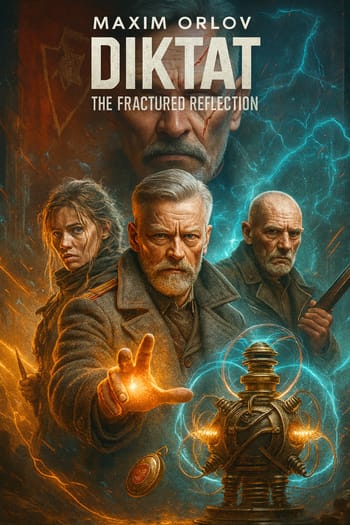
Sineus knelt by a pool of black, still water. He splashed the icy liquid on his face, washing away the sweat and the tension. He saw his own reflection. It was the face of a stranger. Gaunt, hard, tired. But it was a single face. The two halves he had seen before—the loyal commander and the man who knew the truth—were gone. They had merged into this new, grim visage. A fractured reflection made whole. It was the face of a traitor. It was his own.
He stood up. The cold clarity that followed the decision was absolute. The path behind him was gone, erased by his own words. There was only the path forward.
— We move east, — he said. It was an order. The first order of his new command.
Kulagin checked the action on his weapon. Zoya slid a fresh clip into her rifle. Sokolov, shivering, pushed himself to his feet. Morozov simply stared, a man whose map of the world had just been burned.
They left the bodies for the crows and walked east.