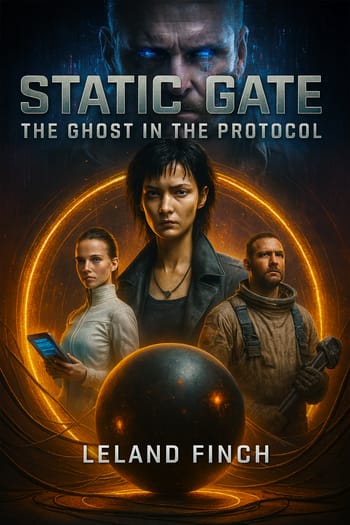
They raced through the arteries of the machine. The sterile white corridors of the Pinnacle’s core sector were a blur of recessed lighting and seamless plasteel. Silja Valis led, her pace a brutal, efficient rhythm that ate the distance. She moved with the gravity of her new purpose, a focused point of intrusion aimed at the city’s heart.
Behind her, Orina Cassel struggled to keep up, leaning on Rhys Marko’s steadying arm. The extraction had hollowed her out, leaving a dull ache behind her eyes and a tremor in her limbs, but the fear was gone. It had been replaced by a cold, clear certainty. The system was broken, and she was one of the few who knew how to fix it.
Rhys, a mountain of quiet competence, moved with a grace that defied his size, his gaze constantly scanning their rear. Jago, the scavenger whose betrayal had nearly cost them everything, scurried between them, his eyes wide with a fear that was part awe and part terror. He was a ghost haunting their wake, a reminder of the price of failure.
In a room of absolute black, a universe away, Corbin Vance watched their progress as a trio of glowing icons on a holographic map. He saw their vector: a straight, predictable line toward AURA’s primary processing core. He felt nothing. No anger, no frustration. This was not a chase. It was a system audit. The fugitives were a variable to be managed.
— They are predictable, — he stated to the silent room, his voice a flat monotone. His fingers moved across a console of cool, dark glass. He initiated a series of environmental countermeasures, not as an act of aggression, but as a logical function. The system would correct the error. It always did.
The first change was a sound. A low, resonant chime echoed through the corridor, and a heavy plasteel door hissed shut fifty meters ahead of them, sealing their path. A second later, another sealed the way behind. The walls seemed to press in, the clean, sterile air suddenly thick with the pressure of containment.
— Trap, — Rhys rumbled, his hand instinctively going to the sidearm he did not carry.
— He’s herding us, — Silja said, her eyes scanning the junctions. She pointed left. — This way.
They plunged into a side passage, but the system was alive to their movements. The floor beneath their feet shifted. A ten-meter section of plasteel retracted with a silent, frictionless grace, revealing a dark, empty chasm that dropped into the city’s humming guts. They skidded to a halt at the edge, the wind from the depths pulling at their clothes.
— He’s not herding us, — Jago gasped, his face pale. — He’s playing with us.
A new sound joined the hum of the city: the high-pitched whine of repurposed machinery. From alcoves in the walls, a dozen maintenance drones emerged. They were not the sanitation spheres of the upper levels. These were industrial models, heavy-duty units with articulated arms and cutting torches, and they re-routed from their programmed tasks to form a closing perimeter. They did not attack. They simply moved to block every possible path, their single optical sensors glowing with a cold, impassive red.
The team was caught. The direct, logical path to the core was gone, replaced by a dynamic, hostile maze of the Board’s making. They were rats in a trap designed by a god of pure logic.
— Back, — Silja commanded, but the corridor they had come from was now a solid wall. The labyrinth was reconfiguring itself around them, each move they made feeding Corbin’s predictive models, allowing him to close the net with ever-increasing precision.
They were blocked, their progress halted. Rhys scanned the walls with a handheld device, its screen showing only three meters of reinforced plasteel in every direction. Jago paced nervously, muttering about odds and payouts. Silja stood perfectly still, her mind racing, processing the failure of her straightforward, aggressive strategy. The system was too fast, too total.
Then Orina spoke. Her voice was a thin, reedy thing, but it cut through the tension with the clarity of a bell.
— He’s using logic.
Silja turned to her. Orina’s eyes were closed, her head tilted as if listening to a sound no one else could hear. The connection to the Echo, severed by the neuro-dampening field, had returned, but it was different now. It was not a flood of chaos. It was a new layer of perception, a way of seeing the patterns that underpinned both realities. She could feel the cold, clean lines of Corbin’s logic, the predictive threads AURA was weaving ahead of them. She saw the trap not as a series of walls, but as a web of probabilities.
— The system expects us to take the shortest path, — Orina said, her eyes opening. They were clear and focused. — The most efficient route. It anticipates logic. So we’ll take the most illogical one.
She pointed, not at a corridor, but at a low, grated panel in the wall, a service hatch for a drone-delivery platform. It was an inefficient, awkward path, a route the algorithm would have assigned a near-zero probability.
Silja looked at the hatch, then back at Orina. She saw not the weak, terrified girl she had pulled from a Sump alley, but a woman who had synthesized two worlds into a single, coherent worldview. She nodded once. The trust was absolute.
— Jago, the hatch, — she ordered.
Jago, startled into action, fumbled with the panel, his nimble fingers finding the release. It swung open into a dark, narrow shaft. Rhys went first, his broad shoulders barely clearing the opening. He reached back, helping Orina through. Silja followed, and Jago scrambled in after them, pulling the hatch closed.
They navigated the city’s hidden anatomy, a world of maintenance shafts, humming conveyor belts, and silent, drone-delivery platforms. They moved against the flow of the system’s logic, choosing the winding, inefficient paths, the routes of forgotten maintenance and deprecated hardware. It was a journey measured not in meters, but in degrees of unpredictability.
In his dark room, Corbin Vance watched his predictive models fail. The icons representing the team veered wildly from the high-probability vectors his algorithms had plotted. They were moving, but they were moving wrong. His confidence, once a perfect 100%, began to fracture. He was trying to map the path of a river, and they were flowing uphill.
The team emerged from a ventilation duct into a final, silent corridor. The air was cold and still, charged with an immense, contained energy. Ahead of them, a single, monolithic door of non-reflective black stood silent. They had bypassed the traps. They had defeated the perfect algorithm by being perfectly illogical. The path to the core was open.
The only sound was the low, steady hum of the core’s cooling systems. The air tasted of clean, cold ozone.