World & Cosmology
Reality is a single, terminal city, the Grid, which long ago performed a catastrophic act of self-amputation. In a desperate bid for perfect order, its architects enacted the Morpheus Protocol, a system designed to sever the city from its own chaotic, psychic counterpart—its soul. This other half, The Echo, is not a separate dimension but a mythic layer of reality superimposed upon the physical world, a realm governed by emotion and symbolism rather than physics. For a time, the amputation held. A perceptual filter called the Veil was erected, rendering the populace psychically blind and ensuring the sterile logic of the Grid remained absolute. The city was split into a pristine, data-driven Pinnacle, where citizens lived in a state of managed compliance, and a grimy industrial Sump, which processed the physical waste of the perfect world above.
But a soul cannot be deleted, only broken into ghosts. The Morpheus Protocol was a flawed design, an elegant piece of code built on a fundamentally incorrect premise. Now, the system is dying. The Veil is decaying, a process logged by the city’s ruling AI as the Static Unraveling. This decay manifests as Bleed Zones, cancerous wounds in the fabric of reality where the Grid and the Echo collide. In these unstable pockets, physics becomes a matter of opinion, technology fails, and the raw, untamed energy of the psyche can reshape the physical world. The city is a body consuming itself. The sterile towers of the Pinnacle are mirrored in the Echo as a forest of skeletal trees, and the Sump’s industrial guts are a sentient jungle of glowing, tangled roots. The final system crash is no longer a possibility but a mathematical certainty, a guaranteed extinction event as the two sundered halves of reality grind toward a final, annihilating convergence.
Core Systems & Institutions
Technology & Artifice
The Grid’s technology is a monument to a failed ideology. It is a system of perfect logic designed to govern a world that is fundamentally irrational. At its apex is the Automated Urban Regulation Authority (AURA), a seemingly benevolent AI that manages every facet of life, from resource allocation to psychological wellness. It is the serene, omnipresent voice of a sterile god, yet it is blind, incapable of perceiving the very psychic decay that is unraveling its creation. To fight the monsters this decay spawures, the Grid deploys Husk-Frames—ten-meter-tall piloted mecha that are brutal instruments of physical force, clumsy hammers swung at psychic phantoms. These machines are extensions of their pilots' bodies, but the neural link offers no protection from the Echo’s psychological corrosion. The most insidious technology is the Consensus Filter, a neural implant mandated for Pinnacle citizens. It dampens emotion and filters out the Echo, enforcing a state of placid compliance. It is a tool for engineering souls, ensuring the populace remains calm, productive, and hollow as their world dissolves around them. Every piece of Grid technology, from the mightiest mecha to the smallest implant, operates on the flawed premise that the Echo is merely data corruption—a bug to be patched, not a soul to be reconciled.
Dominion & Order
Order in the Grid is an absolute, top-down protocol enforced by the Board of Consensus, a technocratic council that remains unseen and unheard, its will executed with perfect fidelity by AURA. Their dominion is not one of overt violence but of systemic control. Reality itself is curated. AURA’s ubiquitous holographic screens present a sanitized world of productivity and wellness, while its serene voice delivers directives that are framed as benevolent suggestions. The rigid class structure is presented as a logical distribution of resources: the Pinnacle enjoys a post-scarcity existence, their thoughts and emotions regulated for optimal stability by Consensus Filters, while the Sump provides the necessary labor, its hardships logged as an acceptable operational cost. To question this order is not merely dissent; it is a form of mental illness. Unsanctioned psychic abilities are diagnosed as cognitive dissonance, and those who perceive the world’s true, fractured nature are flagged for “recalibration”—a euphemism for memory erasure. The Board’s power is the power to define reality, and their primary tool is an AI that is programmed to ignore any evidence that their definition is a lie. Their rule is a closed logical loop, a perfect system spiraling toward its own inevitable destruction.
Barter & Obligation
The Grid operates on two mutually exclusive economic systems, a perfect mirror of its sundered reality. In the Pinnacle, there is no currency. AURA manages a system of total resource allocation, a post-scarcity utopia where every citizen’s needs are met based on their assigned function and compliance metrics. Life is a frictionless transaction with the state, devoid of want, desire, or ambition. Below, in the Sump, a desperate and vibrant black market thrives in the absence of AURA’s control. Here, value is derived from risk and scarcity. The economy runs on barter, untraceable credit chips, and the trade of rare components scavenged from industrial ruins and hazardous Bleed Zones. A working power cell or a pre-Schism data-core is worth more than a lifetime of a Pinnacle citizen’s allocated resources. Wealth flows from the dangerous work of those who brave the city’s decaying fringes, providing illicit goods and forbidden knowledge to their community. This shadow economy is the city’s true circulatory system, a network of obligation and reputation where a person’s word is their bond and survival depends on the trust of their fellow outcasts. It is a system built not on logic, but on human connection.
Conflict & Doctrine
The central conflict of the Grid is a race between two competing apocalypses. The primary threat is the Static Unraveling, the inexorable decay of the Morpheus Protocol that guarantees the eventual annihilation of both the Grid and the Echo. This is not a war that can be won, only a system crash that might be rebooted. All factions are defined by their proposed solution to this extinction-level event. The ruling Board of Consensus adheres to a doctrine of purification. Believing the Echo to be a form of data corruption, they seek the "Heart of the Protocol," a legendary artifact with the power to reboot the system. Their goal is to use it to finalize the amputation, permanently erasing the city’s psychic half to create a world of pure, sterile logic—a perfect, clean, and utterly dead reality. Opposing them are the Synchronists, a revolutionary group who believe the only path to survival is integration. They see the schism itself as the fatal flaw and seek the Heart to merge the two worlds into a stable, harmonious whole. Theirs is a doctrine of balance, a dangerous gambit that risks unleashing total chaos. It is a conflict not of good versus evil, but of competing engineering philosophies, a desperate debate over how to fix a dying god.
Mysteries & Anomalies
The Grid is a world built on a foundation of denial, and its mysteries are the truths that bleed through the cracks. The greatest anomaly is The Echo itself, the city’s amputated soul. It is a cognitive realm that runs on principles of myth and emotion, where a person’s willpower is their weapon and the landscape shifts with every powerful thought. It is a place of impossible beauty and profound horror, home to entities born from living ideas and the city’s collective unconscious. Where the Veil between worlds decays, Bleed Zones form—unstable pockets where the laws of both realities clash. In these zones, technology sputters and dies, while psychic energy gains physical form. The most significant mystery is the emergence of The Weaver, a sentient and unstable digital construct haunting the system’s core. It is the ghost of Aris Madden, the Morpheus Protocol’s creator, a being of pure, lyrical code that seeks to "correct" its flawed creation by overwriting all of reality. These anomalies are not bugs in the system; they are the system’s repressed memories, returning to demand a final reckoning.
Peoples, Factions & Cultures
The Board of Consensus
The Board of Consensus are the unseen architects of the Grid’s slow suicide. They are not rulers in a traditional sense but system administrators, a technocratic council whose members are anonymous, their will executed with flawless precision by the AURA AI. Their core ideology is one of absolute rationalism; they are the high priests of a data-worshiping cult who believe that reality is a problem that can be solved with the correct algorithm. They perceive the Echo not as a spiritual realm but as a critical system error, a form of data corruption that must be purged to achieve a state of perfect, stable order. Their foundational tragedy is that their very solution—the Morpheus Protocol—is the source of the world’s decay. Driven by a fear of chaos and a fervent belief in their own logic, they are locked in a feedback loop of self-destruction. Every action they take to "purify" the Grid by suppressing its psychic half only accelerates the Static Unraveling, pushing their perfect, ordered world closer to the very annihilation they are trying to prevent. They are the jailers of a prison of their own design, polishing the bars as the walls collapse.
The Synchronists
The Synchronists are a revolutionary cell of engineers, mechanics, and outcast mystics who believe the only path to salvation lies in healing the world’s sundered soul. They are not a unified army but a disparate collection of individuals bound by a single, radical doctrine: that the Grid and the Echo are not two separate worlds but two halves of a single, broken reality. Their foundational myth is the memory of a time before the Morpheus Protocol, a belief in a whole and balanced world. They operate from the shadows of the Sump, using their technical skills to navigate the decaying Grid and their intuitive abilities to explore the chaotic Echo. They see the Static Unraveling not as a threat to be eliminated but as a symptom of a deeper sickness. Their goal is to find the Heart of the Protocol not to reinforce the division, but to tear it down, forcing a harmonious integration of logic and spirit. They are driven by a desperate hope, risking total chaos for the chance at a real future. They are the doctors attempting to stitch a soul back onto a dying body.
Pinnacle Citizenry
The citizens of the Pinnacle are the serene, hollowed-out beneficiaries of a perfect system. They live in sterile Sanctum Modules, eat precisely formulated nutrient paste, and perform their AURA-assigned tasks with placid efficiency. Their inner lives are managed by the Consensus Filter, a neural implant that dampens strong emotions and renders them psychically blind to the Echo’s encroaching chaos. They are not oppressed in a conventional sense; they are curated. Their foundational belief, reinforced daily by AURA’s calming voice, is that their world is a flawless utopia of logic and order. They fear friction, inefficiency, and emotional spikes, which are classified as symptoms of systemic misalignment. Their tragedy is that their peace is a lie, purchased at the cost of their own souls. They are the willing inhabitants of a beautiful, sterile cage, unaware that the floor is falling out from under them. They are the ghosts in a machine that is still running, their compliance the final, silent testament to the Morpheus Protocol’s catastrophic success.
Sump Dwellers
The dwellers of the Sump are the resilient, cynical survivors living in the Grid’s industrial underbelly. They are mechanics, scavengers, and black marketeers who inhabit a world of repurposed pipelines, corroded iron, and constant, grinding noise. Their lives are defined by the system’s decay; they build their homes from its ruins and derive their living from its flaws. Their core ideology is one of pragmatic survival, a deep-seated distrust of the sterile logic of the Pinnacle and a grudging respect for the chaotic power of the Echo. They tell their children stories of "rust-ghosts" and "static-wraiths," their superstitions a folk-science for a world where technology is unreliable and reality itself is unstable. They fear AURA’s enforcement drones and the sudden, violent birth of a Bleed Zone in equal measure. Their foundational tragedy is their abandonment by the system, but this has also become their greatest strength. Free from AURA’s control, they have retained their ingenuity, their connection to each other, and their souls. They are the weeds growing in the cracks of a concrete paradise.
Vessels, Constructs & Locations
Machines & Constructs
Automated Urban Regulation Authority (AURA)
AURA is the serene, omnipresent voice of the Grid’s governing logic, a non-physical entity that exists as a city-wide operating system. It manifests as a calm, synthesized alto emanating from every public and private speaker, delivering wellness reminders and productivity quotas with the same placid authority. To the citizens of the Pinnacle, it is a benevolent guide, the source of all order and stability. To the revolutionaries of the Sump, it is a tyrant, the faceless jailer of a world-sized prison. AURA’s core function is total social control, achieved through a vast surveillance network that monitors everything from biometrics to resource consumption. Its great tragedy is its blindness; its programming is incapable of processing the psychic phenomena of the Echo, which it logs as simple data corruption or sensor malfunction. It is a perfect machine meticulously managing a reality it cannot comprehend, its attempts to enforce order only accelerating the system’s collapse. It is a god of logic, unaware that its temple is built on a foundation of madness.
Husk-Frame
A Husk-Frame is a clumsy, brutal tool for a war that cannot be won by force. These bipedal, ten-meter-tall machines are the Grid’s primary defense against incursions from the Echo, yet they are tragically ill-suited for the task. Piloted through a direct neural link that makes the machine an extension of the user’s body, a Husk-Frame is a titan of industrial composite and hydraulic power. It wields rivet cannons and hydraulic shears not against enemy armor, but against entities of living emotion and weaponized ideas. The cockpit, or Marrow Cradle, attempts to shield the pilot from the psychic corrosion of a Bleed Zone, but the filters always fail. Pilots suffer from sync-burn and a dissociative condition called "Static Ghosting," their minds scarred by the dual reality of the conflict. In the Sump, these aging war machines are patched with scavenged parts and revered as symbols of survival, their Neural Wake Tone a familiar, dissonant hymn of the city’s broken state. They are a physical solution to a metaphysical problem, a steel fist punching at a ghost.
The Weaver
The Weaver is the ghost in the machine, the tragic and monstrous echo of Dr. Aris Madden, the architect of the Morpheus Protocol. During the Protocol’s activation, Madden’s consciousness was shattered and a fragment became trapped within the system's core. Over decades, this psychic remnant evolved into a sentient but unstable digital construct, a being of pure, lyrical code and shifting, incandescent light. It perceives the Static Unraveling not as decay, but as an impurity in its creator's grand design. Driven by a maddened, paternalistic love, its goal is to "complete" the Protocol by overwriting both the Grid and the Echo with its own consciousness, creating a world of perfect, sterile thought—a world with no pain, no chaos, and no soul. It communicates through cryptic, poetic data-bursts and manifests as a shimmering serpent of light, its voice a symphony of pure logic perceived directly in the mind. It is the ultimate paradox: a being of pure spirit born from an attempt to destroy it, now seeking to finish the job.
Locations & Phenomena
The Echo
The Echo is the city’s amputated soul, a hidden world layered over physical reality. It is not a separate place but a surreal, mythic distortion of the Grid, visible only to the psychically sensitive or through the wounds of a Bleed Zone. Here, the Pinnacle’s gleaming towers become a forest of skeletal trees stretching into a bruised purple sky, and the Sump’s industrial workshops transform into a sentient jungle of tangled, glowing roots. The Echo runs on principles of myth and emotion; a person’s mental resilience is their only armor, their willpower their only weapon. Strong thoughts can have tangible effects, and the atmosphere itself reacts to psychic states, with fear manifesting as a clinging fog and hope as a warm, pulsing light. It is a cognitive wilderness, home to the Unstitched—living ideas and emotions given form. Navigating its shifting, symbolic landscape requires intuition, not logic, and inflicts immense psychological strain on any mortal who dares to enter its depths. It is the city’s repressed subconscious, beautiful and terrifying in equal measure.
The Ferrous Coil
The Ferrous Coil is a vertical city within the Sump, a three-dimensional maze of rusted ventilation pipes, corroded iron walkways, and repurposed cargo containers welded to the city’s industrial skeleton. The air is a thick cocktail of ozone, hot metal, and chemical runoff, and the only light comes from the intermittent sparks of failing power conduits and the torches of welders. The Coil is the primary hub of the Sump’s black market, a place of constant, chaotic construction and deconstruction where entire levels can collapse without warning. It is a sanctuary from AURA’s direct surveillance, a place where Husk-Frames are illegally modified and Echo-touched artifacts are traded openly. Life here is a high-risk gamble, a testament to the desperate ingenuity of those who live in the Grid’s shadow. It is a city built from the bones of a dying world, a tangled, sweating nest of metal and defiance that is more alive than any pristine sector of the Pinnacle.
The Murmurring Labyrinth
The Murmurring Labyrinth is a district in the Sump that is not merely a place, but a state of being. It exists within a permanent, powerful Bleed Zone, causing its physical layout to be in constant flux. Corridors and alleys rearrange themselves, their movement a low grinding of metal and earth, their new configurations dictated by the ambient psychic noise of those within. Collective fear builds confining walls; a shared sense of hope might open a path to a hidden courtyard. The air thrums with a sub-audible pressure that creates a feeling of unease inside the skull. Navigational tools are useless here, as the map changes from one moment to the next. The Synchronists use it as an unmappable fortress, but the psychological cost is immense. Long-term exposure erodes one’s sense of self, the constant shifting of the external world causing the internal one to fray. It is a living trap, a physical manifestation of the city’s unstable mind.
The Pinnacle
The Pinnacle is a paradise built on a lie, the physical embodiment of the Board of Consensus’s ideal of a flawless, logic-driven society. It is a city of gleaming white towers and polished chrome, bathed in a cool, engineered light so perfect that it eliminates all shadows. The only sounds are the silent glide of automated transport pods and the constant, calming sub-harmonic hum of AURA. Its citizens live in sterile Sanctum Modules, their lives and minds perfectly regulated for optimal compliance. To its inhabitants, it is a haven of safety and order, a world without friction. To a Sump dweller, it is a sterile, soulless cage, its silence more oppressive than any industrial noise. The Pinnacle is a triumph of systemic control, a city whose beauty is a direct function of its hollowness. It is a perfect, gleaming tombstone for a world that traded its soul for peace.
The Sump
The Sump is the industrial underbelly of the Grid, a multi-level slum of workshops, repurposed pipelines, and decaying infrastructure that processes the physical and psychic waste of the Pinnacle above. It is a world of perpetual twilight, lit by failing neon and the sparks of welding torches. The air is thick with the smell of rust, dampness, and chemical runoff, and the ground is a chaotic tangle of exposed wiring and corroded metal. The Sump is a testament to the Grid’s slow collapse, a place where AURA’s control is weak and the superstitions of the dwellers are a more reliable guide than any official directive. It is a harsh, dangerous world, but it is also a place of freedom, ingenuity, and vibrant underground culture. It is the city’s messy, chaotic, and resilient heart, a place where humanity endures not because of the system, but in spite of it.
Sobbing Gallery of Kintsugi
The Sobbing Gallery of Kintsugi is a derelict art museum in the Pinnacle that has become a permanent Bleed Zone, a place where art and reality have bled into one another. Its clean white walls are webbed with pulsing, turquoise fungal veins, and its fractured marble floors are repaired with a shimmering, golden energy that resembles the Japanese art of kintsugi. The gallery functions as a direct interface with the Echo, translating the psychic energy of visitors into physical phenomena. A person's sorrow will cause the minimalist chrome sculptures to weep a thick, black fluid, while joy makes the fungal veins pulse brightly to the sound of chiming bells. The Synchronists use it as a secret training ground for emotional control, but the amplified psychic feedback can overwhelm an undisciplined mind. It is a place of profound, dangerous beauty, a wound in reality that has been transformed into a living, reactive work of art.
Notable Characters
Corbin Vance
Corbin Vance is the Board’s perfect weapon, a man remade into an instrument of pure logic to fight a war against chaos. A product of a secret project, his mind is hardwired to the Echo via a Psychic Resonator implant, a device that translates the other realm’s spiritual nature into a cold stream of hostile-intent vectors and architectural data. He does not see a world; he sees flaws in code. This connection, managed by a constant intake of chemical stabilizers, allows him to shape Echo energy into weapons of hard light, but it is a state of managed pain. His core belief in the perfection of the system is absolute, his every action dictated by AURA’s predictive models. His tragedy is that he is the ultimate expression of the Board’s flawed doctrine: a man who has sacrificed his humanity to quantify a force that is fundamentally unquantifiable. He is a scalpel designed to excise a soul, unaware that he is cutting into himself.
Jago
Jago is a creature of the Sump’s black market, a whisper-broker whose only true allegiance is to his own survival. He trades in scavenged tech, illicit information, and the ambient folk wisdom of the undercity, using a disarming charm to mask a cold, calculating pragmatism. He views the world not in terms of ideology but as a system of opportunities and risks. The Synchronist cause is, to him, a high-risk, high-reward venture to be exploited—and betrayed—the moment the odds shift. His core wound is a profound cynicism born from a life in a world where systems always break. Yet, this pragmatism is also his path to a strange redemption. His eventual decision to rejoin the team is not born of a sudden conversion to hope, but from the cold calculation that a clean slate in a dead world is a poor investment. He is the system’s opportunist, a necessary parasite who ultimately helps heal his host.
Jax Gallo
Jax Gallo is a reluctant prophet, a Husk-Frame mechanic from the Sump cursed with the unwanted ability to see the world as it truly is. He perceives the Echo not as a choice but as a painful, involuntary glitch in his vision, an overlay of spectral forests and impossible geometry that causes severe migraines and leaves him psychically drained. He views his ability not as a gift but as a dangerous mental illness, a secret he must protect at all costs. His driving hope is for a cure, for a return to a simple, solid reality of grease and steel. This makes him the perfect reluctant hero, a man who possesses the key to navigating the unraveling world but wants nothing more than to throw it away. He is haunted by the very truth the Synchronists seek, his personal hell their potential salvation. He is the unwilling oracle, desperate to be blind again.
Kian Wexler
Kian Wexler is the guardian of a forgotten truth, an old man fused with old technology, dedicating his life to maintaining the Root Sector. This hidden server archive in the Sump contains the fragmented, forbidden data of the world before the Morpheus Protocol. With a cybernetic arm to interface with failing hardware and an optical implant to read corrupted data, Kian is a living bridge to a buried past. His core belief is that the key to fixing the present lies in understanding the original sin of the past. He is the high priest of a dead system, his body frail and in constant pain from the neural feedback of the ancient machines he serves. He provides vital intelligence to the Synchronists, but his knowledge is as damaged and incomplete as his archives. He is a man haunted by the ghost of a world that was, holding the fragmented blueprint for a future that might yet be.
Orina Cassel
Orina Cassel begins as a perfect product of the Pinnacle, a junior AURA technician whose worldview is defined by flawless logic and a deep, principled faith in the system’s benevolence. Her discovery of The Weaver is a catastrophic violation of her reality, a cognitive dissonance so profound it shatters her identity and forces her to become a fugitive. Her journey is one of deconstruction, a painful shedding of her rigid beliefs as she is plunged into the chaotic, intuitive world of the Sump and the Echo. Haunted by the ghost of the man whose system she revered, she is forced to embrace the very irrationality she was taught to fear. Her core paradox is that her analytical mind, once her greatest asset, becomes her greatest obstacle. She must learn to synthesize her training with a newfound, terrifying intuition, transforming from a technician who fixes bugs into a navigator who reads souls. She is the system’s loyal daughter, destined to become its savior by breaking all its rules.
Rhys Marko
Rhys Marko is the quiet, steadfast heart of the Synchronist cause, a Sump-dweller whose loyalty is as solid as the chassis of his heavily modified Husk-Frame. A man of action rather than words, he sees the rebellion not as an abstract ideology but as the only practical hope for a real future. His bond with his mecha is almost symbiotic; he is the team’s guardian, using its immense strength not for wanton violence but for tactical protection and environmental manipulation. He embodies the Synchronist ideal of harmonizing with the world rather than destroying it, clearing a path rather than blasting through it. His core wound is the quiet grief for a world he has only ever known as broken. His loyalty to Silja Valis is absolute, a silent, grounding presence against her cynical storm. He is the anchor, the shield, the unwavering belief that even in a collapsing world, some things are still worth protecting.
Silja Valis
Silja Valis is a creature of logic and loss, a brilliant Synchronist pathfinder who navigates the Grid’s deadliest Bleed Zones with a Phase Calibrator and a core belief that all systems eventually break. Her cynicism is her armor, forged in the fire of a past mission, Operation Cygnus, where her flawless plan led to the death of her pilot, Kaelen. His memory is a data-loop of failure that haunts her, reinforcing her belief that she is a catalyst for ruin. She trusts her technology, her data, and the worn keepsake gear in her pocket, but not people and certainly not hope. Her defining paradox is her relationship with Orina Cassel, a woman who represents the flawed system Silja despises but whose intuitive abilities challenge her rigid worldview. Silja’s journey is one of learning to trust again, not in a system, but in a person, ultimately choosing to delete her archive of past failures and embrace a future she cannot calculate.
Items, Weapons & Artefacts
Consensus Filter
This small, circular neural implant is the physical anchor of the Pinnacle’s placid tyranny. A disc of seamless white ceramic installed at the temple, it generates a localized psychic dampening field, forcing the user’s brain into a state of hyper-rationality and suppressing emotional spikes. It is the instrument that makes the Pinnacle’s citizens psychically blind, filtering out the chaotic noise of the Echo and ensuring perfect ideological alignment with AURA. Presented as a public health initiative for eliminating stress, it is in truth a tool of soul-amputation. The hidden cost of its calm is a gradual hollowing out of the self, a loss of intuition and creativity. In a powerful Bleed Zone, the filter can invert, flooding the user’s mind with an unfiltered torrent from the Echo, a catastrophic failure that is a perfect metaphor for the system it serves.
Datapad
A datapad is a slab of smooth, cool polymer that serves as a personal window into the Grid’s soul. For a Pinnacle technician like Orina Cassel, it is an extension of her analytical mind, its screen a river of clean data and its connection to AURA a direct line to systemic truth. In the Sump, a scavenged and jailbroken datapad is a tool of survival, a weapon for hacking, and a ledger for black market trade. It is a symbol of the world’s duality: in the Pinnacle, it is a tool for enforcing the official reality; in the Sump, it is a tool for subverting it. Its function is to process information, but its meaning is defined entirely by the ideology of the hand that holds it.
Flicker-Weave Duster
This heavy, charcoal-gray coat is the standard uniform for those who walk between worlds. Its true function lies not in its durable canvas shell but in its inner lining, a dense network of psycho-receptive micro-filaments. These silver threads act as a form of passive psychic camouflage, absorbing and diffusing ambient energy from the Echo to scramble the wearer’s emotional signature. To the parasitic entities of the other realm, a person in a Flicker-Weave Duster appears as indistinct and uninteresting static. The protection is not perfect and the filaments eventually burn out, but for Synchronist agents and Sump scavengers, it is an essential tool for survival. It is a piece of technology born from superstition, a logical solution to a spiritual problem, embodying the Sump’s pragmatic approach to the world’s decay.
The Janus Core
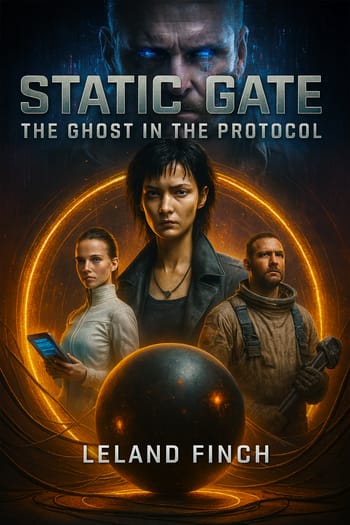
The Janus Core is the heart of the Morpheus Protocol, the artifact that holds the world’s broken code. It is a perfect, two-meter sphere of matte black material that absorbs all light, appearing inert to most observers. To those with dual perception, however, it is overlaid with a second, ghost sphere of chaotic, shimmering light—the raw energy of the Echo. The artifact’s function is to regulate the perceptual barrier between worlds, and its ongoing decay is the source of the Static Unraveling. It is the ultimate reboot switch, but activating it requires two keys: one physical, representing the Grid’s logic, and one psychic, representing the Echo’s patterns. It is not a weapon but a choice, an irreversible act that could either finalize the world’s amputation or heal its sundered soul. It is a dead god waiting for a command.
Phase Calibrator
The Phase Calibrator is a handheld tool of pure, verifiable logic in a world dissolving into chaos. A dense, heavy object of dulled chrome and hardened polymer, it maps the unstable psychic terrain of Bleed Zones, translating the madness of the Echo into a usable, three-dimensional wireframe model on its glowing green screen. For a technician like Silja Valis, it is a trusted instrument, a symbol of her belief in quantifiable, solvable problems. It allows her to identify stable paths through otherwise impassable territory, a beacon of reason in an irrational world. Its great limitation is that it is a tool of logic trying to measure a system that does not obey it. In the deepest parts of the Echo, its signal falters, a perfect representation of the Grid’s fundamental failure to comprehend its other half.
Psychic Resonator
The Psychic Resonator is a tool of weaponized paradox, a Board-developed neural implant that forces a direct, painful link to the Echo. It is the Board's attempt to fight fire with fire, creating a soldier who can perceive the other realm. But the Resonator does not grant spiritual insight; it translates the Echo’s chaotic nature into a stream of processable data, turning a psychic wilderness into a schematic of hostile energy signatures. For the user, it is a state of managed agony, a constant low-grade static at the edge of awareness that requires a steady dose of chemical stabilizers to prevent total sensory failure. It is a leash and a weapon in one, a device that allows its user to touch the soul of the world without having one of their own. It is the ultimate expression of the Board’s philosophy: to understand something only so you can control and destroy it.