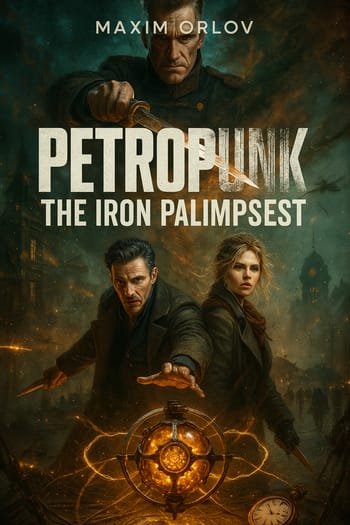
He was in a shielded chamber deep beneath the turbine hall. The sounds of the battle were a dull, rhythmic concussion, a distant heartbeat felt through the soles of his boots. He knelt on the cold stone floor. The Heart of the Artisan was a heavy, solid weight in his hands. It was warm, a living warmth that pulsed against his palms. A slow, steady beat. One pulse per second. It was the only clock left in his world.
He held the cure. But the patient was dead. The rage that had carried him here had burned out, leaving only the cold, sterile void he had once mistaken for peace. It was not peace. It was a vacuum. An absence of everything. Lilya was gone. Morozov was gone. The watch was broken. These were facts. The Heart was a failure. That was a fact. He had won nothing.
The artifact in his hands seemed to sense the void. It responded to the vacuum of his grief. The slow, steady pulse quickened. The soft glow intensified, the light pressing against his closed eyelids. It offered him a new purpose. Not a cure. A weapon. It showed him a possibility, a path forward written in the language of erasure.
He saw Captain Valerius Wolff in a distant command post, his uniform immaculate, his face a mask of cold satisfaction. The Heart showed Sineus how to unwrite him. Not to kill him. To erase him. The memory of the room would forget him. The polished wood of his desk would remember being a tree. The steel of his chair would remember being iron ore, buried in the dark earth. The man himself would simply cease to have been. A clean, surgical excision.
The temptation was a clean, cold fire. He could do it. He could unmake them all. The Heart showed him more. Sergeant Gregor Stahl, his face of scarred granite dissolving into a mist of forgotten moments. The entire Ordo Umbrarum headquarters, its black iron sigil of a two-headed eagle rusting into dust in a single second. The records turning to blank paper. The men forgetting their orders, their names, their cause. A perfect, silent victory.
A faint, ugly sound returned to his perception. A phantom echo in the silence of his mind. The dry, frantic ticking of a watch made of ice. The Ticker’s Rattle. The sound of unmaking. It grew louder with each imagined erasure. He could erase the memory of the battle itself, the screams and the cordite fading into a quiet Tuesday afternoon. He could erase the memory of Morozov’s murder, the stain on the concrete becoming simple discoloration. He could go further. He could reach into his own mind and excise the memory of his own grief. The void would be filled. He would be whole again. He would be clean. The price was nothing. Just a little more forgetting.
He saw the act. The final, perfect erasure of his own pain. And he recognized the texture of it. It was the same pressurized silence that had filled the cafe. The same psychic cold that had frosted Lilya’s soul. It was the same brutal, efficient logic the Imperial Censorium had used to unwrite a whole neighborhood, leaving the festering wound of the Iron Palimpsest in its place. He would be using the disease as the cure.
He would become Wolff. He would become the Censorium. He would become the faceless, merciless power that had taken everything from him. The method was the same. Only the target had changed. The rage was gone, but the arrogance that had built the Chronal Purifier remained. The belief that he could fix the world by cutting away the parts he did not like.
The phantom rattle in his head faltered. The cold fire of vengeance cooled, replaced by a different kind of cold. The cold of absolute clarity. He heard a voice. Not a ghost. Not a whisper from the plague. A memory. His memory. The one the Archivist had not taken.
Lilya’s face, earnest and frustrated across the polished wood of their dining table. Her hand resting on the simple silver locket at her throat.
— Some things are worth more than a single life, — her memory said. — Some debts can’t be paid with machines.
The words were a physical anchor in the psychic storm. A truth he had dismissed as sentiment, now the only principle left standing in the wreckage of his world. He had tried to pay the debt of his love with a machine. He had failed. Now the Heart offered to let him pay the debt of his grief with another machine. A machine of erasure. It was the same sin, repeated on a grander scale.
He opened his eyes. He looked down at the Heart of the Artisan. Its surface was like polished obsidian, a dark mirror reflecting the pulsing light. He saw his own face, hollow-cheeked and gaunt, his eyes wide with a terrible, hungry light. The face of a man who would unwrite the world to soothe his own pain. The face of a monster.
He saw other faces in the reflection, layered over his own like ghosts. His father’s, stern and disappointed. Dr. Morozov’s, his expression not of anger, but of a deep, weary sadness. Anja’s, her tough, cynical mask broken by a look of horrified pity. This was the man he would become in their eyes. This was the memory he would leave behind.
He had a choice. A final one. He could become that man in the reflection. He could accept the sterile peace of erasure, at the cost of his own soul. Or he could accept the pain. He could accept the loss of Lilya, the loss of Morozov, the loss of Anja. He could let their memories be a burden. A debt that could never be paid, only carried.
He made the choice.
He relaxed his grip. He did not drop the Heart. He simply stopped wanting what it offered. He pushed back against the torrent of power, not with a machine, but with a simple, silent refusal. He chose to remember. He chose the pain.
The effect was immediate. The violent, hungry pulse of the artifact softened. The intense light dimmed. The low, threatening hum resolved into a clean, quiet tone, the sound of a perfectly balanced gear train. The phantom Ticker’s Rattle in his head was gone, replaced by the profound silence of his own decision.
He was left alone in the quiet chamber, the battle outside a distant rumor. He held the Heart, its power now calm, neutral, waiting. He had rejected the path of selfish erasure. He had chosen to carry the weight of his dead.
But the artifact was still a bomb. Wolff was still out there. The overload cascade was still in motion. He could not use it. He could not abandon it. He could not let them have it.